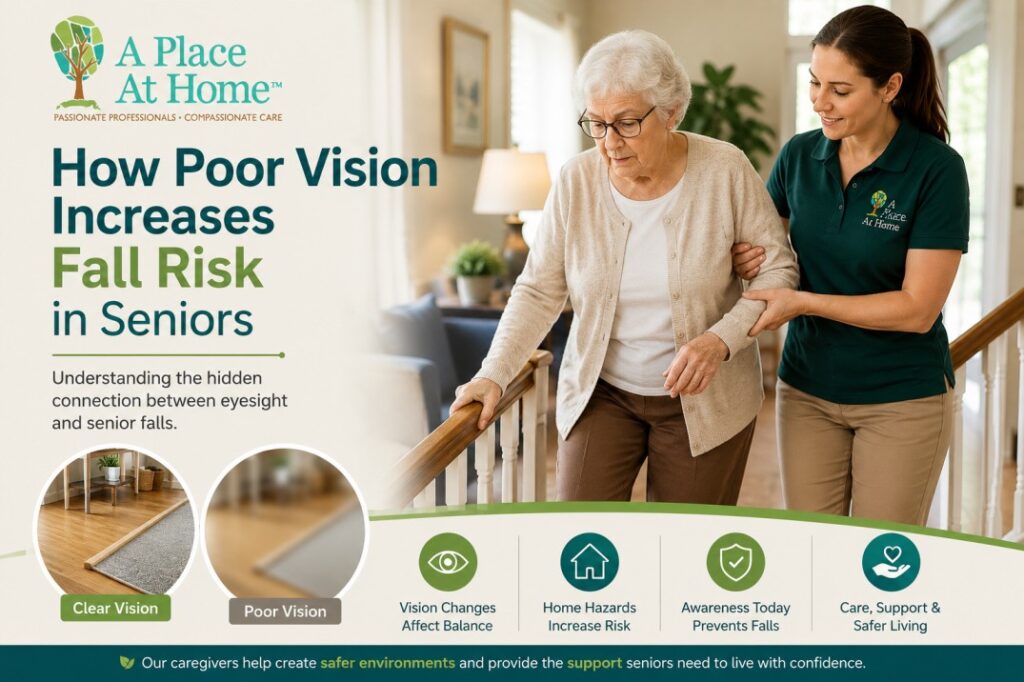
Accidents, in the form of falls are the most frequent cause of injury in the elderly in the United States – and poor vision is the most common risk factor that family members repeatedly fail to acknowledge.
This guide tells families how, exactly, poor vision contributes to falls in seniors-which specific eye conditions pose the biggest risks, why the home environment exacerbates the risk, and how families can act right now to protect their loved ones. The evidence is undeniable. Most falls are preventable. And the sooner families act-the greater the potential outcome.
The Connection Between Vision and Falls — What the Research Actually Says
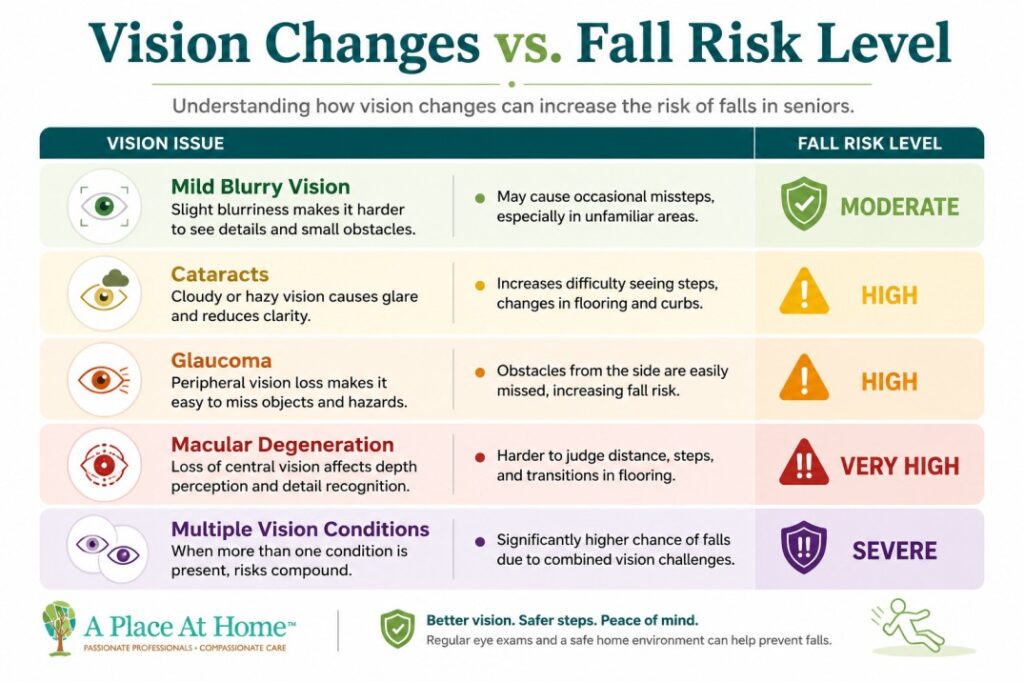
According to a breakthrough study published in JAMA Ophthalmology and reviewed by Harvard Health — researchers followed 575,000 older adults over four years and found that:
- 30% who suffered from cataracts were responsible for falling, compared to 14% with no cataracts.
- 37% suffering from AMD reported falling compared to 21% in controls.
- 25% suffering from glaucoma were responsible for falling compared to 13% of controls.
A senior with macular deterioration is nearly twice as likely to fall as a senior with healthy vision. And a senior with falls is more than twice as likely.
And according to a study published in the National Library of Medicine, vision loss is associated with double the odds of falls, multiple falls and fractures.
The last study, presented in 2025 by researchers at the Massachusetts Eye and Ear Infirmary at Harvard Medical School in JMIR Aging, revealed that having any near and far vision loss, including glaucoma, significantly increase the fall risk in the elderly.
This is not an insubstantial risk factor. This is among the largest risk factors of falls in the elderly today, supported by considerable evidence.
Vision and Falls in Arkansas
The national statistics are alarming. But for families right here in Little Rock and across Arkansas — the picture is even more concerning.
According to the Arkansas Department of Health, falls are a leading cause of injury-related emergency room visits among older adults in Arkansas. The state has a significant and growing senior population — with adults aged 65 and older representing a fast-growing segment of Pulaski County’s community.
Arkansas also has higher-than-average rates of chronic conditions like diabetes and hypertension — both of which are associated with diabetic retinopathy and increased vision-related fall risk. And with Arkansas ranking among states with lower rates of routine preventive healthcare visits — vision problems in seniors are frequently undetected until they have already contributed to a fall.
For Little Rock families — this makes proactive vision care and fall prevention support not just important — but urgent.
Why Does Poor Vision Cause Falls?
It is perhaps beneficial to understand first what exactly the visual system does in order to move without harm, to understand why vision is such an important part of fall risk.
Walking through a room safely requires far more than just keen-seeing visibly. The brain is repeatedly processing visible info to judge spaces, sense changes in floor begin, clarify observes and lights shifts, identify difficulties, and organize progress with spatial consciousness.
When vision is impaired — any part of that process breaks down. And when it breaks down — falls happen.
Here are the specific visual mechanisms most closely linked to fall risk in seniors:
Contrast Sensitivity — The Most Overlooked Risk Factor
Most families focus on visual acuity — the 20/20 number from an eye chart. But researchers have identified contrast sensitivity as an even more important predictor of fall risk.
According to research published in the Journal of the American Geriatrics Society, contrast sensitivity impairment was associated with a higher prevalence of recurrent falls — even independent of visual acuity. In other words — a senior can accept a usual vision test with flying affects and still have a drastically elevated fall risk as of poor compare sensitivity.
What is contrast sensitivity? It is the ability to recognize between stuff and their backgrounds — especially in low light or when the difference in color and brightness is subtle. Think about the edge of a curb against a gray sidewalk. A step at the bottom of a stair that is the same color as the floor. A glass on a white tablecloth. A doorstep in the evening light.
A senior with poor contrast sensitivity cannot consistently perceive these subtle differences — and they trip on them. Over and over again. Often without ever understanding why.
Depth Perception
Depth perception — the ability to judge the distance between yourself and objects around you — depends heavily on having two eyes working together effectively. As vision deteriorates with age depth perception often suffers significantly.
For a senior navigating stairs, stepping off a curb, or moving between rooms with different floor heights — poor depth perception is genuinely dangerous. They misjudge where the step is. They think the floor is closer than it is. They reach for a surface and miss.
The consequences happen in a fraction of a second.
Peripheral Vision
The ability to see what is happening at the edges of your visual field — without turning your head — is critical for safe movement. Peripheral vision is what catches the chair leg you are about to walk into. The cat sleeping on the floor. The grandchild’s toy in the hallway.
Glaucoma — one of the most common eye conditions in seniors — specifically and progressively destroys peripheral vision. According to AARP, the brain actually compensates for peripheral vision loss by filling in what is missing — which means a senior with early-stage glaucoma may not even realize their peripheral vision is gone. Until they trip over something they did not see.
Light and Dark Adaptation
The ability to adjust quickly when moving from a bright area to a dim one — or vice versa — slows significantly with age. For most younger adults this transition happens in seconds. For a 75-year-old — it can take significantly longer.
Think about what happens when a senior gets up from a bright living room to use the bathroom at night. Or steps from a sunny porch into a darker hallway. Their visual system is temporarily unable to process what is in front of them — and that momentary blindness is when falls happen.
According to research published in JAMA Ophthalmology and reported by the Oncology Nursing Society, home hazards combined with poor vision create compounding risks — particularly in low-light conditions where contrast sensitivity and light adaptation are most challenged.
Visual Acuity — Seeing Clearly at Distance and Near
While contrast sensitivity may be more predictive of falls — straightforward visual acuity still matters enormously. A senior who cannot clearly see where they are going simply cannot safely navigate their environment.
The JMIR Aging study from Harvard Medical School confirmed that both distance and near vision impairment are independently associated with higher fall risk. Near vision problems affect the ability to safely navigate steps, read medication labels accurately, and detect floor hazards at the feet. Distance vision problems affect the ability to judge spatial relationships — how far away walls, furniture, and people are — which directly impacts safe movement through any environment.
How Poor Vision and Home Hazards Combine to Create Dangerous Falls
Here is something the latest research makes very clear — it is not just the vision problem itself that causes falls. It is the interaction between vision problems and the home environment.
According to a study published in the December 2025 issue of JAMA Ophthalmology and reported by the Oncology Nursing Society, home environmental hazards — such as lack of grab bars in the bathroom — are associated with a greater risk of falls specifically among older adults with poor vision.
The researchers assessed 4,648 community-dwelling Medicare beneficiaries and found a clear interaction between visual function and home hazards. Poor vision amplifies the danger of every hazard in the home.
The hazards that become most dangerous with poor vision include:
Poor lighting Dim hallways, dark staircases, and inadequate bathroom lighting become genuinely treacherous when contrast sensitivity is reduced. What a senior with good vision navigates safely becomes a significant fall risk when vision is impaired.
Stairs and steps Steps with poor contrast between the tread and riser — especially carpeted stairs or steps that are all the same color — become nearly invisible to a senior with poor contrast sensitivity or depth perception problems.
Rugs and floor transitions A throw rug on a hardwood floor. A transition strip between rooms. A change from carpet to tile. These subtle floor-level changes are routinely missed by seniors with visual impairment — and they cause trips and falls constantly.
Cluttered pathways Objects on the floor — shoes, pet bowls, electrical cords, bags — that a sighted person navigates around automatically become invisible hazards for a senior with peripheral vision loss or poor contrast sensitivity.
Bathroom hazards The bathroom is the highest-risk room in the home for falls in seniors — and poor vision makes every bathroom hazard more dangerous. A wet floor that is hard to detect. A toilet that blends with the surrounding tile. A shower entry with no visual contrast marking.
Warning Signs of Vision Problems in Seniors
Many seniors do not recognize — or do not report — the gradual decline in their vision. The changes happen slowly. The brain compensates. And many older adults are too proud or too worried about losing their independence to admit that their vision is failing.
| Behavioral Changes | Safety Risks |
|---|---|
| Squinting frequently | Missing steps or curbs |
| Holding items too close | Bumping into furniture |
| Avoiding nighttime outings | Increased fear of falling |
| Walking slower than normal | Loss of confidence and balance |
| Difficulty recognizing faces | Navigation challenges |
Here are the warning signs families should watch for:
Behavioral changes:
- Holding reading material much closer or further away than usual
- Squinting frequently or tilting the head to see better
- Turning up the brightness on the television significantly
- Having difficulty recognizing familiar faces in photos
- Stopping hobbies that require detailed vision — sewing, reading, puzzles
- Reluctance to go out at night or in dim conditions
- Moving more slowly and cautiously than usual — particularly on stairs
Safety-related changes:
- Bumping into furniture or doorframes regularly
- Misjudging the height of steps or curbs
- Reaching for objects and missing by several inches
- Spilling drinks or knocking things over frequently
- Difficulty navigating unfamiliar environments
- Near-miss incidents on stairs or in the bathroom
Medical or reported symptoms:
- Complaining that lights seem too bright or glare is bothersome
- Reporting that straight lines appear wavy or distorted
- Noticing a dark spot or blur in the center of their vision
- Complaining that colors seem washed out or faded
- Reporting halos around lights at night
- Describing their vision as foggy or cloudy
If you have noticed several of these signs in a loved one — an eye examination is not optional. It is urgent.
What Families Can Do — An 8-Step Practical Action Plan
The good news is significant. Most of these vision conditions are either treatable or manageable. And the falls they cause are largely preventable — when families take the right steps.
Step 1 — Schedule a Comprehensive Eye Exam Immediately
This is the single most important step — and it needs to happen regardless of when your loved one last had their eyes checked.
According to Caring Senior Service, regular eye exams are essential for detecting and treating vision problems early. Eye doctors can test depth perception, peripheral vision, and visual clarity — and screen specifically for cataracts, glaucoma, and macular degeneration.
Seniors with existing eye conditions may need exams every six months rather than annually. Do not wait for obvious symptoms — because with conditions like glaucoma, obvious symptoms often mean irreversible damage has already occurred.
What to ask the eye doctor:
- Does my loved one have any conditions that increase fall risk?
- Is their current eyeglass prescription up to date?
- Do they have contrast sensitivity issues?
- Are there low-vision aids that could help?
- Should we schedule more frequent follow-up visits?
Step 2 — Ensure the Prescription Is Current
An outdated glasses prescription is one of the most common and most easily fixed contributors to fall risk in seniors. A prescription that is even one or two years old may no longer adequately correct vision — leaving seniors navigating with less clarity than they should have.
Beyond simple updates — the type of lens matters too. Bifocals and progressive lenses — while excellent for reading — can distort depth perception when looking down at stairs or the floor. Some seniors do better with separate reading and distance glasses. Discuss this specifically with their eye care provider in the context of fall risk.
Step 3 — Address Treatable Conditions Without Delay
If your loved one has cataracts significant enough to affect their daily function — pursue cataract surgery. The research is very clear that cataract surgery reduces fall risk meaningfully alongside improving vision. Delaying surgery means extended fall risk exposure.
If glaucoma has been diagnosed — ensure treatment is being followed consistently. Glaucoma eye drops are only effective when used exactly as prescribed. Missed doses allow pressure to fluctuate — and vision loss to progress.
If AMD is present — explore all available treatment options with their ophthalmologist. For wet AMD, anti-VEGF injections can slow or stop vision loss when started early. For dry AMD, certain nutritional supplements have been shown to slow progression.
Step 4 — Improve Home Lighting Immediately
Lighting is the fastest and most impactful home modification for reducing fall risk in seniors with vision impairment — and it costs very little.
According to Caring Senior Service, improving home lighting can make a significant difference in preventing falls. Practical steps include:
- Installing bright LED bulbs in all high-traffic areas — particularly hallways, staircases, and bathrooms
- Adding motion-activated night lights in hallways between the bedroom and bathroom — the most common nighttime fall location
- Installing task lighting in the kitchen for food preparation
- Using illuminated light switches so switches are visible in the dark
- Ensuring transitions between rooms are well lit — particularly where flooring changes
The goal is to eliminate the low-light moments where contrast sensitivity and adaptation speed are most challenged.
Step 5 — Reduce Home Hazards That Vision Problems Amplify
Every home hazard becomes more dangerous when vision is impaired. A targeted home safety assessment should address:
Stairs and steps:
- Apply high-contrast colored tape or non-slip strips to the edge of each step
- Ensure handrails are present and secure on both sides of every staircase
- Mark the top and bottom steps with a different color or texture
Flooring:
- Remove or secure all throw rugs — one of the most common fall causes in seniors with vision problems
- Ensure floor transitions between rooms are clearly marked or eliminated
- Address any raised thresholds that can catch a dragging foot
Bathroom:
- Install grab bars in the shower, beside the toilet, and along the bathtub
- Use contrasting colors for bath mats, toilet seat covers, and towels so they are visually distinct from surrounding surfaces
- Consider a raised toilet seat with handles — making the transition safer
General home:
- Clear all pathways of clutter — shoes, pet items, electrical cords, decorative objects
- Ensure furniture arrangement creates wide clear pathways through every room
- Consider furniture with rounded corners — less injury if contact does occur
Step 6 — Explore Low-Vision Aids
For seniors whose vision cannot be fully corrected — low-vision aids can meaningfully improve function and reduce fall risk. These include:
- Magnifying glasses and lenses for reading and close work
- High-contrast tableware — plates, cups, and utensils that contrast with the surface they sit on
- Large-print materials for reading
- Talking devices — clocks, medication organizers, and appliances that announce the time or provide audio cues
- White cane for seniors with significant peripheral vision loss — providing tactile feedback about the environment ahead
An occupational therapist specializing in low vision can assess your loved one’s specific needs and recommend the most appropriate aids.
Step 7 — Consider Balance and Strength Training
According to the University of Michigan researchers, preventive measures like exercises to improve strength and balance may be especially helpful for enhancing the safety of older Americans with visual difficulty.
When vision cannot compensate fully for spatial navigation — the body’s other balance systems need to work harder. Regular balance and strength exercises — including tai chi, yoga, and targeted physical therapy — build the physical reserve needed to recover from near-miss stumbles that would otherwise result in falls.
Speak with their doctor about a referral to a physical therapist for a fall-risk-specific balance assessment and exercise program.
Step 8 — Ensure Consistent Daily Caregiver Support
For seniors with significant vision impairment — having a consistent trained caregiver present during the highest-risk daily activities can be the difference between a near-miss and a serious fall.
The highest-risk moments for seniors with vision problems are:
- Getting up from bed at night to use the bathroom
- Navigating stairs without full lighting
- Moving between areas with different lighting levels
- Bathing and transferring in and out of the shower or tub
- Stepping outside where lighting and surface conditions are unpredictable
A professional home caregiver who understands the specific vision challenges your loved one faces — and who is present during these high-risk moments — provides both physical support and environmental awareness that directly reduces fall risk.
Eye Care Resources for Seniors in Little Rock, AR
If your loved one needs a comprehensive eye exam — here are local resources serving the Little Rock and central Arkansas area:
University of Arkansas for Medical Sciences — Department of Ophthalmology UAMS provides comprehensive eye care services for seniors throughout the Little Rock area — including screening and treatment for cataracts, glaucoma, and macular degeneration.
Arkansas Eye Care A well-established ophthalmology practice serving Little Rock and surrounding communities — offering comprehensive eye exams, cataract surgery consultations, and glaucoma management.
Baptist Health Eye Care — Little Rock Baptist Health provides comprehensive eye care services throughout central Arkansas — including diabetic eye care and low-vision services for seniors.
Arkansas Blue Cross — Vision Benefits Many Arkansas seniors have vision benefits through Medicare Advantage or supplemental insurance. Contact your provider to understand coverage for comprehensive eye exams and treatment.
How a Home Caregiver Reduces Fall Risk for Seniors With Vision Problems
At A Place at Home- Little Rock, our in home caregiver are trained to recognize and respond to the specific fall risks associated with vision impairment. Here is what that looks like in practice every single day:
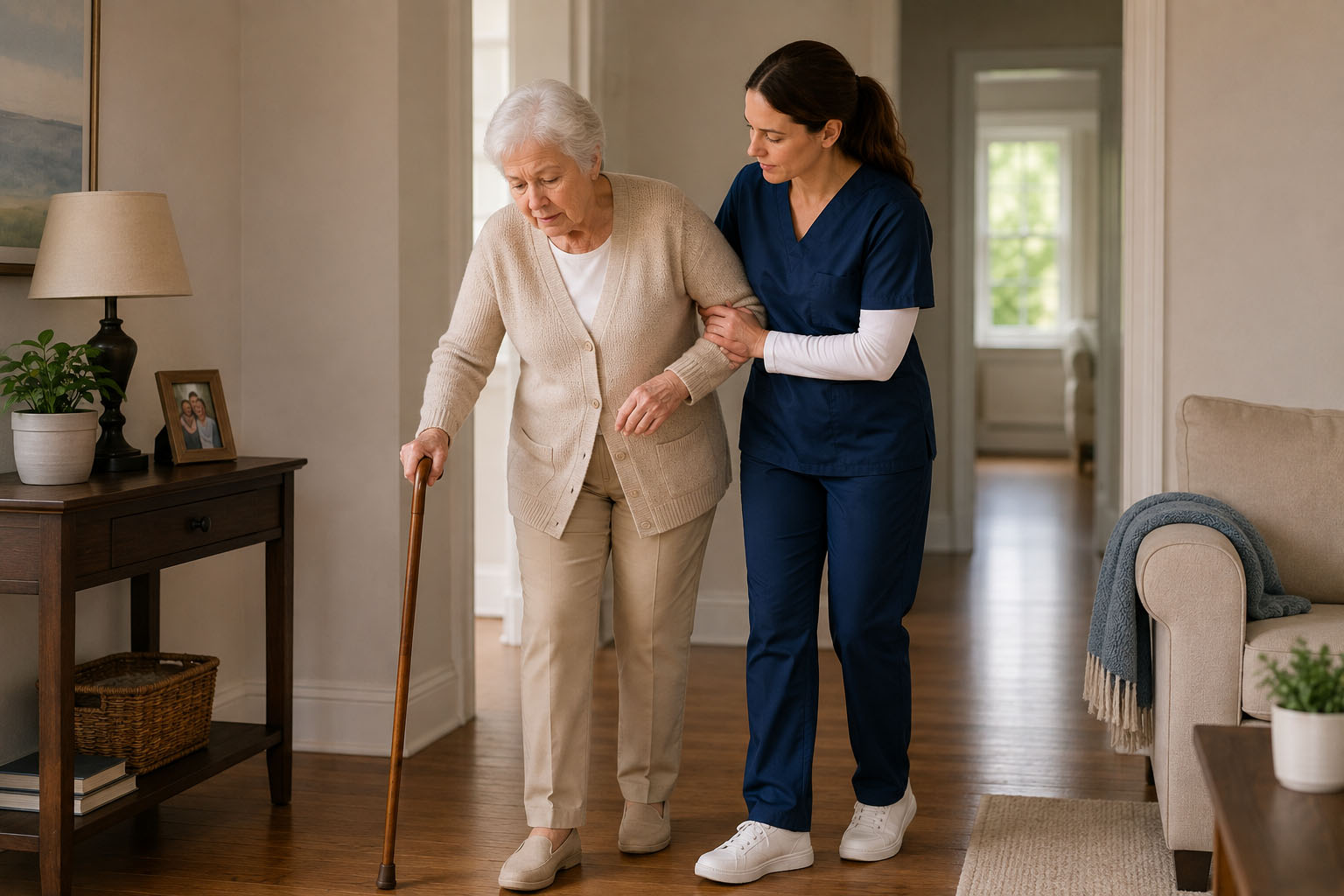
Safe mobility guidance and physical support Our caregivers provide steady confident assistance during the highest-risk transfer and mobility moments — getting in and out of bed, navigating stairs, moving in and out of the shower, and transitioning between rooms. They do not rush. They anticipate the specific visual challenges their client faces and adjust their support accordingly.
Home safety monitoring Our caregivers are the eyes — in the fullest sense — for seniors whose own vision is failing. They notice the throw rug that has shifted. The item is left on the floor. The light bulb that has burned out. The bathroom mat that is no longer gripping the floor. And they address these hazards before they cause a fall.
Lighting management throughout the day Ensuring appropriate lighting is in place before a senior moves from one area to another is a simple but highly effective fall-prevention practice. Our caregivers manage lighting proactively — never letting their client navigate a dim or poorly lit space.
Accompanying to all vision-related appointments Regular eye examinations are critical for seniors with vision problems — and our caregivers ensure those appointments happen. Transportation to ophthalmologist visits, follow-up treatments for glaucoma or AMD, and cataract surgery consultations — all arranged and accompanied.
Family communication and reporting Our caregivers notice subtle changes — when a senior is bumping into things more frequently, when they seem less confident navigating familiar spaces, when they mention that things look blurry or different. These observations are reported to family members promptly — because early detection of vision changes is one of the most effective fall-prevention strategies available.
If your loved one has vision challenges — and you want consistent professional support to keep them safe at home — we are here.