
What Are the Signs of Vitamin D Deficiency in the Elderly?
Vitamin D is one of the most critical nutrients for healthy aging, yet it is also one of
When a family member is living with Parkinson’s disease, the day-to-day realities pile up fast. Getting dressed takes twice as long. Meals become a safety concern. The fear of a fall is always in the back of your mind. At A Place At Home-Eatontown, we provide in-home Parkinson’s care where our caregivers are trained specifically for the condition and every plan is written around your loved one’s current symptoms, daily schedule, and home environment.
We serve families throughout Eatontown and the surrounding Monmouth County communities, including Red Bank, Tinton Falls, Shrewsbury, Middletown, and Atlantic Highlands.

Parkinson’s is a progressive neurological condition, which means the support someone needs today is not the same as what they will need in six months. The symptoms that start as a mild tremor or slight stiffness gradually affect movement, balance, speech, swallowing, memory, and sleep.
For many Monmouth County families, the tipping point comes when a loved one has a fall, starts missing medications, or begins struggling with basic personal care. At that stage, trying to manage everything as a family without outside help is not just exhausting, it is also a safety risk.
In-home care does not slow the disease, but it meaningfully changes the experience of living with it. Seniors who receive consistent, knowledgeable support at home maintain their independence longer, experience fewer hospitalizations, and report a better quality of life than those who struggle through the day without it.
Parkinson’s affects everyone differently, and care should reflect that. Someone in the early stages might need a caregiver a few mornings a week to help with bathing, breakfast, and staying on top of medications. Someone further along may need support around the clock, with transfers, meals, and the more complex challenges that come with advanced symptoms. We have worked with both, and everything in between.
Help with bathing, dressing, grooming, toileting, and meals. For someone with Parkinson’s, something as simple as buttoning a shirt or managing utensils at the table can become a real obstacle. Our caregivers assist without rushing, and always with respect for the person’s dignity.
Isolation worsens both physical and emotional outcomes for people with Parkinson’s. Our caregivers spend real time with clients, having conversations, playing games, going for walks when possible, and keeping them connected to the routines that matter to them.
Helping someone with Parkinson’s move safely through their home requires both technique and attentiveness. Our caregivers know how to assist with walking, standing from a seated position, and transferring between surfaces in ways that protect the client and reduce fall risk.
Parkinson’s medications need to be taken at specific intervals to manage symptoms effectively. Missing a dose or taking one at the wrong time can noticeably affect how a person feels and moves for the rest of the day. We make sure that does not happen.
Falls are the leading cause of injury-related hospitalization for seniors with Parkinson’s in New Jersey. We identify hazards in the home, provide steady physical support during movement, and monitor for changes that may signal an increased fall risk.
Rides to neurologist appointments, physical therapy, or the Eatontown Senior Center, along with help with grocery runs and pharmacy pickups at local spots like the CVS, Dollar Tree or Target.
Many Parkinson’s symptoms worsen at night. Restless sleep, vivid dreams, the need to use the bathroom multiple times, and difficulty getting back into bed are all common. Overnight caregivers provide safety and comfort through those hours.
Scheduled breaks for family caregivers in Monmouth County who need time to rest, work, or manage their own lives while knowing their loved one is being well cared for.
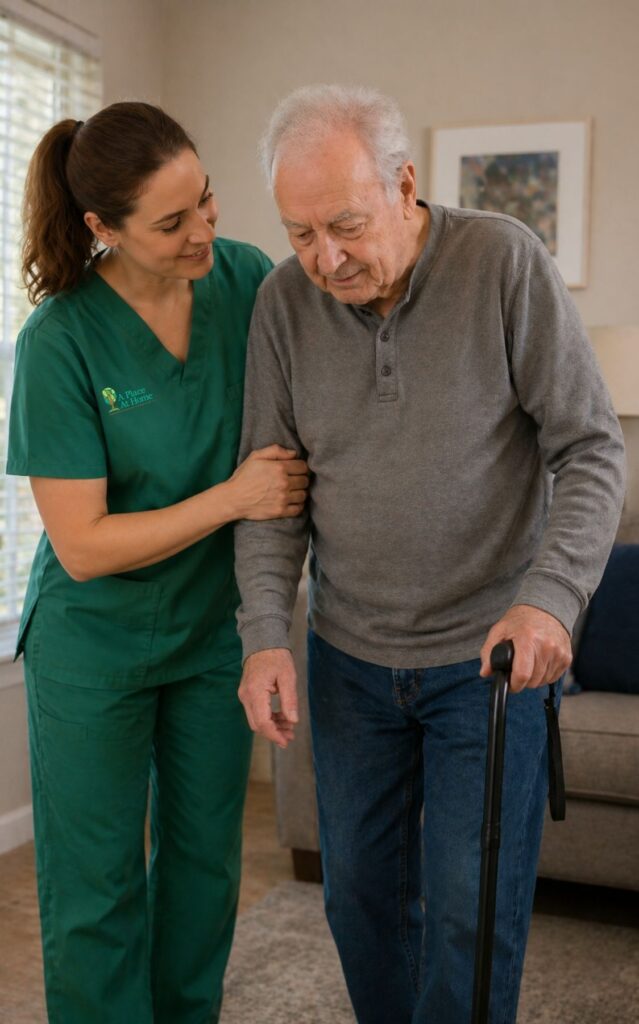
Parkinson’s requires more than general home care skills. Our caregivers complete training through the Parkinson’s Foundation and the Home Care Association of America, which covers how the disease progresses across each stage, the difference between motor symptoms like tremors and rigidity and non-motor symptoms like sleep disruption and cognitive changes, and safe movement and transfer techniques that reduce fall risk. They are also trained in dysphagia awareness, so they can recognize and respond appropriately when a client is having difficulty chewing or swallowing safely.
Beyond initial training, our caregivers stay current through ongoing education in dementia care and neurological conditions, which matters because Parkinson’s and cognitive decline frequently overlap in later stages.
We also prioritize caregiver consistency. For someone with Parkinson’s, a familiar face is not just a comfort, it is part of how care works. Established routines reduce anxiety, make daily tasks smoother, and mean the caregiver already knows what a good day looks like versus a day when something is off. Where possible, we assign the same caregiver to the same client long term so that relationship has room to develop.
If your family is at the point where you know more help is needed, we want to make the next step easy. We offer a free, no-obligation in-home consultation where we come to you, learn about your loved one’s current situation, and build a care plan that reflects what is actually happening in your home.
Call A Place At Home in Eatontown at (732) 702-5710 to schedule your consultation. We can usually begin care within a few days of that first conversation.
We review care plans regularly and update them when needs change. You can also call us anytime if something shifts between scheduled reviews. We increase hours, add overnight support, or transition to live-in care based on what the situation requires.
The 5-2-1 rule is a medication timing guideline for levodopa, the most common Parkinson’s treatment. It recommends at least 5 hours between the last dose and bedtime, 2 hours between daytime doses, and taking medication 1 hour before or after meals since protein can interfere with absorption. For families in Eatontown managing Parkinson’s at home, this timing matters because an off-schedule dose can noticeably worsen tremors, stiffness, and mobility within hours. Our caregivers stay mindful of these intervals and work alongside each client’s care team to keep medications on track.
Medicare does not cover ongoing in-home personal care for Parkinson’s. It will pay for short-term skilled nursing or therapy visits when a doctor orders them and the patient is homebound, but once that skilled need ends, coverage stops. Day-to-day help with bathing, dressing, meals, and mobility is not covered.
Yes. Many of our Eatontown clients receive PT or OT through providers connected to Riverview Medical Center or Monmouth Medical Center. Our caregivers coordinate with those therapists, reinforce exercises and techniques recommended during sessions, and report any changes in mobility or function back to the family.


A Place At Home Eatontown’s customizable non-medical services make the lives of seniors and their families even better. Learn more about the CARE programs available to seniors in Eatontown, Little Silver, Red Bank, and Long Branch when you reach out today.