
El Niño is strengthening heading into fall and winter 2026–27. Here is a practical preparedness checklist for families of seniors and adults with disabilities in Summerlin and the Las Vegas Valley.
Continue reading
El Niño is strengthening heading into fall and winter 2026–27. Here is a practical preparedness checklist for families of seniors and adults with disabilities in Summerlin and the Las Vegas Valley.
Continue reading

Choosing a dementia caregiver is about more than availability. Families should ask about caregiver training, experience with Alzheimer’s and other forms of dementia, emergency procedures, communication, care planning, and how the agency matches caregivers with clients. Asking the right questions can help your loved one receive safe, compassionate, and consistent care.
Dementia affects more than memory. Depending on the type and stage of dementia, a person may experience difficulty with judgment, communication, mobility, personal hygiene, eating, medication routines, or recognizing familiar people and surroundings.
A caregiver who does not understand dementia may unintentionally increase frustration by arguing, correcting, rushing, or asking too many questions. An experienced dementia caregiver knows how to slow down, offer reassurance, redirect attention, and adapt daily activities to the person’s abilities.
Professional in-home dementia care may help a senior remain in familiar surroundings while receiving assistance with daily routines, companionship, personal care, meal preparation, safety monitoring, and respite for family caregivers.
Here are 15 important questions to ask before deciding.
General senior care experience is helpful, but dementia care requires additional patience, awareness, and communication skills.
Ask whether the caregiver has supported people with:
You can also describe your loved one’s current challenges and ask the caregiver to explain how they would provide support.
For example:
“My mother becomes anxious in the evening and sometimes believes she needs to leave the house. How would you respond?”
A strong answer should focus on remaining calm, identifying possible triggers, reassuring the person, redirecting their attention, and protecting their safety rather than arguing with them.
Ask what dementia training the caregiver has completed and whether that training is updated regularly.
Training may cover:
Avoid relying only on statements such as “I am good with seniors.” Ask for specific examples of what the caregiver learned and how those techniques are used during a typical visit.
A person with dementia may repeat the same question, accuse someone of taking an item, resist bathing, or become upset when a routine changes. Ask the caregiver how they handle these situations.
A dementia-informed caregiver should avoid:
Instead, the caregiver should use a calm voice, acknowledge the person’s feelings, simplify choices, redirect attention, and look for unmet needs such as hunger, pain, fatigue, fear, or overstimulation.
Consistency can help reduce confusion and anxiety for someone living with dementia. Ask how the caregiver will learn about your loved one’s:
Good dementia care should be personalized. The caregiver should learn who the person is, not simply what diagnosis they have.
Dementia may eventually make bathing, dressing, grooming, toileting, and oral hygiene difficult. Ask whether the caregiver can safely and respectfully assist with:
Also ask how the caregiver protects dignity when a senior refuses or becomes embarrassed by personal care. The caregiver should explain each step, preserve privacy, offer simple choices, and allow additional time rather than rushing.
Wandering can happen at different stages of dementia and may create serious safety risks. A person may leave home because they believe they need to go to work, find a family member, or return to a previous residence.
Ask the caregiver:
The caregiver should never depend only on locked doors. Effective support also includes meaningful activities, regular movement, bathroom access, hydration, reassurance, and awareness of the person’s usual behavior.
Nonmedical caregivers typically provide medication reminders rather than administering medications. Ask the agency to explain exactly what its caregivers are permitted to do under Nevada requirements and company policy.
Depending on the care plan, a caregiver may be able to:
Make sure the caregiver understands whom to contact when medication is missed, refused, or appears to cause a concerning reaction.
Dementia can affect appetite, food recognition, swallowing, coordination, and the ability to prepare meals safely.
Ask whether the caregiver can help with:
The caregiver should know that sudden changes in eating, drinking, or swallowing should be reported promptly to the family and appropriate healthcare professional.
Dementia care should involve more than sitting nearby or watching television.
Ask how the caregiver will provide meaningful, ability-appropriate engagement.
Activities may include:
Dementia can affect appetite, food recognition, swallowing, coordination, and the ability to prepare meals safely.
Ask whether the caregiver can help with:
The caregiver should know that sudden changes in eating, drinking, or swallowing should be reported promptly to the family and appropriate healthcare professional.
Caregivers often notice small changes because they spend time with the senior in their everyday environment.
Ask how the caregiver documents and reports changes such as:
Caregivers should not diagnose medical problems, but they should recognize and promptly communicate meaningful changes.
When hiring a caregiver privately, the family may be responsible for screening, employment verification, payroll, scheduling, supervision, and backup coverage.
When working with an in-home care agency, ask whether it handles:
Ask for clear explanations rather than assuming every home care company follows the same procedures.
Dementia care often depends on consistency, but caregivers can become sick, take time off, or face emergencies.
Ask:
An agency with an established caregiver team may be able to coordinate replacement coverage more easily than a family relying on one independently hired caregiver.
Families need regular information, particularly when adult children live outside Summerlin or elsewhere in the Las Vegas Valley. Ask how communication will be handled.
Updates may include:
Designate a primary family contact whenever possible. This helps prevent conflicting instructions and ensures important information reaches the right person.
A person who currently needs a few hours of companionship may later require daily personal care, overnight supervision, or continuous support.
Ask whether the provider offers:
Choosing an agency that can adjust the schedule may help the family maintain greater continuity as needs change.
Before services begin, the agency should learn about the senior’s current abilities, risks, routines, home environment, and family priorities.
Ask whether the care-planning process includes:
The care plan should be reviewed as the person’s condition, preferences, or schedule changes.
Continue your search when a caregiver or agency:
Trust is important, but it should be supported by clear policies, reliable communication, appropriate training, and consistent care.
Read: Is Forgetting Names a Sign of Dementia?
Working With a Home Care Agency
An established agency may manage caregiver recruitment, screening, training, scheduling, supervision, payroll, and replacement coverage.
Before choosing an agency, ask what is included and how caregivers are matched with clients who have dementia.
It may be time to speak with a home care provider when your loved one:
Family caregiver exhaustion is also an important reason to seek help. Respite care can provide time to work, rest, attend appointments, or spend time with other family members.
A Place At Home – Summerlin provides personalized in-home senior care and dementia support for families in Summerlin and surrounding areas of the Las Vegas Valley.
Care may be available for families in communities such as:
Service availability can vary by address and caregiver scheduling. Contact the local team to confirm whether care is available in your neighborhood.
You do not have to manage every stage of dementia care alone.
A Place At Home – Summerlin works with families to create personalized care plans based on each senior’s routine, abilities, safety concerns, and preferred schedule. Support may include companionship, personal care, meal preparation, medication reminders, safety monitoring, respite care, and assistance with daily activities.
Whether your loved one needs occasional support, daily dementia care, overnight supervision, or a more consistent caregiving schedule, the first step is a conversation about what is happening at home.
Call A Place At Home – Summerlin at (702) 903-2985 to schedule a free consultation and discuss in-home dementia care for your loved one.
A Place At Home’s Summerlin location promotes personalized in-home senior care, dementia support, companion care, free assessments, and specialized Alzheimer’s and dementia care.


You know your parent needs help.
You have seen the signs. The messy kitchen. The weight loss. The bruise they waved off. The medications they missed. The house that used to be spotless and now is not.
You know something has to change.
But every time you try to bring it up — your parent shuts it down.
“I am fine. I do not need stranger coming into my house. I have been taking care of myself for 70 years.”
And the conversation ends before it really begins.
If this sounds familiar — you are not alone. This is the most common situation families in Summerlin tell us about. Not that they could not find help. But that they could not get their parent to accept it.
Before you can have this conversation well, you need to know what is really happening when your parent says no.
It is almost never that they do not realize they need help.
Most seniors know. On some level they know things are getting harder. They know the house is not what it used to be. They know they missed those pills. They know that fall last month was not nothing.
What they are really saying when they refuse is something much deeper than no.
For most older adults, independent status is not just a preference. It is individuality. It is dignity. It is the thing that separates them from being dependent and helpless. Accepting help — especially from a stranger in their own home — can feel like the beginning of the end of who they are.
Your parent loves you. They do not want you to worry. They do not want you to spend money on them. They do not want to feel like a problem that needs answering. Saying they are fine is sometimes a way of caring you — even if it is not protecting them.
Admitting they need help can feel like acknowledging that things are going in one direction and not coming back. Like a door closing. That fear is real and understandable.
Maybe they knew someone who had a caregiver they did not like. Maybe they picture someone taking over their home and indicative them what to do. Maybe the word caregiver makes them think of hospitals and drop rather than support and company.
Many seniors — especially those of a generation that did not talk openly about struggles — find the idea of a stranger in their personal space deeply uncomfortable. Their home is their sanctuary. Understanding which of these is driving your parent’s resistance is the most important first step. Because the conversation looks very different depending on the real reason.
Having this conversation without preparation is how it turns into an argument.
Do not bring this up in the middle of a stressful visit. Do not bring it up right after something went wrong — after you discovered the fall, after you found the expired medication. Doing it that way makes it feel like an accusation.
Choose a calm, unhurried time. A Sunday afternoon. A quiet coffee together. A walk if your parent is able. A moment when neither of you is tired, hungry, or already stressed.
The conversation goes wrong when it starts as a presentation of facts you have already decided. You have noticed X, Y, and Z. You have already decided they need a caregiver. You need them to agree.
That approach almost always backfires. It puts your parent on the defensive immediately. Go in instead with genuine questions. How have you been feeling lately? Is there anything that has felt harder recently? What parts of the day do you find most tiring?
Let them talk. Let them tell you. You might be surprised what they say when they do not feel like they are being assessed.
Some families think bringing everyone together — all the siblings, maybe a doctor — will be more convincing. It is usually the opposite. Most seniors experience this as an intervention. It feels like an attack. It triggers defensiveness and humiliation. One trusted person, one conversation, is almost always more effective.
Do not go into this conversation asking for a caregiver. That is too big a first step. Go in asking for something smaller.
Would you be willing to have someone come and help with meals a couple of times a week? Would you be open to someone coming with you to your appointment on Thursday? Would you let me arrange for someone to help with the house once a week?
Small asks are easier to say yes to. And one yes usually leads to another.
There is no perfect script. But here is what works.
Open with what you actually feel. Not the list of things you have noticed. Not the plan you have in mind.
Something like:
“Mom, I want to talk to you about something because I love you and I have been worried. I am not here to tell you what to do. I just want to understand how things have really been for you lately.”
That opening changes the entire tone of the conversation. It is not a confrontation. It is a connection.
There is a significant difference between these two sentences:
“You have not been eating properly and you missed your medications.”
“I have been worried because when I visited last week the fridge was almost empty and I noticed your pills from Tuesday were still in the pack.”
The first one accuses. The second one shares. Your parent will respond very differently to each.
“Is there anything that has been harder lately? Anything you wish you had a little more help with?”
A lot of parents will open up when asked directly and gently. They have been waiting for someone to ask. They just did not want to bring it up themselves.
And even if they do not open up right away — you have planted a seed.
Your parent wants to stay in their home. That is almost universal. They do not want to move to a facility. They do not want to give up their independence.
Use that.
“I know how important it is to you to stay in your home in Summerlin. I want that for you too. The best way to make sure that stays possible — for as long as possible — is to have some support in place now. Not because you cannot manage. But because having a little help means you can keep doing things your way, in your home, on your terms.”
That framing changes everything. Help is not the threat to independence. Help is what protects it.
Your parent needs to feel like they have a say. Because they do.
“You get to decide how often someone comes. You get to decide what they help with. You get to decide what your days look like. We are not taking anything away from you — we are adding support that fits around your life.”
The more control they feel they have, the less threatening the whole conversation feels.
Sometimes the most powerful thing you can say is the simplest.
“I lie awake at night worrying about you. Not because I think you cannot handle things. But because I love you and I would feel so much better knowing someone was there with you. Can you help me feel less worried?”
Most parents do not want their child lying awake worrying. Framing it this way — asking them to help you — can open a door that arguments and logic could not.
“I do not want a stranger in my house.”
“I understand that completely. What if we just started with one visit — together — so you could meet the person first? You would be there the whole time. If you do not like them we do not continue. You are completely in charge.”
“I can manage fine on my own.”
“I know you can manage. This is not about whether you can manage. It is about making your life a little easier and giving me peace of mind. Would you do it for me?”
“I do not want to waste money.”
“I have looked into the cost and it is more affordable than I expected. And honestly, preventing one fall or one hospital stay would cost far more. Can we just look at the options together?”
“I do not want to end up in a nursing home.”
“That is exactly why I am suggesting this. Having support at home is what keeps people out of facilities. The families who get help early are the ones who stay home the longest.”
“I will think about it.”
“Okay. Can we agree to talk about it again next week? And in the meantime can I just make one call to find out what it would look like — just so we have the information?”
Sometimes a parent will not agree no matter what you do. That is genuinely hard. And it is worth acknowledging that you cannot force someone to accept help if they are mentally competent and determined to refuse.
But here is what you can do.
Keep the conversation open. Do not let one refusal become a permanent closed door. Come back to it gently and regularly.
Involve their doctor. Many parents will hear from a doctor what they will not hear from a child. A physician saying “I think having some support at home is really important for your health right now” can carry enormous weight.
Start very small. Do not ask for a caregiver. Ask if someone can come and help in the garden. Ask if a companion can come for coffee once a week. Get a foot in the door. Most parents who accept one small thing gradually accept more.
Let a crisis create an opening. After a fall, after a hospital stay, after a scare — parents are often more open to accepting help than they have ever been. When that moment comes, be ready to move quickly. Have the information already gathered. Have the conversation ready.
Contact A Place at Home, Summerlin. We have helped hundreds of Summerlin families navigate this exact situation. We are happy to talk through your specific circumstances and suggest approaches that have worked for other families in similar situations — at no obligation to you.
If you have been having this conversation — or trying to — for months and getting nowhere, we see you.
This is genuinely one of the hardest parts of caring for an aging parent. You are trying to help someone who does not want to be helped, in a way that preserves their dignity, while managing your own fear and exhaustion.
There is no perfect way to do this. There is no magic sentence. There is just patience, persistence, love, and the willingness to keep showing up.
You are already doing the right things. You are paying attention. You are trying. That matters more than you know.
When your parent agrees — even tentatively — move forward gently and quickly. Do not wait for them to change their mind.
At A Place at Home Summerlin, here is what the process looks like:
Step 1 — Free in-home assessment We come to your parent’s home in Summerlin, meet them in person, listen to their needs and preferences, and get to know them as a person — not a client. This is a conversation, not an evaluation.
Step 2 — Personalized care plan We build a care plan around your parent’s actual life. What they need help with. What they prefer to do independently. What their routines look like. What they enjoy.
Step 3 — Caregiver matching We match your parent with a specific caregiver who fits their personality, preferences, and needs. Consistency matters enormously. Your parent will see the same familiar face — not a different person every visit.
Step 4 — Care begins Usually within 24 to 48 hours of the free assessment. Gently, at whatever pace your parent is comfortable with.
There are no long-term contracts. No locked-in packages. And if at any point your parent does not connect with a caregiver — we find a different match.
Having this conversation with a parent is hard. Doing it well — without it turning into an argument, without damaging the relationship, without making your parent feel like they are losing control — requires patience, preparation, and sometimes a little outside help.
If you are stuck, call us. Not to set up care — just to talk. We can walk you through how other Summerlin families have navigated this conversation, what has worked, what has not, and what specific approaches tend to land well with parents who are resistant.
There is no obligation. No pressure. Just a real conversation with someone who has been through this with hundreds of families.

Noticing small changes in an aging parent is not being dramatic. It is being a good son or daughter.
The truth is most families do not call a home care agency because of one big dramatic moment. They call because of small things. Things that individually seem minor but together tell a bigger story.
A messy kitchen. A half-empty fridge. A bruise they cannot explain. A phone call that just felt different.
This blog covers the real signs — the ones families in Summerlin actually notice — that suggest an aging parent may need more support at home than they are currently getting.
Not every change means something is wrong.
Slowing down a little is normal. Forgetting where you put your keys is normal. Getting tired more easily is normal.
What is not normal — and what is worth paying attention to — is change. A gradual or sudden shift from how your parent has always been. In their home. In their habits. In their mood. In their safety.
One small change on its own might mean nothing. But several changes together — or one thing that keeps getting worse — is a signal worth taking seriously.
When you love someone you adjust to what you see slowly.
Each visit your brain normalizes a little more. This is just how they are now. This is just getting older.
And that is exactly why so many families miss the early signs. Not because they are not paying attention. But because they are too close to see clearly.
You are not failing your parent by not noticing sooner. But now that something has caught your attention — this post will help you know what to look for.
Walk through your parent’s medications. Are there bottles that should be empty but are not — meaning doses are being skipped? Are there multiple bottles of the same medication because they refilled without checking? Are they uncertain about what they take or when?
Medication mismanagement in seniors is extraordinarily common and genuinely dangerous. A missed blood pressure pill. A double dose of a blood thinner. Insulin not taken because the routine slipped. These are not minor issues — they are medical emergencies waiting to happen.
Managing multiple medications correctly requires consistent memory, organization, and routine. All three of those things can become harder as people age — and especially for anyone in the early stages of cognitive decline.
Watch for:
A caregiver who provides daily medication reminders — making sure the right pill is taken at the right time — is one of the most straightforward and impactful forms of support available.
This one is uncomfortable to notice and even more uncomfortable to bring up. But it matters enormously.
If your parent — who has always cared about how they look and felt — is now wearing the same clothes for days, not bathing regularly, not combing their hair, or showing up to things looking noticeably unkempt — something has changed.
This can happen for different reasons. Getting in and out of the shower is physically difficult and risky when balance has declined. Depression significantly reduces motivation to care for oneself. Early dementia can make the sequence of getting washed and dressed confusing and overwhelming.
Your parent is not going to bring this up. They may not fully realize it is happening. And if it is pointed out directly, most seniors feel deeply embarrassed — which can make them defensive and resistant to help.
What to notice:
A caregiver who helps with personal care does so with professionalism and dignity — making it feel like part of a routine rather than a problem to be addressed.
If your parent has a bruise they cannot quite explain — or a vague story about bumping into something — take that seriously.
Falls are the leading cause of injury and death among adults 65 and older in the United States. And the majority of falls happen at home — in the bathroom, the kitchen, the bedroom, the hallway at night.
Most seniors do not tell their families when they fall. They do not want to worry anyone. They do not want to give anyone a reason to suggest they need help or need to move. So they downplay it. They wave it off. They call it nothing.
But a fall is almost never truly nothing. A person who falls once has a significantly higher chance of falling again. And a fall that causes a hip fracture — the most feared senior injury — can permanently change the trajectory of a person’s independence and health.
Signs to look for:
If your parent is having falls — even small ones, even near-falls — they need someone with them.
Everyone forgets things. That is not what we are talking about here.
We are talking about a pattern. The same question asked three times in one conversation. A story told to you twice without your parent realizing they already told it. Confusion about what day it is, what year it is, or what happened yesterday. Getting disoriented in places they know well. Difficulty following a conversation or finding words they are looking for.
These kinds of changes can be early signs of dementia or another form of cognitive decline. They can also be signs of other treatable conditions — depression, thyroid issues, medication interactions, dehydration. Which is why they are worth taking seriously and worth discussing with a doctor.
What a dementia caregiver provides in this situation is consistency. Familiar routines. A calm, patient presence that reduces confusion and anxiety. Someone who notices when things are getting worse and communicates that to the family.
Pay attention to:
For families in Summerlin who are navigating a parent with early to mid-stage dementia — in-home care is often what makes it possible for their loved one to stay safely at home for longer.
Your parent used to walk around the neighborhood in the morning. Used to have lunch with a friend. Used to garden, read, do the crossword, watch their favorite shows.
And now they do not. Or barely do.
Gradual withdrawal from the activities and routines that gave someone’s day meaning and structure is one of the clearest signs of depression in older adults — and depression is widely underdiagnosed and undertreated in the senior population.
Isolation makes almost everything worse. It accelerates cognitive decline. It deepens depression. It removes the daily reasons to get up and get dressed and engage with the world.
Seniors in Summerlin who live alone — especially those who have lost a spouse or moved here to be near family and do not have their own long-standing social network — are particularly vulnerable to this kind of quiet withdrawal.
Notice if:
Companion care — a caregiver who comes specifically to be present, to talk, to engage, to do things together — is genuinely transformative for seniors experiencing this kind of isolation.
If a neighbor has knocked on your door when you visited to mention they are worried. If a friend of your parent’s has called you. If someone from their building has sent a message. Take it seriously.
Neighbors and community members see the daily reality of your parent’s life in ways that families who do not live next door simply cannot. They see the lights on at 3am every night. They see your parent looking confused in the parking lot. They have heard a fall. They have noticed that your parent has not come outside in two weeks.
People do not reach out to family members unless they have been watching with concern for a while and finally decided to say something. These calls are meaningful.
This belongs on the list.
If you are lying awake thinking about whether your parent is okay — if you call more often than you used to because something just does not feel right — if every visit leaves you with a low-level anxiety that you carry for days — that worry is telling you something.
You know your parent better than anyone. You know what they look like when they are doing well. And something is telling you that what you are seeing now is different.
Families who work with us almost universally say the same thing: they wish they had called sooner. Not because things were terrible before — but because once care was in place, the constant background worry they had been living with for months finally lifted.
A lot of Summerlin families picture in-home care as a last resort — something that happens when things are very bad. It is not.
In-home care is flexible. It can start with just a few hours three times a week. It can be as simple as a caregiver coming to make lunch, tidy up, and spend time with your parent in the afternoon.
Our caregivers at A Place at Home Summerlin help with:
Personal care — bathing, grooming, and dressing with dignity and respect
Meal preparation — fresh, home-cooked meals tailored to dietary needs and personal preferences
Light housekeeping — keeping the home clean, safe, and free of fall hazards
Medication reminders — making sure the right medications are taken at the right time
Companion care — being present, having real conversations, and keeping your loved one engaged with their life
Transportation — getting to doctor appointments, errands, and activities
Overnight and 24-hour care — for parents who need support through the night or around the clock
There are no long-term contracts. You are not locked into a package. Care is built around your parent’s actual life — and adjusted as their needs change.
We are not a national franchise with a call center in another state. We are a locally operated home care agency that has been building relationships with Summerlin families for years.
Every caregiver we place is thoroughly background-checked, referenced, and in-person interviewed. We match your parent with a consistent caregiver — not a different face every visit — because consistency matters. Especially for seniors with memory concerns.
We are licensed, bonded, and insured in Nevada. We communicate with families regularly. And we genuinely care about the people we work with — not as clients, but as people.
We serve: Summerlin · Sun City Summerlin · Spring Valley · Henderson · Centennial Hills · The Lakes · Peccole Ranch · Desert Shores · Queensridge · Red Rock · and surrounding Las Vegas communities within 20 miles

Las Vegas summers can be extremely difficult for older adults. With temperatures regularly climbing above 100 degrees, spending too much time outdoors may increase the risk of dehydration, fatigue, dizziness, and heat-related illness — especially for seniors living alone.
But staying indoors all summer does not mean seniors have to feel isolated or inactive.
In fact, having meaningful indoor activities can help older adults stay mentally engaged, physically active, socially connected, and emotionally healthier throughout the hottest months of the year.
Whether your loved one lives independently at home, in a senior community, or receives in-home care support, these indoor activity ideas can help make summer in Las Vegas safer, more enjoyable, and more fulfilling.
Extreme heat can affect seniors differently than younger adults. Aging bodies often have a harder time regulating temperature, and many older adults may not recognize dehydration symptoms until they become serious.
Seniors who live alone are especially vulnerable because they may:
Indoor activities help create structure, movement, social interaction, and mental stimulation while reducing heat exposure.

Staying physically active is important even during extreme summer heat. Fortunately, many senior-friendly exercises can be done safely indoors.
Low-impact activities may include:
Even short daily movement sessions can help improve circulation, flexibility, balance, and overall energy levels.
For seniors living alone, caregiver support or companionship during exercise may also help improve motivation and safety.

Creative activities are excellent for reducing boredom and supporting emotional wellness.
Many seniors enjoy:
Creative hobbies can provide a sense of accomplishment while also helping reduce stress and anxiety.
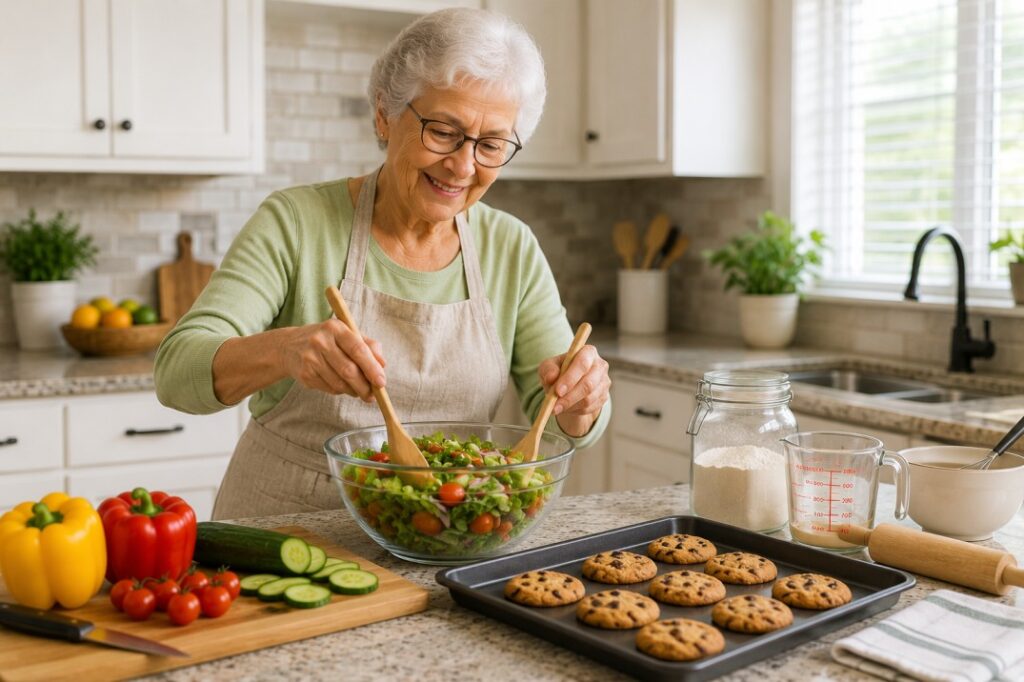
Preparing light meals or healthy snacks indoors can become a fun and meaningful daily activity.
Simple summer-friendly ideas may include:
Cooking also encourages seniors to maintain better nutrition and hydration during hot weather.
For seniors with mobility concerns, caregivers can help with meal preparation and kitchen safety.

Technology offers seniors more ways than ever to stay mentally active without leaving home.
Many older adults enjoy:
Learning something new helps stimulate memory, concentration, and cognitive function.
Small indoor plants can brighten a senior’s home while also providing a calming daily routine.
Easy indoor gardening ideas include:
Caring for plants encourages movement, responsibility, and relaxation.
Mental stimulation is important for seniors who spend long periods at home alone.
Games and brain activities may include:
These activities help support memory and cognitive engagement while also creating opportunities for social interaction with family, friends, or caregivers.

Social isolation becomes more common during extreme heat when seniors avoid going outside.
Scheduling regular video calls with loved ones can help seniors feel more connected and emotionally supported throughout the summer months.
Even short conversations can significantly improve mood and reduce loneliness.

Las Vegas summers are no joke. With temperatures regularly climbing above 100°F, the extreme desert heat can pose serious health risks—especially for seniors.
The Centers for Disease Control and Prevention emphasizes that staying hydrated is one of the most effective ways to prevent heat-related illnesses, especially during extreme temperatures.
For families in Summerlin and across Las Vegas, keeping aging loved ones safe during the summer months isn’t just important—it’s critical.
Whether your parent lives alone or you’re checking in regularly, understanding how to prevent heat-related issues can make all the difference.
Seniors are more vulnerable to heat because the body becomes less efficient at regulating temperature with age. According to the National Institute on Aging, older adults are at a higher risk for heat-related illnesses due to changes in how the body responds to temperature and certain medications.
Seniors are more likely to experience:
In Las Vegas, where temperatures often exceed 100°F, this risk is significantly higher, making preventive care essential.
Preventing dehydration in seniors requires consistent fluid intake throughout the day, even if they don’t feel thirsty. Older adults are more prone to dehydration because their sense of thirst decreases with age, making it essential to proactively monitor hydration—especially during extreme heat in places like Las Vegas.
Seniors can become dehydrated quickly, which may lead to dizziness, confusion, urinary issues, or even hospitalization if not addressed early.
Staying ahead of dehydration is one of the simplest and most effective ways to protect seniors during extreme heat conditions.
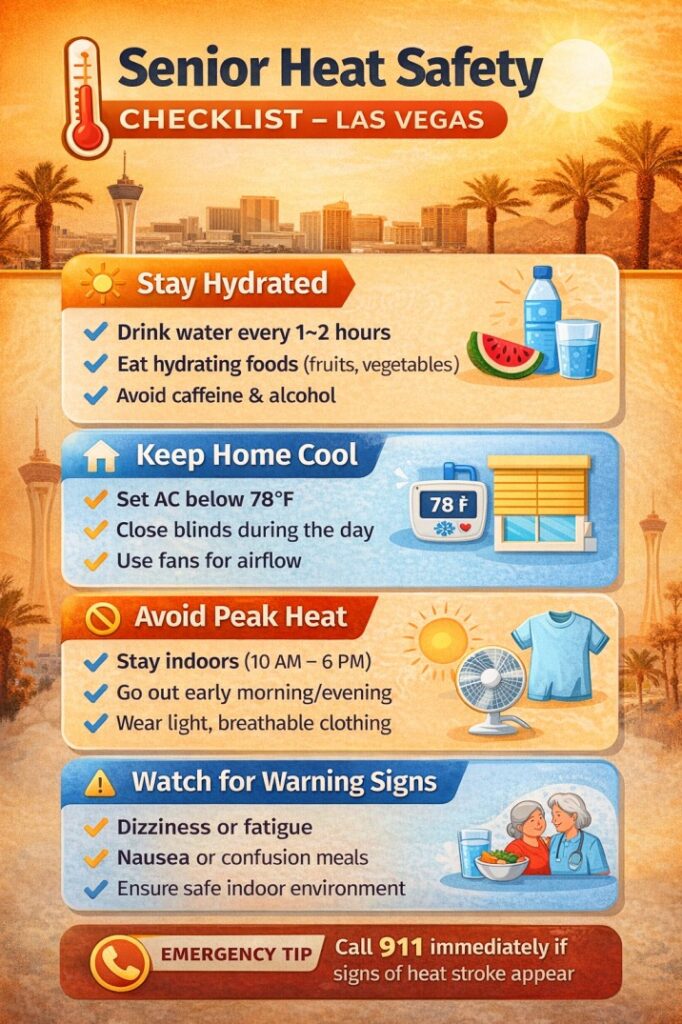
Keeping a senior’s home cool during summer is essential to prevent heat exhaustion and heat stroke, especially in extreme climates like Las Vegas. Seniors are more sensitive to temperature changes, so maintaining a consistently cool indoor environment can significantly reduce health risks.
A properly cooled home not only improves comfort but also helps prevent dehydration, fatigue, and other heat-related illnesses.
If air conditioning fails, act quickly to prevent dangerous heat exposure:
Seniors should avoid going outside during extreme heat, especially between 10 AM and 6 PM in Las Vegas, when temperatures are at their highest. During these peak hours, the risk of heat exhaustion and heat stroke increases significantly, even with short exposure.
Limiting outdoor activity during these times is one of the most effective ways to protect seniors from dangerous heat-related illnesses.
Safe Tips If Going Outside Is Necessary
The signs of heat exhaustion and heat stroke in seniors include symptoms like dizziness, nausea, confusion, and changes in body temperature. Recognizing these warning signs early is critical, as heat stroke can become a life-threatening emergency if not treated immediately.
Seniors in hot climates like Las Vegas are especially at risk, making it important for caregivers and family members to monitor symptoms closely during extreme heat.
Following guidance from Ready.gov can help families recognize warning signs early and respond quickly to prevent serious complications.
Yes, certain medications can increase heat risk for seniors by affecting hydration levels, body temperature regulation, or the ability to sweat. These side effects can make older adults more vulnerable to dehydration, heat exhaustion, and heat stroke—especially in extreme heat conditions like Las Vegas.
Understanding how medications interact with heat is an important step in preventing serious health complications.
Regular check-ins are critical for seniors during extreme heat because they help detect early signs of dehydration, overheating, or home safety issues like AC failure. Seniors who live alone are at a much higher risk, especially in hot climates like Las Vegas, where conditions can quickly become dangerous.
Consistent communication ensures that small issues are addressed before they turn into serious health emergencies.
Caregivers help protect seniors during extreme Las Vegas heat by monitoring hydration, maintaining a safe indoor environment, and identifying early signs of heat-related illness. Their support reduces the risk of dehydration, heat exhaustion, and other serious health complications.
In high-temperature climates like Las Vegas, having consistent caregiver support can make a significant difference in a senior’s safety and overall well-being.
At A Place At Home- Summerlin, caregivers provide essential support by:
This proactive care helps seniors stay safe, comfortable, and independent at home—even during extreme Las Vegas temperatures.
Yes, in-home care is one of the safest and most effective options for seniors during extreme Las Vegas heat. It allows older adults to remain in a cool, familiar environment while receiving the support they need to stay safe, hydrated, and comfortable.
In-home care reduces exposure to high temperatures and ensures that seniors are monitored throughout the day.
Sources & References

Forgetting names is a common experience for seniors and aging adults, and occasional lapses are usually a average part of aging. However, if your parent or loved one frequently forgets names, repeats questions about familiar people, or shows waning memory over time, it could be an early sign of dementia. Caregivers and families should pay attention to patterns of memory loss, as recognizing changes early can help provide timely support, in-home senior care, and strategies to maintain independence for aging adults.
Memory is a complicated process that involves determining, storing, and saving information. As adults age, it is natural for some cognitive changes to occur:
These experiences are normally mild and do not affect daily life, but understanding the difference between normal forgetfulness and signs of dementia is key for families and older adults alike.
Forgetting names is a common experience for seniors and older adults, and it is usually a normal part of aging. Names are often harder to remember because they are arbitrary labels with no inherent meaning, making them more difficult for the brain to store and memory. Additionally, seniors may use certain names infrequently, so the lack of repetition can make recall even harder. Everyday stress, distractions, or multitasking can also affect memory, as the brain battles to focus on and retain information. Finally, normal intellectual slowing that occurs with age means the brain procedures information more slowly, which can make retrieving names feel more challenging. While these factors are typical for aging adults, repeated or persistent struggles may signal the need for further evaluation.
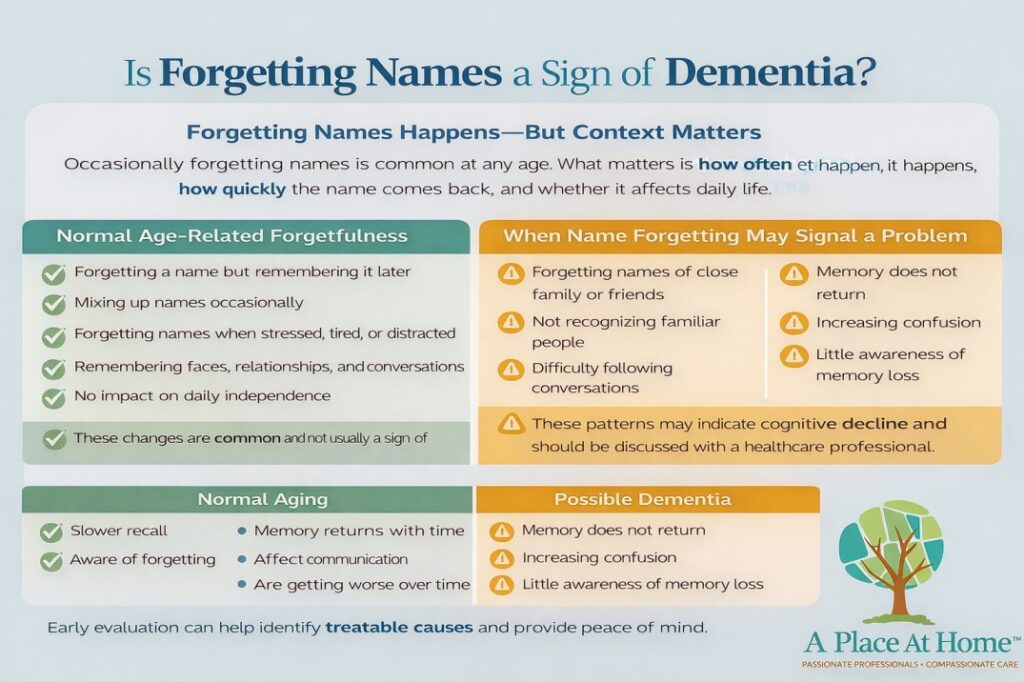
For seniors and aging parents, it’s important to differentiate normal memory lapses from early signs of dementia. Warning signs include:
Persistent memory loss that influences daily life is often an early symptom of dementia and warrants a medical evaluation.
Telling if a senior is showing early signs of dementia needs careful observation and practical assessment in everyday life. Instead of just observing memory lapses, you can use real-life approaches to see if cognitive changes are continuing and impactful.
Ways to tell if a senior may have early dementia:
The key is constant observation over time. One or two isolated incidents are usually normal aging, but persistent patterns in multiple areas should prompt a professional evaluation.
Not every memory problem in older adults is caused by dementia. Other factors can temporarily affect memory, including:
Addressing these factors can improve memory without the need for dementia-specific interventions.
Frequent forgetfulness, especially when it comes to names, can be concerning for both seniors and their families. Taking early, proactive steps can help your loved one maintain independence and support their cognitive health. One of the first things families can do is keep a memory log, recording when forgetfulness occurs, any patterns, and how often it happens. This record becomes an important tool for doctors to understand whether memory lapses are occasional or part of a larger cognitive issue.
It’s also important to observe how memory challenges affect daily life. Forgetting names can impact routines, safety, and social interactions, making it clear whether additional support is needed. Seeking a professional evaluation is a crucial next step. A healthcare provider can assess overall cognitive function and rule out treatable causes of memory loss, such as medication side effects, vitamin deficiencies, or sleep problems.
Doctors may recommend formal cognitive testing, including exams like the Mini-Mental State Exam (MMSE) or the Montreal Cognitive Assessment (MoCA), to detect early changes and provide a baseline for monitoring. Beyond professional evaluation, families can encourage brain-healthy habits that support memory. Regular physical activity improves blood flow to the brain, while a balanced diet rich in fruits, vegetables, and healthy fats supports cognitive function. Social engagement, including conversations with friends or family and participation in community activities, keeps the mind active and connected. Mentally stimulating activities, such as reading, puzzles, or learning new skills, can further reinforce memory and focus.
As seniors experience memory changes, even mild forgetfulness can make daily routines more challenging and affect their independence. This is where a trained home caregiver from A Place at Home – Summerlin, NV can make a real difference. Caregivers provide support with daily tasks, companionship, and safety monitoring, helping seniors continue to live comfortably at home.
A home caregiver can assist with:
With in-home care, seniors can maintain their independence, feel secure, and enjoy personalized support tailored to their needs, while families have peace of mind knowing their loved ones are cared for.
Also Read: How Long Can Someone Live with Dementia?

As people live longer, healthier lives, the question of when someone is considered elderly has become less clear. Is it 60? Is it 65? Or does age alone even tell the full story?
Understanding just what defines an age-for seniors, families, and caregivers-can help with planning, decision-making, and conversations about aging and health independence and eventual care needs. The short answer is that both 60 and 65 are in common use, depending on context. The longer answer is more complicated:
Yes, in some settings-60 is considered the beginning of older adulthood, but not necessarily “elderly” in the traditional sense.
It is used by, commonly: Age 60
Many senior centers, wellness programs, and public health discussions begin using the term older adult or senior at age 60. However, most people at this age are still active, independent, and working or newly retired.
Because of this, age 60 is more accurately described as the start of later adulthood rather than old age.
The age of 65 was quite arbitrary, as this is usually considered the age when one is labeled elderly, primarily because it coincides with retirement, senior benefits, and age-related healthcare planning. However, it is less of a rule and more of an outline than an actual measure of health or competency. The majority of people at age 65 live active, independent, and productive lives.
This is largely because age 65 marks eligibility for major milestones such as:
For decades, age 65 has been used as a benchmark in healthcare, policy, and retirement planning. As a result, it has become the most widely accepted definition of when someone is considered elderly—at least administratively.
Still, many adults at 65 remain healthy, active, and fully independent.
There is no definition of the word elderly, since aging is a different process for each person.
Chronological age, or the age a person is, does not always reflect:
Two persons aged 70 years may have very different health profiles and support needs. That is why many professionals today focus less on age alone and more on functional aging.
Functional age describes how well a person functions in daily life, other than how old they are by years. It is a reflection of factors such as one’s mobility and balance, the ability to manage activities of everyday living, memory and decision-making, and overall health and stamina. From a care perspective, functional age often means more than chronological age. Whereas some people in their late 70s are still fully independent, some others in their early 60s may require daily support as a result of illness, injury, or health changes.
No–an increase in years does not make any person pop into the care category. Many adults remain independent, living in their communities well into their 80s and beyond. The basis for most care decisions includes:
Age may be a reference point, but care needs are driven by function and safety, not a number.
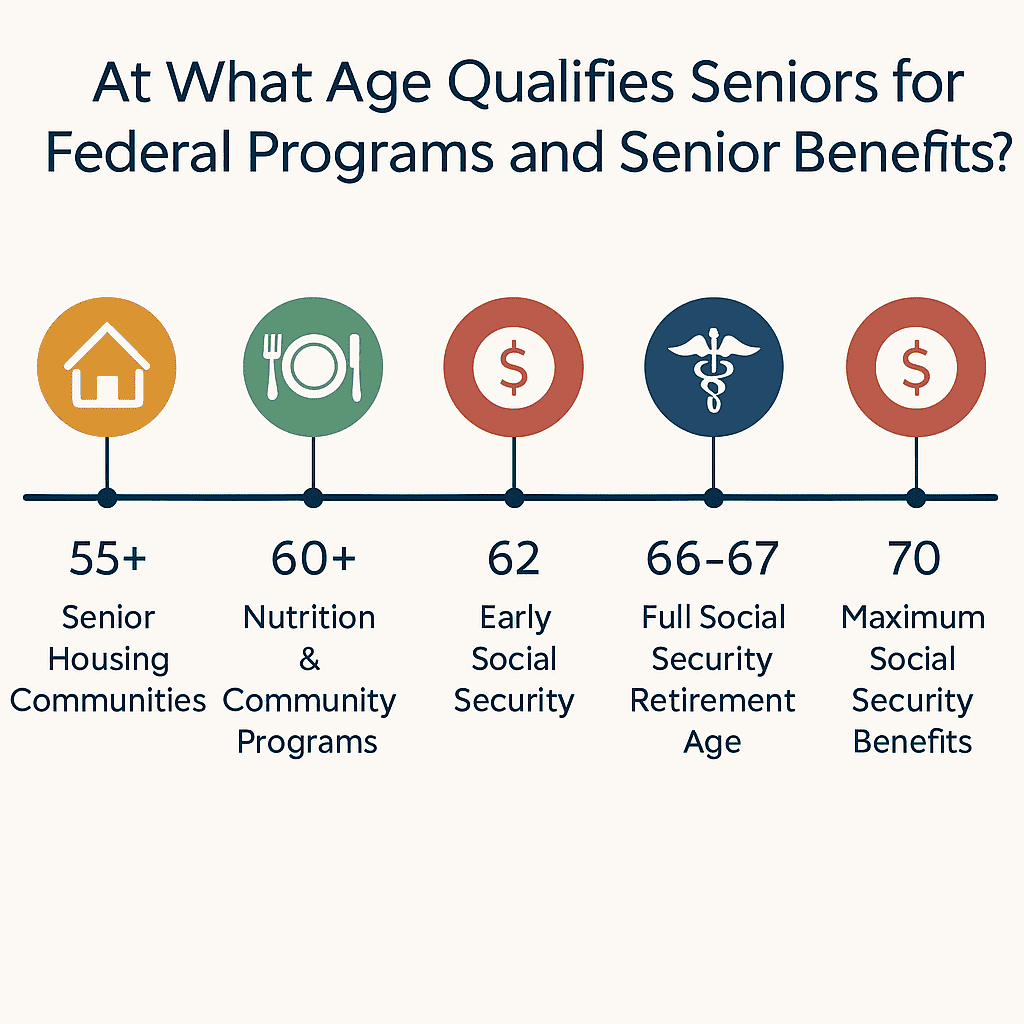
Most of the senior benefits are attached to an age threshold instead of a single definition of “elderly” in the United States. These programs are made for healthcare access, income security, housing, and daily living as one is aging. The most widely applied benchmark is 65, although under or over this level of age, eligibility can begin for different programs.
Attains Medicare eligibility at an elderly stage of life, which begins at 65 years, providing them with health insurance. The programs offered under Medicare cover hospital and medical treatment and prescription drugs. Attaining Medicare is one of the reasons why a person attains senior status when they reach 65 years.
Benefits for retirement under Social Security can be drawn from as early as 62 years of age, but they are reduced if one wishes to start taking them before attaining full retirement age. Benefits are available from 66 to 67 years of age, with an option to raise them if one delays taking them until 70 years of age.
SSI offers financial assistance to senior citizens with limited income and resources. Although eligibility can start at 65, some people can become eligible before this time if they have a disability. Assistance from this social service will cover basic living needs such as food and shelter.
Eligibility for Medicaid benefits is determined by income and resources, but not by age, and many people can become eligible when their care requirements escalate in old age. Medicaid benefits include assistance with long-term healthcare such as in-home and SNF care.
Numerous government and local programs exist for senior citizens beginning at either age 55 or 62 years. Such programs can include rent subsidies, senior-only apartment buildings, and senior-friendly living communities.
Veterans may be eligible for healthcare benefits, pensions, and assistance programs when they reach advanced age. Benefits come with eligibility based on age, military service, financial need, or disability.
Programs such as congregate meal services, home-delivered meals, and senior community services often begin at age 60. These services support nutrition, social engagement, and independent living for older adults.
Apart from benefits and eligibility, other dimensions of life in which aging might be considered include phases of life in order to address varying requirements at different stages.
Often, people will use these terms interchangeably, but “older adult” or “senior” can be a better option because it sounds more respectful and less concentrated on vulnerability. “Elderly” may be a common term in a medical or a government setting, but usage is moving toward someone-first languages.
Although it does not in itself define aging or need, age is a factor in establishing eligibility for two very important government programs.

Aging can be described in terms of phases in order to have a better understanding of health, autonomy, and function. Although different authors describe phases in different ways, a generally accepted model consists of four phases:
These stages aren’t strict rules. They’re a helpful way to talk about aging in a realistic, respectful way—because people age differently based on health, environment, and support systems.
There is no specific age at which someone suddenly needs care. Most support needs develop gradually and are driven by functional changes, not birthdays. Challenges such as loss of mobility, balance problems, forgetfulness, managing daily activities, taking medications, or safety in and around the dwelling are more likely considerations before support is actually required. Some people can continue to look after themselves well into their 80s, where others will require support in their early 60s.
The best time to plan for senior care is before a crisis occurs. Families often benefit from starting conversations and exploring options once a loved one begins experiencing falls, trouble managing medications, difficulty cooking or keeping up with household tasks, or needs extra support after a hospital stay. Early planning allows families to make thoughtful, less stressful decisions and put the right support in place before safety or health becomes urgent.
The word elderly is increasingly being replaced with terms like:
This shift reflects a more respectful and accurate view of aging. Many people associate “elderly” with frailty, which does not represent most adults in their 60s or even 70s.
Using people-first language helps focus on ability, not limitation.
Every individual grows old in a different way, and when they need help, it is not based on a certain age. The most important factor is safety, independence, and a good life at home. A Place At Home – Summerlin residents will have access to tailor-made senior home care, which will address each individual in a manner in which they can be assisted either occasionally or on a continual basis.
Our caregivers assist senior citizens in being comfortable and self-reliant in their homes by providing assistance with personal care, meal service, medication reminders, mobility support, friendship, and post-illness recuperation. We assist the family in adjusting this support based on their evolving requirements, keeping in mind their dignity and continuity of care.
If you are just starting to think about planning for the future or if you notice some signs that a loved one in your life may need a little extra assistance, our local team is available to walk you through this next step.
Final Takeaway
Whether a person can be labeled as senior at 60 or at 65 can very much depend on the context in which they are being assessed. The truth is, aging is far more a function of health, independence, and functionality relative to a number.