

Sleep changes significantly as we age. And for families caring for a 70-year-old loved one at home — understanding those changes can make a real difference in their health, safety, and daily quality of life.
Is this normal? Should I be worried? And how much sleep does a 70-year-old actually need?
Let us answer those questions — clearly, honestly, and without the medical jargon.
So How Much Sleep Does a 70-Year-Old Actually Need?
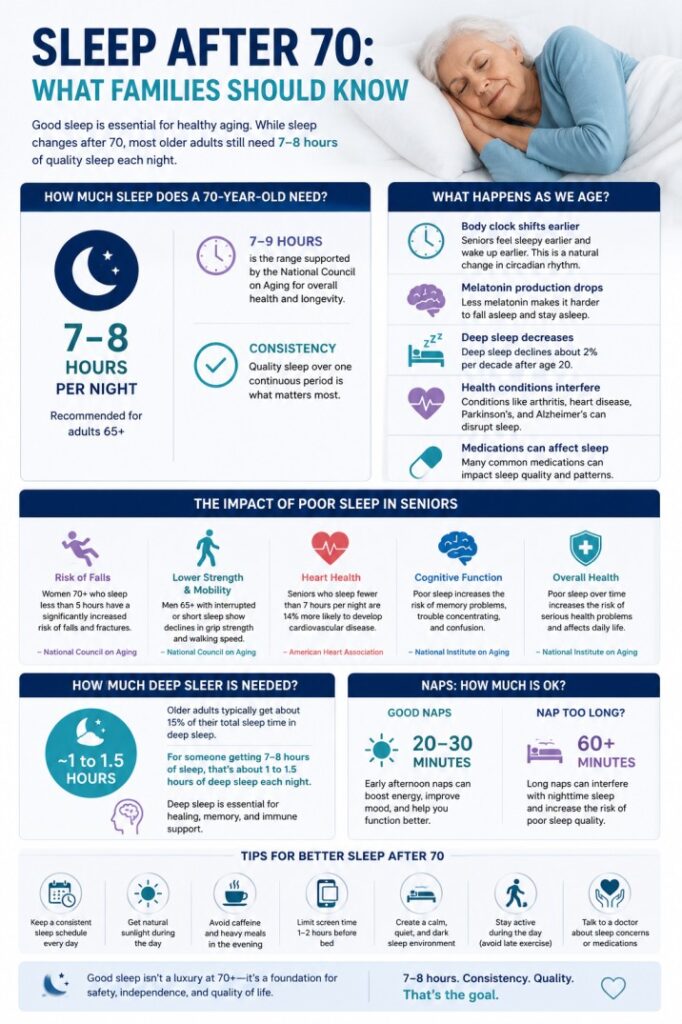
Adults aged 65 and older need 7 to 8 hours of sleep per night — according to the National Sleep Foundation. And ideally that sleep happens over one continuous period — not broken up in pieces throughout the day and night. The National Council on Aging supports this — recommending 7 to 9 hours of quality rest for older adults to support both health and longevity.
So, if your 70-year-old parent is getting a solid 7 to 8 hours every night — they are right where they need to be.
But here is the part most families do not realize.
The Biggest Sleep Myth — And Why It Matters
Most people assume seniors simply need less sleep as they get older. That sleeping less is just part of aging. That it is fine.
It is not fine. And it is not true.
According to the National Institute on Aging — it is a myth that older adults need less sleep. As we get older we do not need less sleep. Our body just has a harder time getting it.
That distinction matters enormously. Because when families believe poor sleep is normal — they stop looking for the cause. And the cause is almost always something that can be addressed.
Why Does Sleep Change After 70?
Understanding what is happening in the body helps families tell the difference between normal sleep changes and warning signs worth addressing.
Here is what science tells us:
The body clock shifts earlier Most seniors naturally feel sleepy earlier in the evening — and wake earlier in the morning. This is a real biological change in the circadian rhythm. It is not a bad habit. It is just how the aging body works.
Melatonin production drops Melatonin is the hormone that signals the body it is time to sleep. According to WebMD, aging adults produce less melatonin — which makes falling asleep harder and staying asleep even harder.
Deep sleep decreases Not all sleep is equal. Deep sleep — the most restorative kind — decreases by about 2% per decade after age 20. By 70 that adds up. The body still needs deep sleep. It just gets less of it naturally.
Medical conditions interfere According to Healthline, health conditions that commonly disrupt sleep in older adults include Parkinson’s disease, Alzheimer’s disease, chronic pain from arthritis, and cardiovascular disease. Many 70-year-olds are managing one or more of these — which makes quality sleep harder to achieve.
Medications play a bigger role than most families realize The National Institute on Aging notes that older adults are more likely to take medications that affect sleep. Blood pressure medications, antidepressants, and even some common pain relievers can significantly disrupt sleep patterns.
What Happens When a 70-Year-Old Does Not Sleep Enough?
This is where families need to pay attention.
Poor sleep in seniors is not just about feeling tired the next day. The consequences are serious — and they build over time.
According to the National Council on Aging:
- Women aged 70 and older who get fewer than five hours of sleep face a significantly increased risk of falls and fractures
- Men aged 65 and older with interrupted or shortened sleep show measurable declines in grip strength and walking speed
The American Heart Association found that seniors who slept fewer than seven hours per night were 14% more likely to develop cardiovascular disease compared to those who slept seven to nine hours.
And the National Institute on Aging is clear — poor sleep over time increases the risk of serious health problems and affects memory, concentration, mood, and daily functioning.
For a senior living at home — these are not small risks. A fall from fatigue. A confused moment at the wrong time. A heart that is working harder than it should. Sleep matters — deeply.
Is It Normal for a 70-Year-Old to Wake Up at Night?
Yes — waking up is normal. What matters is what happens next.
According to the University of Florida Health, adults around age 65 typically wake up three to four times per night. Transitions between sleep and wakefulness become more abrupt with age — meaning even small disturbances are more likely to pull a senior fully awake.
The key question is whether your loved one falls back asleep relatively easily — and whether they feel reasonably rested in the morning.
If the answer to either of those is no — that is worth exploring further.
How Much Deep Sleep Does a 70-Year-Old Need?
Deep sleep is when the real magic happens. The body repairs tissue. The brain consolidates memories. The immune system strengthens.
According to research, older adults typically spend about 15% of their total sleep time in deep sleep. For someone getting 7 to 8 hours — that works out to roughly 1 to 1.5 hours of deep sleep per night.
That is less than a younger adult gets. But it is what the aging body naturally achieves. The goal is to protect that deep sleep — not sacrifice it to late-night television or disrupted routines.
Normal Sleep Changes vs. Warning Signs in Seniors
| Normal Aging Sleep Changes | Warning Signs to Watch For |
|---|---|
| Earlier bedtime and wake-up times | Constant exhaustion throughout the day |
| Waking occasionally during the night | Confusion or noticeable memory decline |
| Naturally getting less deep sleep | Falling asleep during meals or conversations |
| Taking short daytime naps | Sleeping more than 2 hours during the day |
Is Daily Napping OK? How Long Should a Nap Be?
This is one of the most common questions families ask — especially when they notice a parent napping every single afternoon.
The honest answer is — it depends.
Short naps are generally fine A brief nap of 20 to 30 minutes in the early afternoon can restore alertness, improve mood, and give the body a small but meaningful energy boost. For seniors who did not sleep well the night before — a short nap can help them function better for the rest of the day.
Long naps are a problem The American Heart Association found that napping — particularly long or frequent napping — is associated with increased cardiovascular disease risk in older adults.
Long daytime naps also directly steal from nighttime sleep. A 2-hour afternoon nap means the body has already partially met its sleep need for the day — making it significantly harder to fall asleep at night and stay asleep through the early morning.
The napping rules that actually work for seniors:
- Keep naps to 20 to 30 minutes maximum
- Nap before 3pm — later naps interfere with nighttime sleep
- Avoid napping in bed — the couch or a recliner is better for short naps
- If your loved one cannot stay awake despite a full night’s sleep — this is a warning sign worth discussing with their doctor
When napping becomes a concern If your loved one is napping for 2 or more hours every day and still sleeping at night — or if they seem impossible to keep awake during the day — excessive daytime sleepiness may be a symptom of sleep apnea, depression, or another condition that needs medical attention.
Signs of Poor Sleep in Seniors
Poor sleep in seniors does not always look the way families expect. It is not always someone lying awake staring at the ceiling. Often the signs show up during the day — and families miss them entirely.
Here are the signs to watch for you, especially if your loved one lives alone:
Physical Signs
- Falling asleep during conversations, meals, or activities they normally enjoy
- Unexplained falls or near-miss incidents at home — fatigue significantly increases fall risk
- Moving more slowly than usual — shuffling, poor balance, reduced coordination
- Complaints of headaches — especially in the morning
- Getting sick more often — poor sleep weakens the immune system significantly
Cognitive Signs
- Increased confusion or memory lapses — particularly noticeable in the morning
- Difficulty concentrating or following a conversation
- Making unusual mistakes with familiar tasks — cooking, managing medications, handling finances
- Seeming disoriented or unusually forgetful after waking
Emotional Signs
- Irritability, short temper, or emotional outbursts that seem out of character
- Increased anxiety or worry — particularly about nighttime
- Withdrawal from activities, friends, or family they normally enjoy
- Signs of depression — low mood, loss of interest, emotional flatness
Behavioral Signs
- Falling asleep very early in the evening — before 7 or 8pm regularly
- Struggling to stay awake through a normal conversation or television show
- Spending long periods in bed during the day
- Complaining of never feeling rested no matter how much they sleep
According to the Sleep Foundation, up to 48% of older adults experience symptoms of insomnia. That is nearly 1 in 2 seniors. Yet many never mention it to their doctor — because they assume it is just part of getting older.
It is not. If you are noticing several of these signs in your loved one — bring it up at their next doctor’s appointment. Better yet — call today.
10 Practical Ways to Help a 70-Year-Old Sleep Better
Good news — there is a lot families and caregivers can do. Here are the changes that actually work.
- Keep Bedtime and Wake Time Consistent The Sleep Foundation consistently identifies a regular sleep schedule as one of the most effective tools for improving sleep quality in seniors. Same time every night. Same time every morning. Even on weekends.
- Limit Naps — or Cut Them Shorter The American Heart Association found that napping increases cardiovascular disease risk in older adults when done excessively. A short 20-minute nap before 3pm is fine. A two-hour afternoon sleep is not — it steals from nighttime rest.
- Cut Caffeine After Noon The National Institute on Aging recommends avoiding caffeine late in the day — including coffee, tea, chocolate, and soda. Seniors metabolize caffeine more slowly than younger adults. That 2pm cup of tea may still be affecting sleep long after midnight.
- Make the Bedroom Sleep-Friendly Dark. Quiet. Those three things make a measurable difference. Blackout curtains, a white noise machine, and a comfortable mattress all support better sleep. The bedroom should feel like a signal to the brain — this is where we rest.
- Turn Off Screens an Hour Before Bed The National Institute on Aging advises avoiding television, computers, phones, and tablets in the bedroom. The blue light from screens suppresses melatonin — making it harder to fall asleep and stay asleep.
- Skip the Nightcap Many seniors reach for a small glass of wine or beer to help them relax before bed. It seems to help at first. But according to the National Institute on Aging, even small amounts of alcohol disrupt deep sleep in the second half of the night — leaving the body less rested than if no alcohol had been consumed at all
- Stay Active During the Day Gentle daily movement — walking, stretching, chair yoga — makes a real difference in nighttime sleep quality. Activity during the day helps the body feel genuinely tired by bedtime. Just avoid vigorous exercise within a few hours of sleep.
- Manage Pain Before Bedtime Chronic pain from arthritis, joint problems, and old injuries is one of the most common reasons seniors wake up at night. Working with their doctor on an effective evening pain management routine can dramatically improve sleep quality.
- Review All Medications With Their Doctor According to the American Academy of Family Physicians, caffeine, alcohol, and many medications can interfere with sleep. A simple medication review with their physician can identify prescriptions that may be disrupting sleep — and find alternatives.
- Address Worry and Anxiety Directly The Sleep Foundation identifies cognitive behavioral therapy for insomnia as one of the most effective treatments available for seniors. It works by helping seniors identify and change the thoughts and behaviors that interfere with sleep. No medication required. And it works.
Are Sleeping Pills Safe for Seniors?
This is one of the most important questions families ask — and one of the most important to answer carefully.
The short answer is — sleeping pills carry significant risks for seniors and should be approached with real caution.
Why sleeping pills are riskier for seniors According to the American Academy of Family Physicians, if sleep medication is considered for an elderly patient — the lowest effective dose of the shortest-acting medication should be used — and only intermittently. Not every night.
When to Call the Doctor
Some sleep changes with age are completely normal. Others signal a medical condition that needs attention.
Call their doctor if your loved one:
- Snores loudly or appears to stop breathing during sleep — this may be sleep apnea
- Has restless legs or involuntary leg movements at night
- Acts out dreams physically — talking, kicking, or moving while asleep
- Has been sleeping poorly for more than three months
- Shows new confusion, memory loss, or personality changes alongside poor sleep
- Consistently sleeps more than 9 or 10 hours and still feels exhausted
How a Home Caregiver Supports Better Sleep
For seniors, receiving in-home care services— a professional caregiver plays a meaningful daily role in supporting healthy sleep habits.
Here is what that looks like in practice:
- Maintaining a consistent daily routine — same mealtimes, same activity schedule, same bedtime every night
- Preparing light sleep-friendly evening meals and limiting late caffeine
- Encouraging gentle movement and activity during the day
- Providing overnight care and reassurance for seniors who wake up anxious or disoriented
- Watching for early warning signs of poor sleep and reporting changes to family and providers
- Helping with evening pain management routines before bed
- Simply being a calm, reassuring presence — which reduces the anxiety and loneliness that so often disrupts sleep
Sleep does not happen in isolation. It is the result of everything that happens during the day. A consistent, caring caregiver at home supports all of it — every single day.