Independent Living Support for Adults With Disabilities in Fairfax County, VA

Independent living support in Fairfax County

Nobody chooses disability. But most people with disabilities choose exactly the same thing — to live their own life, in their own home, on their own terms.

The challenge is not the desire. It is finding the right support to make it possible.

At A Place at Home — Reston, we provide in-home care for adults with disabilities throughout Fairfax County and Northern Virginia. We see families navigate this process every day. We know which programs exist, which ones have waiting lists, and where the gaps are between what public programs provide and what a person actually needs to live safely and independently at home.

This guide pulls everything together — the local programs available in Fairfax County, the Virginia state programs that apply here, the nonprofit organizations working on the ground in Northern Virginia, and where our caregivers fit into a complete independent living plan.

What Does Independent Living Support Actually Include?

Independent living support is not a single service. It is a combination of supports built around what a specific person needs to live where they choose.

Depending on the individual, it includes:

Personal care — bathing, dressing, grooming, toileting, and hygiene support at the level the person needs

Medication management — reminders, organization, and monitoring for consistency and safety

Meal preparation — planning and preparing nutritious meals that meet dietary and health needs

Mobility and transfer support — safe assistance with movement inside the home and in the community

Transportation — to medical appointments, employment, therapy, and community activities

Household tasks — cleaning, laundry, errands, and home management

Skill development — building daily living skills that increase independence over time

Companion care — reducing isolation and supporting meaningful participation in community life

Where Independent Living Support Comes From in Fairfax County

Support comes from four sources — each with different eligibility criteria, different services, and a different role in a complete plan. Most families end up using more than one.

1. ENDependence Center of Northern Virginia — ECNV

ECNV is the most important free independent living resource in the region — and the one most families have never heard of.

The ENDependence Center of Northern Virginia is a community resource and advocacy center run by and for persons with disabilities. Founded in 1982, ECNV is one of 17 Centers for Independent Living in Virginia — serving Arlington, Fairfax, and Loudoun Counties and the Cities of Alexandria, Fairfax, and Falls Church.

ECNV is peer-led by people with disabilities — including staff, volunteers, and the Board of Directors — who have unique perspectives and understandings of living in the world with a disability.

2. Fairfax County Government Programs

Fairfax County Department of Family Services

The Fairfax County Aging, Disability, and Caregiver Resources intake line connects adults with disabilities to services including assessments for case management and in-home care

Fairfax County’s Disability Rights and Resources provides training, education, and outreach to county residents on their rights under the ADA, the Federal Fair Housing Act, and other disability-related laws. It also supports the Fairfax Area Disability Services Board and AccessAbility Fairfax — a free annual event for individuals with disabilities and their families. Website: fairfaxcounty.gov/familyservices/disabilities

Fairfax-Falls Church Community Services Board

The CSB is the entry point for developmental disability services in Fairfax County.

Virginia Community Services Boards determine eligibility for individuals with intellectual and developmental disabilities to receive Support Coordination. Support Coordinators assess, plan, develop, link, monitor, and coordinate services and supports that empower individuals. The CSB serves as the point of entry for residents of Fairfax County and the Cities of Fairfax and Falls Church who have developmental disabilities and wish to receive services

3. Virginia State Programs

Virginia CCC Plus Waiver

The Commonwealth Coordinated Care Plus Waiver is Virginia’s primary Medicaid program for home and community-based care. For qualifying individuals it covers personal care, respite care, adult day health, and other supports that allow a person to stay home rather than enter a nursing facility.

Eligibility requires meeting Medicaid financial criteria and a clinical level of care determination. To begin in Fairfax County — call (703) 324-7948 or visit NoWrongDoor.Virginia.gov.

We work with many families who are waiting for CCC Plus approval. While the eligibility process moves forward — A Place at Home caregivers can begin providing daily support immediately, so your loved one is never without care during the wait.

4. Nonprofit Organizations

The Arc of Northern Virginia

The Arc of Northern Virginia serves people of all ages with intellectual and developmental disabilities — providing advocacy, DD waiver support coordination, information and referral, public guardianship, Special Needs Trust support, and Tech for Independent Living — an award-winning program that develops customizable lesson plans and an app to promote independence in the community

One family shared: “Every time I run out of options for solving a need for my adult intellectually-disabled son, The Arc of Northern Virginia has provided a pathway for help. Without this organization, our lives would be much more difficult. Website: thearcofnova.org

Where A Place at Home – Reston Fits Into This Picture

Public programs and nonprofit resources are the foundation. But they have real limitations — eligibility requirements, waiting lists, limited hours, and services that stop at a certain point.

That is where A Place at Home comes in.

We provide the daily in-home support that fills the gaps — immediately, consistently, and without the constraints of government programs.

We start the day you call

There are no eligibility applications or waiting lists with A Place at Home. When your family is ready for care — we are ready to begin. For families waiting months for Medicaid waiver approval, our caregivers provide daily support from day one.

The same caregiver. Every visit.

We match caregivers to each individual based on their specific disability, their communication style, their daily routine, and their personality. The same caregiver shows up every day. For adults with disabilities this consistency is not a comfort — it is a functional necessity. A caregiver who understands how the person needs to be supported provides fundamentally better care than a rotating pool of strangers following a care plan.

We support the whole person — not just the tasks

Our caregivers do not just assist with bathing and meals. They accompany clients to work, appointments, and community activities. They provide genuine companionship that reduces isolation. They support the independence the person is working toward — not the dependence that low-quality care creates.

Payment

A Place at Home — Reston accepts private pay and most long-term care insurance policies. We do not accept Medicare or Medicaid. This means our care schedules and caregiver assignments are determined entirely by the individual’s needs — not government reimbursement rates.

Is Your Loved One Ready for Independent Living Support?

Our care coordinator will meet with your family at no charge — assessing your loved one’s specific needs and building an in-home care plan that supports the independent life they want to live.

Does Medicare Cover Rides to the Doctor Appointment?

Caregiver helping a senior woman safely get into a car for a medical appointment outside a hospital

No. Original Medicare does not cover routine rides to the doctor.

That is the direct answer. And it surprises most people who ask.

If your loved one has standard Medicare — Parts A and B — Medicare will not pay for a car, van, wheelchair transport, or rideshare to get them to a medical appointment. Not to their primary care doctor. Not to a specialist. Not to chemotherapy. Not to dialysis. Not to physical therapy.

This is not a medical policy gap that might change next year. It is a legal exclusion written into federal Medicare law. But — and this matters — Original Medicare is not the only type of Medicare. And transportation coverage looks very altered depending on which version your loved one has. Keep reading — because the answer for your specific circumstances may be better than you think.

In this guide, we’ll explain:

  • When Medicare may cover transportation
  • What types of rides are included
  • What Original Medicare does and does not pay for
  • How Medicare Advantage plans differ
  • Alternative transportation options for seniors

Key Facts:

  • Original Medicare does NOT cover routine rides to doctor appointments – no exceptions
  • 75% of Medicare Advantage plans include some transportation benefit in 2025
  • According to the US Department of Transportation, over 600,000 seniors miss medical appointments every year — not because they cannot afford the copay, but simply because they cannot get there.
  • Medicaid covers transportation in all 50 states as a mandatory benefit
  • Missing doctor appointments leads to serious and preventable health complications

Why Do So Many People Assume Medicare Covers This?

Because it feels like it should.

Your parent has paid into Medicare for decades. They are 74 years old, cannot drive anymore, and need to get to their doctor. If Medicare does not cover something as basic as a ride to a medical appointment — what exactly is it for?

The frustration is completely valid. The gap is real. And it affects more people than most families realize.

According to the US Department of Transportation, over 600,000 American seniors miss medical appointments every year because they cannot get there. Not because they do not want to go. Not because they cannot pay the copay. Simply because they have no reliable way to get to the building.

Those missed appointments compound quickly. Unmanaged conditions worsen. Medications go unreviewed. Small problems become hospitalizations. The gap in Medicare’s transportation coverage is not just an inconvenience — it has real health consequences for real people.

When Medicare May Cover Transportation

Original Medicare does cover transportation — but only in very specific situations. Here is exactly when:

Genuine Medical Emergency

Medicare covers emergency ambulance transportation when your life is at risk and being moved in any other vehicle would endanger your health. This covers ground ambulance, helicopter, and air transport in genuine life-threatening emergencies.

This is the clearest and most consistent type of transportation coverage under Original Medicare. There is no ambiguity here.

A Doctor Certifies It Is Medically Necessary

This one is narrower than it sounds — and families often misunderstand it.

Medicare Part B may cover non-emergency ambulance transport if your doctor writes a specific order stating that ambulance transport is medically necessary. Not just helpful. Not just convenient. Medically necessary — meaning your loved one is absolutely bed-confined, cannot sit upright safely, or has a condition where any other form of transport would be clinically inappropriate.

If the ambulance company thinks Medicare might not cover the trip, they will give you an Advance Beneficiary Notice of Noncoverage before the ride. That notice means you may be responsible for the full cost if Medicare declines.

Being unable to drive — or even being in a wheelchair — does not automatically qualify. The bar is higher than most families expect.

You Have Medicare Advantage

This is where the answer changes for many families.

Medicare Advantage — also called Part C — is a private alternative to Original Medicare. These plans must cover everything Original Medicare covers but they can go significantly further. Transportation is one of the most common supplemental benefits they add.

Transportation is one of the most common supplemental benefits Medicare Advantage plans add. In fact, the Kaiser Family Foundation found that approximately 75% of Medicare Advantage plans in 2025 included some form of transportation benefit. If your loved one has Medicare Advantage rather than Original Medicare — there is a real chance their transportation is already covered.

You Are on Medicaid

If your loved one qualifies for Medicaid — either on its own or alongside Medicare — transportation coverage changes completely. Medicaid covers non-emergency medical transportation in all 50 states as a mandatory federal benefit.

This is the answer most families never find. And it may be the most important one in this entire article.

What Types of Rides Does Medicare Include?

Understanding exactly which types of transportation Medicare considers — and which it will pay for — helps families stop guessing and start planning.

Emergency ambulance — covered Ground ambulance, helicopter, air transport in genuine medical emergencies. After you meet the Part B deductible of $283 in 2026 you pay 20% of the Medicare-approved amount.

Non-emergency ambulance — sometimes covered Only with a written doctor’s order certifying medical necessity. Only for patients who are bed-confined or cannot safely travel any other way. The ambulance company must confirm Medicare will cover it — or issue an Advance Beneficiary Notice before the trip.

Sedan, car, or van — not covered by Original Medicare This is the category that catches most families completely off guard. A regular car or van to a routine outpatient appointment — no matter how medically important that appointment is — is not covered under Original Medicare. Ever.

Wheelchair van — not covered by Original Medicare Even wheelchair-accessible van transport for non-emergency outpatient visits falls outside what Original Medicare covers. The vehicle type does not change the coverage rule.

Rideshare — Uber or Lyft — not covered by Original Medicare Original Medicare does not cover rideshare transportation under any circumstance. Some Medicare Advantage plans do include rideshare coverage. But standard Medicare — no.

Non-medical trips — grocery, pharmacy, social — not covered Getting to the pharmacy to pick up a prescription. Grocery shopping. Visiting a friend. Going to the senior center. Original Medicare does not cover any of this.

What Original Medicare Pays For and What It Does Not

Situation Coverage
Emergency ambulance — ground ✅ Covered — 80% after deductible
Emergency ambulance — air or helicopter ✅ Covered — when ground transport is too slow
Non-emergency ambulance — doctor certified as medically necessary ✅ Sometimes — written medical order required


Original Medicare will NOT cover:


Situation Coverage
Routine rides to doctor appointments ❌ Not covered — no exceptions
Rides to specialist visits ❌ Not covered
Transportation to physical therapy ❌ Not covered
Chemotherapy or radiation transport ❌ Not covered
Wheelchair van service — outpatient ❌ Not covered
Rideshare — Uber or Lyft ❌ Not covered
Regular car or sedan service ❌ Not covered
Pharmacy, grocery, or social trips ❌ Not covered


How does Medicare Advantage transportation work in practice?

Your loved one calls the transportation benefit number mentioned on the insurance card to books a ride. A driver picks her up and take he/she directly to the clinic or hospital appointment. Picks up after. No cost at time of service.

That is it. That is how it works when the benefit is available.

Supplemental transportation benefits typically include 24 to 48 one-way trips per year to medical appointments. These benefits usually require advance scheduling of 24 to 72 hours and often partner with rideshare companies like Uber and Lyft for booking through apps or a simple phone call.

What to check before assuming your loved one’s plan covers this:

The percentage of Medicare Advantage plans offering transportation has actually decreased in recent years. In 2026 approximately 24% of individual plans include the benefit compared to around 30% in 2025. So the benefit exists — but not universally. And it changes annually.

Always verify before you need the ride. Not after.

Call the member services number on the back of the insurance card. Ask directly: does this plan include non-emergency medical transportation? How many trips per year? What destinations are covered? How do I book? Do it this week — not the morning of the appointment.

What Medicaid Covers — The Answer Most Families Never Find

Medicaid covers non-emergency medical transportation in all 50 states. Not optionally. Not depending on the plan. According to the Centers for Medicare and Medicaid Services — this is a mandatory federal benefit required by law. No state can opt out of it.

If your loved one is on Medicaid — or dual-enrolled in both Medicare and Medicaid — transportation to medical appointments is covered. At no cost. According to Dream Care Rides, dual-eligible seniors receive transportation at zero cost with no trip limits in most states.

This is called NEMT — Non-Emergency Medical Transportation. And according to Healthline, it is one of the most underused benefits in the entire senior care system.

When you enroll in Medicaid transportation services — you contact a caseworker or ride service, confirm your appointment, and they arrange the most suitable vehicle.

Five Alternative Transportation Options for Seniors

When coverage falls short — and even when it does not — these are the eight most practical options available to seniors today. Most families know one or two of them. Very few families know all eight.

1. Call the Area Agency on Aging First

Most counties across the US offer free or low-cost transportation services designed specifically for seniors who need door-to-door rides. The best way to find these programs is to call your county’s Area Agency on Aging.

Call 1-800-677-1116 or visit eldercare.acl.gov. Give them your loved one’s zip code and explain what they need. They will tell you exactly what transportation programs exist locally — programs that most families never find through.

2. Medicaid NEMT — If Your Loved One Qualifies

Already explained above — but worth restating here clearly.

If your loved one is on Medicaid and has never used the transportation benefit — they may have free rides available right now that nobody has told them about. Contact their state Medicaid program or managed care plan to enroll in NEMT. This is a mandatory benefit in all 50 states.

3. Volunteer Driver Programs — Free and Closer Than You Think

These programs run quietly through local churches, synagogues, mosques, senior centers, and community organizations. They are often free. They are often personal. And they are almost never advertised online.

Calling 2-1-1 in most areas connects you with local volunteer transportation resources within minutes. This is not a hotline most families know about — but it surfaces local programs faster than any online search.

4. Hospital and Clinic Patient Shuttles

Many hospitals and medical centers operate their own free patient transportation between locations or from nearby areas. This option is almost never advertised — but it exists more often than families expect.

Call the patient services desk at your loved one’s hospital or clinic and ask specifically whether free transportation is available for patients. The answer is yes often enough that it is always worth asking.

5. In-Home Caregiver Transportation

This is the option most families discover last. It is usually the one they wish they had found first.

A Place at Home caregivers do not just drive your loved one to appointments. They accompany them — from their front door through check-in, through the appointment, and safely back home. They remember what was said. They ask the question that was forgotten. They handle the prescription on the way back.

Beyond medical appointments — grocery shopping, pharmacy runs, social visits — our in home caregivers provide transportation for everything that keeps your loved one independent and connected.

Final Thoughts

Transportation barriers can make it harder for seniors to maintain their health and independence. While Original Medicare has limited transportation coverage, Medicare Advantage plans, Medicaid programs, local senior services, and caregiver support can help fill the gap.

Understanding your options can help reduce missed appointments, improve healthcare access, and provide greater peace of mind for seniors and families alike.

Frequently Asked Questions

Does Medicare pay for Uber or Lyft rides to doctor appointments?

Original Medicare usually does not. However, some Medicare Advantage plans may include rideshare transportation benefits.

Will Medicare pay for transportation to dialysis?

Yes, if ambulance transportation is medically necessary and approved.

Does Medicare cover wheelchair van transportation?

Usually not under Original Medicare unless medically necessary ambulance criteria are met.

How do I know if my Medicare Advantage plan includes transportation?

Contact your insurance provider or review your plan’s Evidence of Coverage document.

Can caregivers help seniors get to appointments?

Yes. Many in-home care providers offer transportation and appointment assistance services.


Note: This article is for educational purposes only and does not constitute medical or insurance advice. Medicare benefits change annually. Always verify current coverage with Medicare.gov or your specific plan provider.


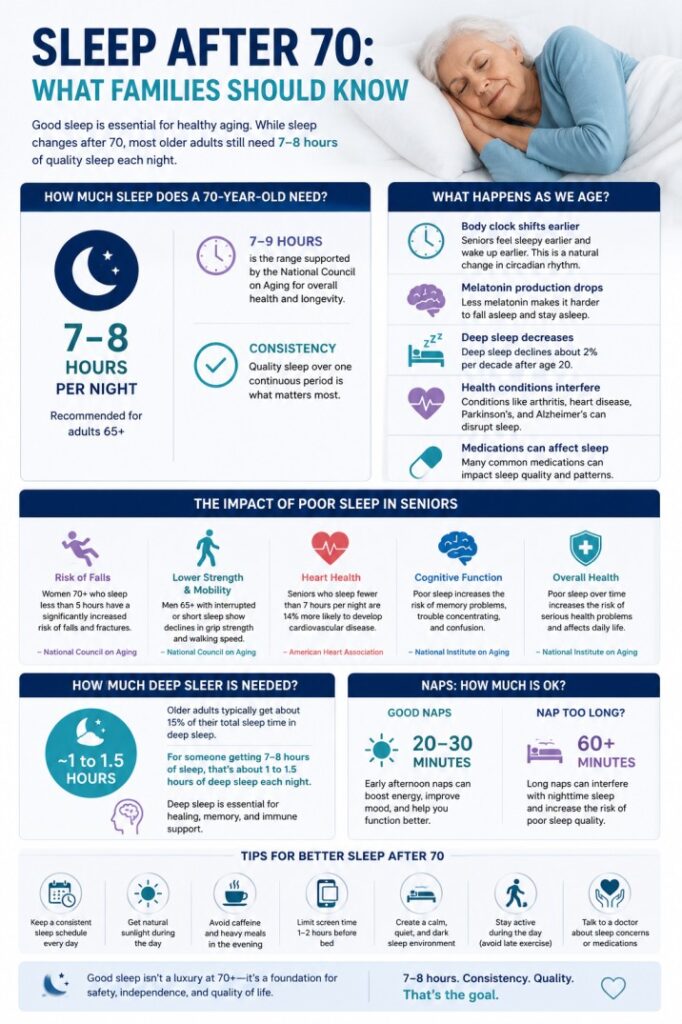
How Many Hours of Sleep Does a 70-Year-Old Need?

Sleep changes significantly as we age. And for families caring for a 70-year-old loved one at home — understanding those changes can make a real difference in their health, safety, and daily quality of life.

Is this normal? Should I be worried? And how much sleep does a 70-year-old actually need?

Let us answer those questions — clearly, honestly, and without the medical jargon.

So How Much Sleep Does a 70-Year-Old Actually Need?

Adults aged 65 and older need 7 to 8 hours of sleep per night — according to the National Sleep Foundation. And ideally that sleep happens over one continuous period — not broken up in pieces throughout the day and night. The National Council on Aging supports this — recommending 7 to 9 hours of quality rest for older adults to support both health and longevity.

So, if your 70-year-old parent is getting a solid 7 to 8 hours every night — they are right where they need to be.

But here is the part most families do not realize.

The Biggest Sleep Myth — And Why It Matters

Most people assume seniors simply need less sleep as they get older. That sleeping less is just part of aging. That it is fine.

It is not fine. And it is not true.

According to the National Institute on Aging — it is a myth that older adults need less sleep. As we get older we do not need less sleep. Our body just has a harder time getting it.

That distinction matters enormously. Because when families believe poor sleep is normal — they stop looking for the cause. And the cause is almost always something that can be addressed.

Why Does Sleep Change After 70?

Understanding what is happening in the body helps families tell the difference between normal sleep changes and warning signs worth addressing.

Here is what science tells us:

The body clock shifts earlier Most seniors naturally feel sleepy earlier in the evening — and wake earlier in the morning. This is a real biological change in the circadian rhythm. It is not a bad habit. It is just how the aging body works.

Melatonin production drops Melatonin is the hormone that signals the body it is time to sleep. According to WebMD, aging adults produce less melatonin — which makes falling asleep harder and staying asleep even harder.

Deep sleep decreases Not all sleep is equal. Deep sleep — the most restorative kind — decreases by about 2% per decade after age 20. By 70 that adds up. The body still needs deep sleep. It just gets less of it naturally.

Medical conditions interfere According to Healthline, health conditions that commonly disrupt sleep in older adults include Parkinson’s disease, Alzheimer’s disease, chronic pain from arthritis, and cardiovascular disease. Many 70-year-olds are managing one or more of these — which makes quality sleep harder to achieve.

Medications play a bigger role than most families realize The National Institute on Aging notes that older adults are more likely to take medications that affect sleep. Blood pressure medications, antidepressants, and even some common pain relievers can significantly disrupt sleep patterns.

Sleep tips for seniors over 70

What Happens When a 70-Year-Old Does Not Sleep Enough?

This is where families need to pay attention.

Poor sleep in seniors is not just about feeling tired the next day. The consequences are serious — and they build over time.

According to the National Council on Aging:

  • Women aged 70 and older who get fewer than five hours of sleep face a significantly increased risk of falls and fractures
  • Men aged 65 and older with interrupted or shortened sleep show measurable declines in grip strength and walking speed

The American Heart Association found that seniors who slept fewer than seven hours per night were 14% more likely to develop cardiovascular disease compared to those who slept seven to nine hours.

And the National Institute on Aging is clear — poor sleep over time increases the risk of serious health problems and affects memory, concentration, mood, and daily functioning.

For a senior living at home — these are not small risks. A fall from fatigue. A confused moment at the wrong time. A heart that is working harder than it should. Sleep matters — deeply.

Is It Normal for a 70-Year-Old to Wake Up at Night?

Yes — waking up is normal. What matters is what happens next.

According to the University of Florida Health, adults around age 65 typically wake up three to four times per night. Transitions between sleep and wakefulness become more abrupt with age — meaning even small disturbances are more likely to pull a senior fully awake.

The key question is whether your loved one falls back asleep relatively easily — and whether they feel reasonably rested in the morning.

If the answer to either of those is no — that is worth exploring further.

How Much Deep Sleep Does a 70-Year-Old Need?

Deep sleep is when the real magic happens. The body repairs tissue. The brain consolidates memories. The immune system strengthens.

According to research, older adults typically spend about 15% of their total sleep time in deep sleep. For someone getting 7 to 8 hours — that works out to roughly 1 to 1.5 hours of deep sleep per night.

That is less than a younger adult gets. But it is what the aging body naturally achieves. The goal is to protect that deep sleep — not sacrifice it to late-night television or disrupted routines.

Normal Sleep Changes vs. Warning Signs in Seniors

Normal Aging Sleep Changes Warning Signs to Watch For
Earlier bedtime and wake-up times Constant exhaustion throughout the day
Waking occasionally during the night Confusion or noticeable memory decline
Naturally getting less deep sleep Falling asleep during meals or conversations
Taking short daytime naps Sleeping more than 2 hours during the day


Is Daily Napping OK? How Long Should a Nap Be?

This is one of the most common questions families ask — especially when they notice a parent napping every single afternoon.

The honest answer is — it depends.

Short naps are generally fine A brief nap of 20 to 30 minutes in the early afternoon can restore alertness, improve mood, and give the body a small but meaningful energy boost. For seniors who did not sleep well the night before — a short nap can help them function better for the rest of the day.

Long naps are a problem The American Heart Association found that napping — particularly long or frequent napping — is associated with increased cardiovascular disease risk in older adults.

Long daytime naps also directly steal from nighttime sleep. A 2-hour afternoon nap means the body has already partially met its sleep need for the day — making it significantly harder to fall asleep at night and stay asleep through the early morning.

The napping rules that actually work for seniors:

  • Keep naps to 20 to 30 minutes maximum
  • Nap before 3pm — later naps interfere with nighttime sleep
  • Avoid napping in bed — the couch or a recliner is better for short naps
  • If your loved one cannot stay awake despite a full night’s sleep — this is a warning sign worth discussing with their doctor

When napping becomes a concern If your loved one is napping for 2 or more hours every day and still sleeping at night — or if they seem impossible to keep awake during the day — excessive daytime sleepiness may be a symptom of sleep apnea, depression, or another condition that needs medical attention.

Signs of Poor Sleep in Seniors

Poor sleep in seniors does not always look the way families expect. It is not always someone lying awake staring at the ceiling. Often the signs show up during the day — and families miss them entirely.

Here are the signs to watch for you, especially if your loved one lives alone:

Physical Signs

  • Falling asleep during conversations, meals, or activities they normally enjoy
  • Unexplained falls or near-miss incidents at home — fatigue significantly increases fall risk
  • Moving more slowly than usual — shuffling, poor balance, reduced coordination
  • Complaints of headaches — especially in the morning
  • Getting sick more often — poor sleep weakens the immune system significantly

Cognitive Signs

  • Increased confusion or memory lapses — particularly noticeable in the morning
  • Difficulty concentrating or following a conversation
  • Making unusual mistakes with familiar tasks — cooking, managing medications, handling finances
  • Seeming disoriented or unusually forgetful after waking

Emotional Signs

  • Irritability, short temper, or emotional outbursts that seem out of character
  • Increased anxiety or worry — particularly about nighttime
  • Withdrawal from activities, friends, or family they normally enjoy
  • Signs of depression — low mood, loss of interest, emotional flatness

Behavioral Signs

  • Falling asleep very early in the evening — before 7 or 8pm regularly
  • Struggling to stay awake through a normal conversation or television show
  • Spending long periods in bed during the day
  • Complaining of never feeling rested no matter how much they sleep

According to the Sleep Foundation, up to 48% of older adults experience symptoms of insomnia. That is nearly 1 in 2 seniors. Yet many never mention it to their doctor — because they assume it is just part of getting older.

It is not. If you are noticing several of these signs in your loved one — bring it up at their next doctor’s appointment. Better yet — call today.

10 Practical Ways to Help a 70-Year-Old Sleep Better

Good news — there is a lot families and caregivers can do. Here are the changes that actually work.

  1. Keep Bedtime and Wake Time Consistent The Sleep Foundation consistently identifies a regular sleep schedule as one of the most effective tools for improving sleep quality in seniors. Same time every night. Same time every morning. Even on weekends.
  2. Limit Naps — or Cut Them Shorter The American Heart Association found that napping increases cardiovascular disease risk in older adults when done excessively. A short 20-minute nap before 3pm is fine. A two-hour afternoon sleep is not — it steals from nighttime rest.
  3. Cut Caffeine After Noon The National Institute on Aging recommends avoiding caffeine late in the day — including coffee, tea, chocolate, and soda. Seniors metabolize caffeine more slowly than younger adults. That 2pm cup of tea may still be affecting sleep long after midnight.
  4. Make the Bedroom Sleep-Friendly Dark. Quiet. Those three things make a measurable difference. Blackout curtains, a white noise machine, and a comfortable mattress all support better sleep. The bedroom should feel like a signal to the brain — this is where we rest.
  5. Turn Off Screens an Hour Before Bed The National Institute on Aging advises avoiding television, computers, phones, and tablets in the bedroom. The blue light from screens suppresses melatonin — making it harder to fall asleep and stay asleep.
  6. Skip the Nightcap Many seniors reach for a small glass of wine or beer to help them relax before bed. It seems to help at first. But according to the National Institute on Aging, even small amounts of alcohol disrupt deep sleep in the second half of the night — leaving the body less rested than if no alcohol had been consumed at all
  7. Stay Active During the Day Gentle daily movement — walking, stretching, chair yoga — makes a real difference in nighttime sleep quality. Activity during the day helps the body feel genuinely tired by bedtime. Just avoid vigorous exercise within a few hours of sleep.
  8. Manage Pain Before Bedtime Chronic pain from arthritis, joint problems, and old injuries is one of the most common reasons seniors wake up at night. Working with their doctor on an effective evening pain management routine can dramatically improve sleep quality.
  9. Review All Medications With Their Doctor According to the American Academy of Family Physicians, caffeine, alcohol, and many medications can interfere with sleep. A simple medication review with their physician can identify prescriptions that may be disrupting sleep — and find alternatives.
  10. Address Worry and Anxiety Directly The Sleep Foundation identifies cognitive behavioral therapy for insomnia as one of the most effective treatments available for seniors. It works by helping seniors identify and change the thoughts and behaviors that interfere with sleep. No medication required. And it works.

Are Sleeping Pills Safe for Seniors?

This is one of the most important questions families ask — and one of the most important to answer carefully.

The short answer is — sleeping pills carry significant risks for seniors and should be approached with real caution.

Why sleeping pills are riskier for seniors According to the American Academy of Family Physicians, if sleep medication is considered for an elderly patient — the lowest effective dose of the shortest-acting medication should be used — and only intermittently. Not every night.

When to Call the Doctor

Some sleep changes with age are completely normal. Others signal a medical condition that needs attention.

Call their doctor if your loved one:

  • Snores loudly or appears to stop breathing during sleep — this may be sleep apnea
  • Has restless legs or involuntary leg movements at night
  • Acts out dreams physically — talking, kicking, or moving while asleep
  • Has been sleeping poorly for more than three months
  • Shows new confusion, memory loss, or personality changes alongside poor sleep
  • Consistently sleeps more than 9 or 10 hours and still feels exhausted

How a Home Caregiver Supports Better Sleep

For seniors, receiving in-home care services— a professional caregiver plays a meaningful daily role in supporting healthy sleep habits.

Here is what that looks like in practice:

  • Maintaining a consistent daily routine — same mealtimes, same activity schedule, same bedtime every night
  • Preparing light sleep-friendly evening meals and limiting late caffeine
  • Encouraging gentle movement and activity during the day
  • Providing overnight care and reassurance for seniors who wake up anxious or disoriented
  • Watching for early warning signs of poor sleep and reporting changes to family and providers
  • Helping with evening pain management routines before bed
  • Simply being a calm, reassuring presence — which reduces the anxiety and loneliness that so often disrupts sleep

Sleep does not happen in isolation. It is the result of everything that happens during the day. A consistent, caring caregiver at home supports all of it — every single day.


What Documents Are Needed for Long-Term Care Insurance Claims? (Step-by-Step Guide)

Insurance claim

To file a long-term care insurance claim, you need documents such as a policyholder statement, physician certification, care plan, provider documentation, and service invoices. These help verify eligibility and ensure reimbursement for care services.

Many families don’t realize how complex this process can be until they are already dealing with a loved one’s health needs.

What Is Long-Term Care Insurance?

Long-term care insurance is designed to help cover the cost of extended care when someone can no longer safely manage daily activities on their own. Unlike traditional health insurance, it focuses on ongoing support rather than short-term medical treatment.

It can help pay for:

For many families, this coverage provides peace of mind by making it possible for loved ones to receive care while remaining in a familiar environment.

Why Using Long-Term Care Insurance Feels Overwhelming

Even though families pay into these policies for years, the process of actually using them can feel confusing. The claims process often comes at a time when families are already dealing with health changes, caregiving stress, and emotional decisions.

Common challenges include:

  • Understanding policy language and requirements
  • Knowing when to file a claim
  • Gathering the right documentation
  • Managing communication with the insurance company

With the right guidance, these challenges can be simplified.

Step 1: Find and Review the Policy

The first step is locating your loved one’s policy and understanding exactly what it covers. This document outlines eligibility, coverage limits, and what types of care are included.

When reviewing the policy, look for:

  • Covered services (in-home care vs facility care)
  • Benefit amounts and limits
  • Elimination period details
  • Contact information for the claims department

Taking time to understand the policy upfront can prevent confusion later.

Step 2: Confirm Eligibility for Benefits

Long-term care insurance typically requires proof that the individual needs help with two or more Activities of Daily Living (ADLs) or has a cognitive impairment.

These daily activities include:

  • Bathing: Difficulty safely getting in and out of the shower or tub
  • Dressing: Needing assistance choosing or putting on clothing
  • Mobility: Trouble moving between rooms or transferring from bed to chair
  • Toileting: Needing help using the restroom safely
  • Eating: Difficulty feeding oneself
  • Continence: Loss of bladder or bowel control

These criteria help determine whether care is medically necessary.

Step 3: Understand the Elimination Period

Most policies include an elimination period, which acts as a waiting period before benefits begin. This can range from 30 to 90 days or more, depending on the policy.

During this time:

  • Care services may already be needed
  • Families often pay out-of-pocket
  • Documentation must still be collected

Some policies count “service days” instead of calendar days, which can extend the timeline.

Step 4: File the Long-Term Care Insurance Claim

Once eligibility is confirmed, the next step is filing the claim with the insurance company. This involves completing forms and submitting a claim packet.

This typically includes:

  • Claimant or policyholder statement
  • Physician statement or medical certification
  • Plan of care
  • Provider documentation
  • Authorization forms

The insurance company reviews these documents to determine approval.

What documents are required for a long-term care claim?

Insurance providers rely on documentation to confirm both eligibility and the care being delivered. Each document plays a specific role in the approval process.

Policyholder Statement

This document provides basic personal and policy information and explains why care is needed.

It typically includes:

  • Personal details (name, address, date of birth)
  • Description of care needs
  • Limitations with daily activities
  • History of recent medical events

It must be signed by the policyholder or their legal representative.

Attending Physician Statement

This form is completed by the primary care physician and confirms that long-term care is medically necessary.

It may include:

  • Medical diagnosis and history
  • Physician observations
  • Test results or supporting documentation
  • Recommendations for care

This is one of the most important documents for claim approval.

Nursing Assessment & Plan of Care

A nursing assessment provides a detailed evaluation of your loved one’s physical condition, daily limitations, and overall care needs. This is typically completed by a nurse or qualified care professional and plays a key role in supporting the claim.

The plan of care outlines:

  • The type of care required (personal care, mobility assistance, etc.)
  • How often care is needed
  • Specific support needed for daily activities

This document helps ensure that the care being provided aligns with both medical needs and the insurance policy requirements.

Provider Statement

If care is already being provided, the care provider must verify the services being delivered.

This may include:

  • Description of services provided
  • Caregiver qualifications and certifications
  • Proof of licensing (for agencies)

Insurance companies require this to confirm care is being delivered by a qualified provider.

Authorization to Release Information

This HIPAA-compliant form allows the insurance company to access medical records needed to process the claim.

It requires:

  • Signature from the policyholder
  • Or legal documentation (Power of Attorney or guardianship) if signed by someone else

Without this, the insurer cannot fully evaluate the claim.

Step 5: Pay for Care and Request Reimbursement

Many long-term care insurance policies operate on a reimbursement model. This means families may need to pay for care first and then submit documentation to receive payment.

To ensure reimbursement:

  • Keep detailed invoices
  • Track dates and hours of care
  • Maintain payment records

Accurate records help prevent delays in reimbursement.

Why long-term care claims get denied

Even when someone qualifies for long-term care insurance, claims can still be delayed or denied. The good news is that in most cases, denials are not random; they usually happen due to specific, avoidable issues.

If a claim is denied, the insurance company will typically provide an explanation, either by phone or in writing, outlining what went wrong and what needs to be corrected.

Understanding the most common reasons can help you avoid unnecessary delays and frustration.

Type of Care Is Not Covered

One of the most common reasons for denial is that the care being provided does not match what the policy covers.

For example:

  • Some older policies may only cover nursing home or facility care, not in-home care
  • Policies may require care to be provided by a licensed agency or certified caregiver
  • Hiring an unlicensed caregiver (such as a friend or informal helper) may not qualify for reimbursement

It’s important to review your policy carefully to confirm what types of care are eligible before starting services.

Elimination Period Requirements Not Met

Another frequent issue is misunderstanding the elimination period, which is the waiting period before benefits begin.

Many policies do not count calendar days but instead count service days—meaning only days when care is actually provided.

Example:

If your policy requires 90 service days and care is provided 3 days per week:

  • 3 days/week × 30 weeks = 90 service days
  • That equals about 210 calendar days (7 months) before benefits begin

Filing a claim too early—before meeting this requirement—can result in denial or delay.

Missing or Incorrect Documentation

Incomplete or inconsistent paperwork is one of the biggest reasons claims are delayed or denied.

Common issues include:

  • Missing invoices from the care provider
  • Incomplete caregiver notes
  • Lack of a formal care plan
  • Incorrect or inconsistent billing formats

Insurance companies rely heavily on documentation, so even small gaps can slow down approval.

What happens if a long-term care insurance claim is denied?

Having a long-term care insurance claim denied can feel frustrating—especially when your loved one already needs support. However, a denial does not always mean the process is over. In many cases, claims are denied due to missing information, misunderstandings, or technical issues that can be corrected.

When a claim is denied, the insurance company will typically provide a clear explanation outlining the reason. This may be communicated through a letter, email, or phone call.

Common next steps after a denial:

  • Review the denial letter carefully to understand the reason
  • Identify what documentation or criteria were missing
  • Contact the insurance provider for clarification
  • Correct and resubmit the claim with updated information

Many claims are successfully approved after resubmission once the required corrections are made.

Can You Appeal a Denied Claim?

Yes. If you believe a claim was unfairly denied, you typically have the option to file an appeal.

The appeal process may involve:

  • Submitting additional medical records
  • Providing updated care documentation
  • Clarifying policy eligibility requirements
  • Requesting a formal review by the insurance company

Many claims are approved during the appeal process once proper documentation is provided.

How to avoid long-term care insurance claim denials

The best way to handle claim denials is to prevent them in the first place. A proactive approach can significantly improve the chances of a smooth and timely approval.

1. Understand Your Policy Before Filing

Take time to carefully review your policy, including what services are covered, eligibility requirements, and how the elimination period works.

This helps ensure you are filing a claim under the correct conditions.

2. Use Licensed and Qualified Care Providers

Many policies require care to be provided by licensed agencies or certified caregivers. Using unqualified providers can result in immediate denial.

Always confirm provider requirements before starting care.

3. Track the Elimination Period Accurately

Understand whether your policy counts calendar days or service days. Filing too early is one of the most common mistakes.

Keep a record of care days to avoid confusion.

4. Keep Documentation Complete and Consistent

Accurate documentation is critical for approval and reimbursement.

This includes:

  • Care plans
  • Caregiver notes
  • Invoices and receipts
  • Medical documentation

Consistency across all documents is key.

5. Communicate with the Insurance Company Early

Do not wait until issues arise. Reach out to the claims department early to confirm:

  • Required documents
  • Eligibility criteria
  • Submission process

Clear communication can prevent costly mistakes.

6. Work with a Home Care Agency Experienced in LTC Insurance

Experienced agencies understand what insurers expect and can help ensure everything is completed correctly.

They can:

  • Provide required documentation
  • Maintain proper records
  • Help guide you through the process

This significantly reduces the risk of delays or denials.

How Home Care Agencies Help With The Process

Working with a professional home care provider can simplify the entire long-term care insurance process. Agencies understand what insurance companies require and help ensure that all documentation, care plans, and records are completed accurately and on time.

At A Place At Home – Reston, we work closely with families throughout Northern Virginia to guide them through each step of the claims process—so they don’t have to navigate it alone.

We support families by:

  • Conducting comprehensive care assessments to determine eligibility
  • Creating structured, personalized care plans that meet insurance requirements
  • Maintaining consistent caregiver documentation and care notes
  • Providing detailed, insurance-ready invoices for reimbursement

Our goal is to reduce the stress and administrative burden on families, while ensuring your loved one receives the care and support they need at home.

Need Help Navigating Long-Term Care Insurance?

Understanding policies, gathering documents, and filing claims can feel overwhelming—but you don’t have to do it alone.

At A Place At Home – Reston, we help families every day with:

  • Understanding their benefits
  • Organizing required documentation
  • Coordinating in-home care services

👉 Schedule a free consultation today

Also Read: When Is the Right Time to Start Using Long-Term Care Insurance?

When Is the Right Time to Start Using Long-Term Care Insurance?

Long term care insurance

Many families purchase long-term care insurance to help protect their savings and ensure support is available later in life. But when the time comes, it can be difficult to know when it’s appropriate to begin using the policy.

In our experience working with families throughout Northern Virginia, many people simply aren’t sure how or when to activate their benefits. Policies can be complex, and the process of filing claims and submitting documentation can feel overwhelming.

The good news is that you don’t have to navigate it alone.

At A Place At Home – Reston, we regularly help families understand their long-term care insurance benefits and guide them through the process so they can focus on what matters most — supporting their loved one.

When Does Long-Term Care Insurance Actually Apply?

Most long-term care insurance policies are designed to activate when an individual can no longer safely manage certain daily tasks on their own. These tasks are known as Activities of Daily Living (ADLs), and they are a key factor in determining eligibility.

Typically, benefits begin when assistance is needed with two or more of the following:

  • Bathing

  • Dressing

  • Mobility or transferring

  • Toileting

  • Eating

  • Continence

In addition, many policies also provide coverage for individuals experiencing cognitive decline, such as Alzheimer’s disease or dementia. This ensures that support is available not only for physical needs but also for memory-related challenges.

Signs It May Be Time to Explore Your Benefits

Families often begin looking into long-term care insurance when they notice changes in a loved one’s daily routine or independence.

Some common signs include:

Starting care earlier can allow seniors to maintain independence longer while reducing stress for family members.

Navigating the Long-Term Care Insurance Process

One of the biggest challenges families face is understanding what documentation is required to file claims.

Many long-term care insurance providers require:

  • Care plans and assessments
  • Caregiver notes or documentation
  • Service receipts and invoices
  • Ongoing updates regarding care needs

At A Place At Home – Reston, we take pride in helping families navigate this process.

Our agency has been pre-vetted with nearly 30 long-term care insurance providers through Illumifin, which helps streamline the claims process for many families.

We also provide the documentation most insurers require, including:

  • Care assessments
  • Care notes
  • Service receipts and invoices

Our goal is to ensure families have the information they need so they can submit claims smoothly and on time.

Supporting Families Every Step of the Way

Long-term care insurance was designed to help families during times when additional support is needed. Understanding your policy and knowing when to activate benefits can make a meaningful difference in maintaining comfort, safety, and independence at home.

If you or a loved one have a long-term care policy and aren’t sure where to begin, our team is always happy to help.

We’re glad to answer questions, review your situation, and help guide you through the next steps.

If you have questions about long-term care insurance or aren’t sure where to start, our team is always happy to help. At A Place At Home, we work with families every day to help them understand their benefits and coordinate care that allows their loved ones to remain safe and comfortable at home.

Because we are pre-vetted with nearly 30 long-term care insurance providers through Illumifin, we’re familiar with many of the documentation and submission requirements insurers request. We provide care assessments, caregiver notes, and service receipts so families have the information they need to submit claims in a timely manner.

Please feel free to reach out with any questions — we’re here to help. Contact us.

Senior Movie Day in Reston: Bringing Community Together on March 25

Senior Movie Day_March 2026

At A Place At Home – Reston, we believe that meaningful connections and shared experiences play a vital role in senior well-being. That’s why we are excited to host a special Senior Movie Day on March 25 at LOOK Cinemas in Reston Town Center.

This event is more than just a movie—it’s an opportunity for local seniors to come together, socialize, and enjoy a relaxing morning in a welcoming environment.

What to Expect

Guests will be treated to a showing of the highly anticipated grand finale of Downton Abbey—a favorite among many. The event is free for seniors and includes light refreshments such as coffee, juice, and donuts.

  • Location: LOOK Cinemas, Reston Town Center

  • Date: Wednesday, March 25

  • Doors Open: 9:15 AM

  • Movie Starts: 10:00 AM

Supporting Senior Connection in Reston

We are proud to partner with the Reston Association to bring this event to the community. Events like these help reduce isolation, encourage engagement, and create joyful moments for seniors and their families.

Whether you are a longtime Downton Abbey fan or simply looking for a fun and social outing, this is a wonderful way to spend your morning.

Join Us!

We would love to see you there. Bring a friend, meet new people, and enjoy a memorable movie experience with your community.

If you have any questions, feel free to contact our team at A Place At Home – Reston.

A Place At Home – Reston at the Live Well, Reston! Health & Wellness Fair

RCC Health Expo in Reston

At A Place At Home – Reston, we are passionate about supporting the health, independence, and well-being of seniors in our community. That’s why we are excited to participate in the Greater Reston Chamber of Commerce’s Live Well, Reston! Spring Health & Wellness Fair on March 22.

Held at the Reston Community Center from 2:00 PM to 5:00 PM, this free event brings together local organizations, healthcare providers, and wellness experts—all focused on helping individuals and families live healthier lives.

What You Can Expect

Attendees will have the opportunity to:

  • Connect with local health and wellness professionals

  • Discover valuable community resources

  • Learn about services that support aging safely at home

  • Ask questions and gather helpful information for themselves or loved ones

Supporting Seniors & Families in Reston

Our team will be on-site to share how our in-home care services help seniors maintain independence, safety, and quality of life. Whether you are planning ahead or currently exploring care options, we are here to help guide you.

Join Us!

We invite you to stop by, say hello, and learn more about how we can support you or your loved ones.

We look forward to seeing you there!

How to Help an Aging Parent Who Needs More Care

A Place At Home in-home care guide for families in Reston, Herndon, and Sterling, Virginia

A Guide for Families in Reston, Herndon & Sterling, VA

Many families wonder when it’s time to step in and provide more care for an aging parent. For some, caregiving begins gradually — giving a ride to a medical appointment or helping with groceries. For others, the need for care can come suddenly after a fall, illness, or new diagnosis.

No matter how it starts, becoming a caregiver can feel overwhelming. Knowing what signs to look for and what care options are available locally can make the process less stressful — and help both you and your loved one maintain independence, dignity, and quality of life.

At A Place At Home serving Reston, Herndon, Sterling, and surrounding areas, we support families through every stage of this journey.

Signs an Aging Parent May Need More Care

One of the most difficult caregiving decisions is recognizing when more support is needed. While every situation is different, healthcare professionals often look at an older adult’s ability to perform Activities of Daily Living (ADLs).

Activities of Daily Living (ADLs)

If your parent struggles with any of the following, additional care may be needed:

  • Eating: Difficulty preparing food, loss of appetite, trouble swallowing, or lack of coordination
  • Mobility: Frequent falls or subtle challenges such as getting in and out of bed, chairs, or the shower
  • Dressing: Trouble choosing appropriate clothing or putting it on independently
  • Personal hygiene: Difficulty bathing, grooming, brushing teeth, or shaving
  • Toileting: Trouble getting to the bathroom on time or managing hygiene afterward

Instrumental Activities of Daily Living (IADLs)

Even if basic self-care is manageable, challenges with Instrumental Activities of Daily Living may signal the need for in-home support:

  • Preparing meals and cooking safely
  • Managing finances and paying bills
  • Shopping for groceries or necessities
  • Using a phone or managing appointments
  • Taking medications correctly
  • Cleaning and maintaining the home

Other Warning Signs to Watch For

  • Increased forgetfulness or memory issues
  • Confusion or disorientation
  • Reduced physical activity or energy
  • Social withdrawal, loneliness, or depression

If you’re noticing several of these changes, it may be time to explore home care options in Reston, Herndon, or Sterling.

Care Options for Aging Parents in Northern Virginia

There is no one-size-fits-all solution. The best care option depends on medical needs, personal preferences, family support, and budget.

Aging in Place with In-Home Care

Many older adults prefer to remain in their own homes. With the right support, aging in place can be a safe and comfortable option.

Professional in-home caregivers can help with:

  • Personal care and hygiene
  • Meal preparation
  • Medication reminders
  • Mobility and fall prevention
  • Companionship and supervision

This option allows seniors in Reston, Herndon, and Sterling to stay connected to their community while receiving personalized care.

Home Health Aide

A home health aide may provide assistance with ADLs and limited medical care, such as monitoring vital signs. Care may be scheduled during the day, overnight, or around the clock.

Assisted Living Facilities

Assisted living communities provide housing, meals, and support with daily tasks but typically do not offer intensive medical care. This may be appropriate for seniors who need supervision but not continuous healthcare.

Nursing Homes

For individuals requiring ongoing medical supervision, nursing homes offer 24-hour care, rehabilitation services, and skilled nursing support. It’s important to note that even seniors who qualify for nursing-level care may still be able to age at home with the right in-home care services.

The Benefits — and Challenges — of Family Caregiving

Some families choose to provide care themselves or have an aging parent move in with a relative. While caregiving can be meaningful, it also comes with challenges.

Benefits of Family Caregiving

  • Strengthened family relationships
  • Increased confidence in caregiving skills
  • Emotional fulfillment and peace of mind

Research even suggests caregiving may offer long-term health benefits for caregivers.

Local Resources for Families in Reston, Herndon & Sterling

If you’re exploring care options, these resources may help:

  • LongTermCare.gov – Information on costs, Medicare, Medicaid, and care planning
  • Virginia Medicaid Office – Coverage and eligibility resources
  • PACE Programs – All-inclusive care for qualifying seniors (availability varies)
  • Eldercare Locator – Local services based on ZIP code
  • Geriatric Care Managers – Professionals who help families plan and coordinate care

How A Place At Home Can Help

At A Place At Home serving Reston, Herndon, Sterling, and surrounding Northern Virginia communities, we provide compassionate, non-medical in-home care tailored to your family’s needs.

Our caregivers help older adults:

  • Remain safe at home
  • Maintain independence
  • Improve quality of life
  • Reduce stress for family caregivers

The Bottom Line

Knowing when an aging parent needs more help isn’t easy. Many seniors resist change because they value independence — but if you’re noticing warning signs, trust your instincts.

With the right support, you don’t have to navigate this alone. Together, you can find a care solution that keeps your loved one safe, comfortable, and supported at home.


When Care Can’t Wait: How Immediate In-Home Care Can Start Within 24 Hours

Caregiver providing in-home support to a senior

One moment, everything feels manageable — and the next, it isn’t.

A loved one is suddenly discharged from the hospital in Reston.
A fall at home in Sterling or Herndon changes mobility overnight.
A caregiver cancels, and there’s no backup in Chantilly or Fairfax.

When these situations happen, families don’t have weeks to plan. They need help now.

The good news is that immediate home care is possible, and with the right local provider, care can often begin within 24 hours. This guide explains how urgent home care works, when to seek it, and what families across Northern Virginia should know when time is critical.

What Is Immediate In-Home Care?

Immediate in-home care is short-notice support designed for situations where families cannot wait days or weeks for help. It is most often needed after an unexpected hospital discharge, a fall that changes mobility overnight, surgery, sudden illness, or when a family caregiver becomes overwhelmed or unavailable. The goal is to stabilize the situation quickly, keep the senior safe at home, and prevent avoidable complications while longer-term plans are put in place.

Can Home Care Really Start Within 24 Hours?

Yes, immediate home care can often begin within 24 hours when families work with a local, established agency. Providers with caregivers already serving the community can complete intake quickly, assess basic needs by phone, and match an available caregiver without delays. Local agencies are able to move faster than national call centers because they manage staffing, scheduling, and care coordination directly.

Local providers in Reston, Fairfax County, Herndon, Sterling, and Chantilly can often:

  • Complete a same-day intake call
  • Assess general care needs quickly
  • Match an available caregiver
  • Begin care within 24 hours when staffing allows

Large national call centers often move more slowly because they rely on centralized systems and wider coverage areas. Local agencies can respond faster because caregivers are already working within the community.

What Families Should Do When Care Is Needed Urgently

Urgent home care is often needed when a discharge date arrives before a clear plan is in place. Seniors returning home after surgery, illness, or rehabilitation may struggle with mobility, fatigue, medication routines, or basic daily tasks. If a loved one cannot safely manage bathing, meals, walking, or being alone during the day, immediate care helps bridge the gap between medical care and independent living.

When time is limited, a few simple steps help move things forward quickly:

  • Call instead of relying only on online forms

Ask clear questions such as:

  • “How soon can care begin?”
  • “Do you currently have caregiver availability in my area?”
  • Be prepared to describe basic needs (hours, level of assistance, safety concerns)

Detailed medical information can be reviewed securely once care planning begins. The first goal is confirming speed and availability.

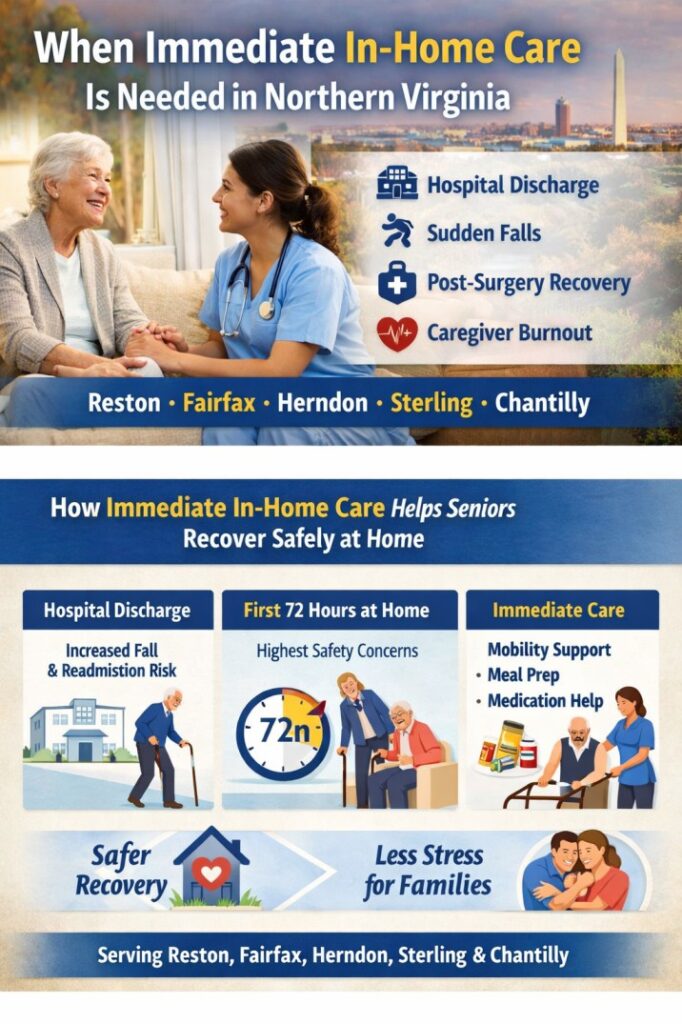
Immediate in-home senior care infographic

Why the First 72 Hours After Discharge Matter Most

The first few days after returning home are when seniors face the greatest risk of falls, medication errors, dehydration, and readmission to the hospital. New medications, weakness from bed rest, and unfamiliar routines can quickly lead to complications. Immediate in-home care provides extra eyes, hands, and support during this critical transition period, reducing stress for both the senior and their family.

Without proper support, seniors are more likely to experience:

  • Falls
  • Medication errors
  • Missed follow-up instructions
  • Preventable hospital readmissions

Immediate in-home care helps by reinforcing discharge instructions, monitoring mobility, supporting daily routines, and ensuring the home environment is safe during recovery. This is especially important for families in busy Northern Virginia households where work and commuting limit availability.

When Should You Seek Urgent In-Home Care?

If daily life no longer feels safe or manageable, it’s time to reach out.

Urgent home care is often needed when:

  • A discharge date is approaching with no care plan
  • A spouse or family caregiver feels overwhelmed
  • Daily tasks are unsafe to manage alone
  • A loved one should not be left home alone

If you’re asking, “How are we going to manage this?” that question itself is a signal to seek support.

Why Local, Clinically Guided Home Care Makes a Difference

Local leadership and clinical oversight improve speed, safety, and outcomes.

Agencies with local management and clinical guidance are better equipped to:

  • Start care quickly
  • Adjust care plans as recovery changes
  • Communicate clearly with families and providers
  • Support safe transitions home

For families in Reston, Fairfax, Herndon, Sterling, and Chantilly, this local responsiveness can make the difference between a smooth recovery and a return to the hospital.

Why Local, Clinically Guided Home Care Makes a Difference

Local leadership and clinical oversight improve speed, safety, and outcomes.

Agencies with local management and clinical guidance are better equipped to:

  • Start care quickly
  • Adjust care plans as recovery changes
  • Communicate clearly with families and providers
  • Support safe transitions home

Need Immediate In-Home Care in Northern Virginia?

When care is needed urgently, families in Northern Virginia don’t have time to wait or sort through uncertainty. A Place At Home – Reston provides dependable in-home care for seniors and adults in Reston, Fairfax, Herndon, Sterling, and Chantilly, helping families respond quickly when a loved one needs support at home.

Our caregivers assist with the everyday needs that matter most during recovery or sudden health changes, including meal preparation, light housekeeping, fall prevention support, medication reminders, and companionship. Whether someone is returning home after a hospital stay, recovering from surgery, or simply no longer safe managing daily routines alone, our care helps reduce risk while supporting comfort and independence at home.

If you’re concerned about a loved one being home alone or struggling after a recent change in health, A Place At Home – Reston is here to help. Call today to talk through what’s happening and learn how in-home care can start when you need it most.

Top 5 Tips for Candid Conversations About Older Adult Fraud

senior work on laptop

Financial fraud targeting older adults remains on the rise, with millions of senior adults falling prey to financial fraud every year. Some of these financial schemes include financial phone scams, phishing messages, romance scams, Medicare fraud, and impersonations, which are becoming increasingly sophisticated. For caregivers in Reston VA, a very important tool in this matter is straight talking.

Speaking of being defrauded, however, can be a tricky matter. Older people in particular prize their autonomy and may be embarrassed, put on the defensive, or scared of being disempowered. Which is why it is just as important as content to consider how these conversations are delivered.

Here are five respectful and practical methods families can discuss elder fraud with a goal of increasing awareness, trust, and protection without offending older adults:

1. Start With Empathy and Respect

Whenever a topic such as senior fraud is being discussed, a topic which can affect senior citizens very personally, conversations need to begin with a sense of concern, rather than a need to correct. Senior citizens can far more easily be approached when they see they are being spoken to with respect rather than being judged or observed.

To present a discussion with a focus on common aims – including staying safe, protecting financial freedom, and minimizing unnecessary stress – can reduce defensiveness. A focus on scammers taking people of all ages emphasizes the idea that being a scam victim is not a matter of poor judgment but rather a product of how successfully scammers have normalized their cons.

Using language rooted in care rather than control encourages openness and trust.

2. Share Examples of Real-Life Scams That Older Adults May Actually Have

General warning messages may not work better than specific examples. Examples of different kinds of elder financial abuse will help elderly people spot such situations when they come across them in reality.

Some common elder scamming schemes include:

  • Phone calls pretending to be from the IRS, Social Security, or Medicare
  • Fake tech support alerts claiming a computer or device is compromised
  • Romance scams that build emotional trust before requesting money
  • Phishing emails or texts asking for personal or banking information
  • Sweepstakes or lottery scams requiring upfront fees

Talking through how these scams work — without implying vulnerability — helps seniors feel informed rather than lectured.

3. Normalize the Experience to Reduce Shame

One of the largest obstacles in elder fraud prevention is a silent treatment option. Seniors are afraid to speak out when they think they have been scammed because they do not want to be embarrassed.

To make your loved one less stigmatized, you can assure her or him that “con artists” are professional “manipulators.” As a matter of fact, “scammers” practice “urgency,” “fear,” “authority,” and “emotional manipulation,” which are methods to

When elderly people realize that financial fraud is prevalent and sophisticated, they can be motivated to ask questions and check suspicious communications.

4. Encourage Simple Verification Habits

Often, fraud prevention is a matter of slowing the process. By encouraging older adults to take a moment before responding to any unexpected request that involves money, personal details, or account access, the risk factor can be greatly reduced.

Helpful habits include:

  • Taking time before responding to urgent requests
  • Information can be verified through official phone numbers/website
  • Consulting a trusted family member or caregiver before acting
  • Avoid clicking on unfamiliar links or attachments

These practices are very empowering for seniors to maintain safety as they continue to be in control of their decisions.

5. Make Fraud Awareness an Ongoing Conversation

The best fraud prevention doesn’t happen when it’s framed as a single, stern warning. Scams constantly change, and non-intense frequency helps reinforce awareness rather than generates anxiety.

Brief conversations at routine times-for instance, discussing a story in the news recently or a current scam alert-serve to keep the subject relevant and normalized. This will make it easier for the older adult to express concern if something feels suspicious.

The best consistency builds confidence and deepens protective habits over time.

The Role of senior caregivers in helping seniors age in place

Why These Conversations Matter More Than Ever

Older adult fraud can result in much more than financial loss. Victims may struggle with emotional distress, anxiety, loss of confidence, and sometimes a reduced independence. Financial exploitation may further interfere with a senior’s ability to pay for care, housing, or vital services.

Open communications safeguard not just finances, but the well-being of all. Families that can communicate about fraud openly will be more likely to recognize early warning signs, unusual behaviors, or sudden financial burdens.

The Role of Caregivers and Support Systems

Caregivers, whether family members or professional home care providers, are often in a unique position to protect older adults from victimization. Through regular contact, caregivers may observe changes in behavior, such as increased frequency of phone calls, suspicious mail, secrecy regarding finances, or anxiety.

Companion care and supportive home care services can provide an extra layer of protection by maintaining routine, offering social connection, and creating opportunities for ongoing communication.

Also Read: Is 60 or 65 Considered Elderly?