Buying an Elder Care Business: 6 Factors Franchisees Should Compare
Buying an elder care business is a significant decision—one that goes beyond choosing a growing industry. From reviewing the Franchise Disclosure Document (FDD) to evaluating territory potential and startup costs, there are several factors that can impact your long-term success. Discover what to evaluate before buying a senior care business and why a franchise opportunity like A Place At Home could be your next best investment.
Why the Elder Care Industry Attracts Franchise Investors
In the U.S. alone, 10,000 people turn 65 every single day. By 2050, older adults will represent more than 20% of the population. With such strong growth among the aging population, there is a consistent need for high-quality senior care services—attracting savvy entrepreneurs to the senior care industry.
Plus, by providing essential services, an elder care business tends to remain stable even as economic conditions change. With less reliance on discretionary spending, entrepreneurs can generate more consistent revenue streams that support long-term growth. With a senior care business, compassionate entrepreneurs can build businesses that are not only profitable but also make a positive impact within their communities.
6 Senior Care Franchise Factors to Compare
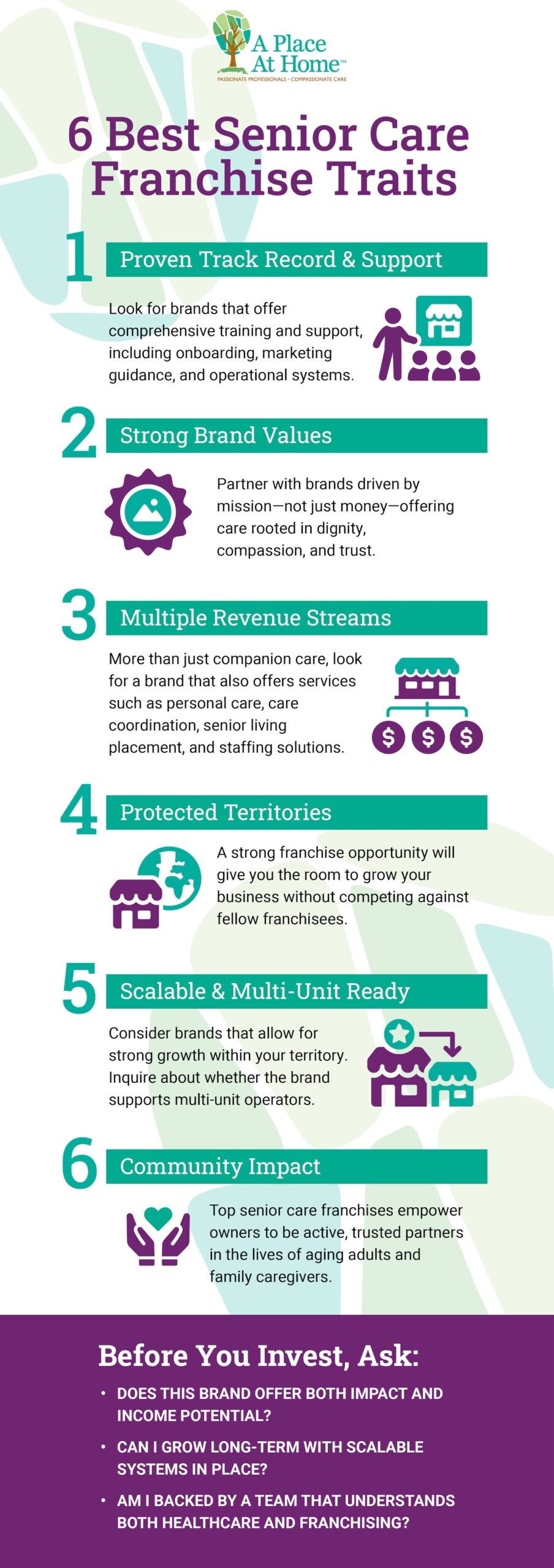
While researching your next venture, you’ve likely come across the option of franchising. Rather than just starting your elder care business from scratch, there’s the opportunity to partner with an established brand—giving you direct access to a trusted playbook, streamlined systems, operational guidance, and strong brand recognition. However, not all franchises are created equally. When considering a senior care franchise, be sure to compare the following across all brands:
1. Review the FDD
The FDD is a legally required document that outlines specific details about the franchise opportunity. In the FDD, you’ll learn about the franchisor’s beginnings, executive team, litigation history, startup costs, financial representations, and more—all of which are vital to making the right investment decision for you.
While reviewing the FDD in its entirety is recommended, you’ll want to pay special attention to Item 7 (startup costs), Item 6 (ongoing fees and costs), and Item 19 (financial performance). Keep in mind, Item 19 is not a required section and may not be included in every brand’s FDD.
As you review these sections, look beyond the numbers. Consider how the costs align with your budget, how ongoing fees may impact profitability, and whether the financial representations reflect realistic expectations of your market. Taking the time to thoroughly understand the FDD can help you make an informed, confident decision.
2. Evaluate Territory and Market Potential
Location, location, location! If your elder care business isn’t positioned in the right territory or market, you’ll likely struggle to build a client base. Not all markets offer the same opportunity, which is why evaluating your territory is a critical step when starting any type of business. A strong franchise territory should provide both immediate demand and long-term growth potential. In senior care, that means markets with a high senior population and a robust referral network are ideal.
As you compare various franchise opportunities, you’ll want to inquire about whether the brand offers protected territories. Protected territories give you exclusive rights to operate within a defined geographic area, reducing internal competition and allowing you to grow your business with confidence.
When these factors work in tandem, you’re set to scale your business and achieve long-term growth within your market.
3. Understand Startup Costs and Investment Range
This is key. Throughout your research, you’ll notice a discrepancy between starting a medical care franchise versus a non-medical care franchise. Due to stricter regulatory and clinical requirements, medical care franchises tend to have a higher barrier to entry, making them less accessible than non-medical care franchises for many first-time owners.
However, regardless of which type of franchise you choose, you need to evaluate all associated costs, including the following:
- Initial franchise fee
- Licensing and compliance fees
- Staffing and recruiting expenses
- Marketing and initial operational costs
You’ll also want to consider the cost differences between an independent startup versus a franchise investment. While starting independently may appear less expensive upfront, it often requires additional time, trial-and-error, and unplanned expenses to build systems, processes, and brand awareness.
By fully understanding your startup costs, you’ll be better equipped to choose an opportunity that supports both a successful launch and sustainable growth.
4. Compare Support Systems and Training
Franchise training is one of the biggest advantages to partnering with an established brand. Critical for first-time owners, strong support systems can make the difference between a challenging launch and a more structured, smooth start.
When evaluating a senior care franchise, look for training and support that extends beyond the initial set up. A comprehensive program should include the following:
- Onboarding and licensing guidance
- Operational playbooks
- Marketing assistance
- Ongoing coaching
It’s also important to understand how support evolves over time. A reputable franchise brand will not only help you with the initial setup but will also guide you through scaling your business and navigating any challenges as they come up.
5. Analyze Unit Economics and Revenue Model
Now comes the most important part—how you make money. Equally important for first-time owners and experienced investors, you need to understand the different revenue streams, cost structures, and margin potential.
With an elder care business, you could build multiple revenue streams through your variety of service offerings. From hourly care and care coordination to senior living placement and staffing services, you can help seniors at every life stage—and build a long-lasting, profitable business.
6. Evaluate Risk Before You Invest
Starting a business comes with risks—and senior care is no different. Before investing in an elder care business, it’s important to understand the common setbacks you may run into, including:
- Staffing challenges
- Market saturation
- Regulatory requirements
By investing in a franchise, you don’t eliminate those risks, but you are better prepared for them. With proven systems, brand recognition, and ongoing support, you’ll have access to the tools you need to handle any issues as they arise.
A Place At Home: A Structured Approach to Elder Care Business Ownership
If you’re eager to learn how to start a homecare agency, look no further than A Place At Home. Whether you’re looking to leave corporate life, exploring a career change, or want to own a mission-driven business, our senior care franchise checks all the boxes.
With established brand recognition, comprehensive training, and ongoing support, A Place At Home provides franchise owners with the resources needed to launch and grow successfully. Our model includes proven operational systems, marketing guidance, and multiple revenue streams—making it an appealing option for both first-time and experienced entrepreneurs.
To qualify for ownership, interested candidates must have a minimum net worth of $250,000 and at least $50,000 in liquid capital. Our total investment costs typically range from $91,195 to $166,012, which includes our $49,500 initial franchise fee.
If you’re interested in learning more about our opportunity, complete our franchise inquiry form today. Once we’ve received your information, a member of our team will contact you to discuss next steps.
How to Become a Successful Entrepreneur: 8 Tips
8 Home Care Marketing Ideas to Get More Clients
The demand for in-home senior care continues to rise as more families seek support for aging loved ones. Simultaneously, competition among providers is increasing, making it more important than ever to have a clear, effective home care marketing strategy.
The most successful agencies don’t rely on one single tactic. Instead, they build a multi-faceted approach that combines:
- Digital visibility
- Community presence
- Relationship-driven referrals
If you’re looking to generate more leads and strengthen your position in the market, we’ve got a few home care marketing ideas that’ll help you do exactly that.
Why Marketing Matters in the Home Care Industry
Choosing a home care provider is a personal decision. Families are looking for trust, credibility, and reassurance that their loved one will receive compassionate care from high-quality caregivers.
This means your marketing efforts need to do more than just generate awareness—they should build confidence. From your online presence to your community involvement, every touchpoint should reinforce your positive reputation.
8 Proven Home Care Marketing Ideas
To ensure you build a strong home care business, consider incorporating some of the following ideas into your marketing plan:
1. Invest in Digital Marketing
Digital marketing is one of the most effective ways to reach families actively searching for in-home care. Platforms like Google Ads and social media allow you to target high-intent audiences based on location, search behavior, and demographics.
Equally important is your Google Business Profile. A fully up-to-date profile helps your agency appear in local searches and on Google Maps. Be sure to keep your contact information, hours, and services current, and regularly add photos and posts to maintain visibility.
2. Improve Your Site Ranking with SEO
Search engine optimization (SEO) helps your website rank higher on search engine results pages (SERPs)—and when you rank higher, it’s easier for potential customers to find you organically. Strong SEO starts by creating high-quality content that answers common questions about senior care and the specific services you provide.
Focus on using relevant keywords, publishing educational blog content, and ensuring your website is easy to navigate and mobile-friendly. With time, you’ll build domain authority and start to drive consistent organic traffic in conjunction with your paid ads.
3. Build a Referral Network
Referrals are a strong way to build a client base. Satisfied clients often become your strongest advocates, especially when they’ve had positive experiences with your caregivers and office staff.
However, while client referrals are powerful, you’ll also want to establish relationships with local healthcare professionals. Physicians, hospitals, rehabilitation centers, and senior living communities can all create a steady pipeline of qualified leads. Plus, at the same time, you’ll strengthen your presence in the local care ecosystem.
4. Participate in Community Events
Establishing visibility within the community can help build trust with potential clients. Participating in local events—such as health fairs, charity walks, or senior-focused gatherings—allows you to meet and connect with families in your area.
At these events, be sure to have branded materials, educational resources, and ways to collect contact information for follow-up. When people see you and your brand as active members of the community, it helps position your agency as a familiar and reliable resource.
5. Host Educational Workshops
Educational workshops are a great way to demonstrate your knowledge while providing valuable insight and information to your community. Consider hosting sessions within your wheelhouse. Topics like fall prevention, dementia care, and navigating senior living options are all beneficial learning opportunities for families within your market.
You can opt to host these events in-person or virtually, whichever you’re most comfortable with. Partner with healthcare professionals to expand your expertise and reach. These sessions not only build credibility but also create opportunities to connect with families who may need care soon.
6. Encourage and Manage Online Reviews
Reputation management is crucial to the success of your home care agency. Online reviews play a major role in how families evaluate providers. Having a strong presence on Google, Yelp, and Facebook can influence their decision-making.
Encourage satisfied clients and their families to leave reviews and be proactive in responding to feedback. Having a consistent flow of positive reviews helps build trust, improves your local search rankings, and reinforces your good reputation.
7. Connect with Local Media
Securing local media coverage can increase your visibility and credibility. Pitch meaningful stories about your caregivers, community involvement, or educational initiatives to local news outlets to see if you get picked up. Also coined “earned media,” this type of marketing doesn’t cost you anything.
Whether it’s a feature story or event coverage, media exposure helps position your agency as a trusted voice in senior care within your community.
8. Utilize Lead Generation Platforms
Listing your agency on trusted lead generation platforms can help you reach families who are actively looking for in-home care. While these platforms may be competitive, maintaining a strong profile with clear service descriptions, positive reviews, and updated information can improve your chances of acquiring new clients.
How Franchising Can Strengthen Your Marketing Strategy
Creating a home care marketing plan from scratch can be time-consuming and complex. However, should you choose to join a franchise, you get a distinct advantage in this area.
When you partner with a franchise brand, you gain direct access to marketing materials, established branding, and ongoing guidance. Instead of using trial-and-error to test strategies on your own, you can implement approaches that have already been refined and validated across multiple markets.
For those looking to become a highly successful entrepreneur, this level of structure and support can make a big difference in how quickly and efficiently you grow your business.
Franchise with A Place At Home
At A Place At Home, we equip our franchise owners with the tools, training, and support they need to thrive in a competitive marketplace. From marketing assistance to operational playbooks, our model is designed to help you build a sustainable, community-focused business.
To learn more about our franchise opportunity, what territories are available, and how much it costs to get started, contact us today. After we’ve received your inquiry, a member of our team will be in touch with you to discuss the next steps.
Dovida Enters U.S. Market With Acquisition of A Place At Home
Global home care provider expands to North America, bringing its person-centered care model to U.S. families
OMAHA, Neb., (February 25, 2026) — Dovida, a global provider of person-centered home care services operating across six international markets, has officially entered the United States through its acquisition of A Place At Home, an established home care franchise network serving communities nationwide.
With millions of hours of care delivered annually across Australia, France, Ireland, the Netherlands, New Zealand, and Switzerland, Dovida brings a proven care model grounded in dignity, independence, and relationship-based support.
The acquisition marks the company’s expansion into its seventh market and its first in North America.
A Strategic Expansion
A Place At Home, known for providing high-quality, relationship-led home care, shares Dovida’s values of compassion, integrity, and mission-driven service, making it a natural fit.
“At its core, Dovida represents continuity with purpose,” said Paul Fritz, Global CEO of Dovida. “We were drawn to A Place At Home because of the quality of care they deliver and the values that guide their work. Together, we are building on that foundation while strengthening our ability to support clients, families and caregivers for the future.”
Commitment to Caregivers and Local Franchise Owners
“Dovida’s focus is on delivering high-quality, person-centered home care while supporting the caregivers and local franchise teams who make that possible,” said Mike Boyer, CEO of Dovida North America. “A Place At Home has built a strong organization rooted in service and integrity. Under the Dovida brand, that foundation remains.”
A Place At Home’s leadership, including its founders and executive team, will continue guiding the organization to ensure continuity for franchise owners, caregivers, and the families they serve.
Leadership Perspectives From A Place At Home
“This decision was about honoring our mission and expanding what’s possible for our franchise owners, caregivers, and the families we serve,” said Dustin Distefano, CEO and Co-Founder of A Place At Home. “Dovida’s experience and shared values make them the right partner to support our continued growth.”
“Growth has always been part of our vision,” added Jerod Evanich, President and Co-Founder of A Place At Home. “Dovida’s global experience strengthens our franchise network and expands our ability to serve more families, while preserving the relationships that define our organization.”
A Global Model With Local Impact
Dovida’s expansion into the U.S. comes at a critical moment, as the nation’s rapidly growing older adult population drives demand for high-quality in-home care and family support services.
The company aims to bring its globally trusted model to local communities while preserving personal relationships at the heart of great care.
# # #
About Dovida
Dovida is a global provider of person-centered home care with millions of hours of care delivered annually across six countries: Australia, France, Ireland, the Netherlands, New Zealand , and Switzerland. Its mission is to support, empower and uplift people by putting them at the heart of everything it does. With a global presence and a local touch, Dovida delivers care that’s personal, empowering, and impactful.
Following its acquisition of A Place At Home, Dovida is expanding its presence into a seventh market, the United States.
More information is available at www.dovida.com.
Media Contact
Mike Boyer
CEO, Dovida North America
+1 571 344 4555
Tammy Delgado
Tidehouse Agency
+1 954-829-9189
The Best Senior Care Franchise: Profit + Purpose
How to Spot the Best Senior Care Franchise
Interested in owning a senior home care franchise? You’re in good company. Research shows the global senior care market is on the rise. Valued at $53.29 billion in 2025, the industry is projected to reach a total value of $98.19 billion by 2032—experiencing a compound annual growth rate (CAGR) of 9% from now until the end of the forecast period.
But what’s driving this growth in the market? To start, 10,000 people in the U.S. turn 65 every day. As these individuals age, they will likely need some kind of senior home care. Additionally, in-home care is considered an essential service with consistent demand. Many older adults prefer to remain in their homes as long as possible, creating sustained need for services like personal care, companionship, and help with daily activities.
So, how do you find the best senior care franchise to invest in? There are a few characteristics to keep a watchful eye on.

How to Start a Homecare Agency: Your 2026 Guide
Thinking about starting a homecare agency? It’s a lucrative idea.
The U.S. senior population is growing every day—along with their overwhelming desire to age at home. Homecare agencies are in high demand, and that demand will only grow in the coming years. In fact, the elderly care market is currently valued at $53.29 billion. Projected to expand at a compound annual growth rate of 9% between now and 2032, the industry will be worth an impressive $98.19 billion by the end of the forecast period.
With market growth on the horizon, now is the ideal time to consider joining this booming industry. Curious about how to start a homecare agency? Our guide will walk you through every step—from licensure to hiring to growth.
Steps to Opening a Homecare Agency
As you research how to open a homecare business, you’ll likely come across the following tasks:
Step 1: Determine What Services You’ll Offer
In homecare, there are two main types of services: medical and non-medical homecare.
- Medical homecare requires clinical licensure, skilled nurses, and licensed physical therapists to deliver care.
- Non-medical homecare focuses on providing seniors with companionship and assistance with daily living activities by highly trained, compassionate caregivers.
Step 2: Choose a Business Model
There are multiple avenues you can choose from when starting a homecare business:
- Independent agency: Starting your homecare agency independently will give you more control over your operations, but this path does not come with any additional support. Everything from operational processes to marketing tactics will need to be curated on your own.
- Franchise model: Rather than starting your business completely from scratch, partnering with a franchisor gives you a bit of a head start. With built-in brand recognition, branding, franchise training and support, and proven systems, you’ll have all the tools you need to launch a thriving homecare business.
Step 3: Register Your Business
After you have named your business and have registered with your state’s business division, apply for an Employer Identification Number (EIN) through the IRS. Then establish a legal business structure such as a Limited Liability Company (LLC) or corporation, depending on your tax and liability preferences. Finally, open a dedicated business bank account to manage incoming payments, payroll, and other expenses.
Step 4: Obtain the Right Licensing and Certifications
Home care agencies must comply with local, state, and federal regulations. Requirements will vary depending on where you’re operating and the type of care you’ll provide. Always consult your state’s Department of Health for up-to-date requirements. If you’ve chosen to work with a reputable franchise brand, their development team can help you through the process and ensure nothing is overlooked.
Step 5: Secure Insurance Coverage
You will need multiple types of insurance coverage to fully protect your business. This includes:
- General liability insurance
- Professional liability insurance
- Workers’ compensation
- Auto insurance (should you offer transportation services)
Skimping on any of the above not only leaves your business vulnerable but can also lead to costly mishaps.
Step 6: Recruit and Train Your Team
As the heart of your homecare agency, it’s important to hire compassionate, reliable people who not only have the right credentials, but also align with your mission and values. After hiring your team, establish a structured onboarding and training process. Include information on your agency’s policies, culture, and expectations. Be sure to review state-specific protocols and documentation requirements. Lastly, provide ongoing professional development opportunities to support career growth and retention.
Step 7: Market Your Services Locally
Consider establishing referral relationships with hospitals, rehab centers, and senior living communities. Go beyond just word-of-mouth and create a multi-faceted marketing strategy that utilizes search engine optimization (SEO), local Google Business listings, social media ads, email campaigns, and print collateral to get the word out about your homecare agency.
Step 8: Launch Your Homecare Business
The crowning moment in your how to start a homecare agency research journey, it’s time for launch. In this step, the work is only beginning. You’ll want to monitor KPIs such as client satisfaction, caregiver retention, and revenue. Consider collecting feedback from customers and employees so you can adjust your operations where needed. You’ll also need to stay compliant with regulatory requirements to ensure everyone’s safety.
Franchise with A Place At Home
If handling all the above on your own sounds overwhelming, there’s always the option of partnering with an established franchise like A Place At Home. Whether you’re looking to leave corporate life, exploring a career change as a nurse, or considering an investment in a mission-driven business, in-home senior care offers both impact and income potential.
Offering brand recognition, training and support, proven operational systems, marketing guidance, and even multiple revenue streams, A Place At Home is a great opportunity for new and seasoned entrepreneurs looking for their next venture.
To qualify for an A Place At Home franchise, interested candidates must have a net worth of $250,000 and at least $50,000 in liquid assets. Franchisees can expect to spend between $91,195 and $166,012 in startup costs, which includes our initial franchise fee of $49,500.
To learn more about our franchise opportunity, fill out our franchise inquiry form, and a member of our team will be in touch with you to discuss your next steps.
Veteran-Friendly Franchises: Why Veterans Choose A Place At Home for Their Next Mission
Best Veteran Franchises: 5+ Reasons Why Senior Care Is a Natural Fit
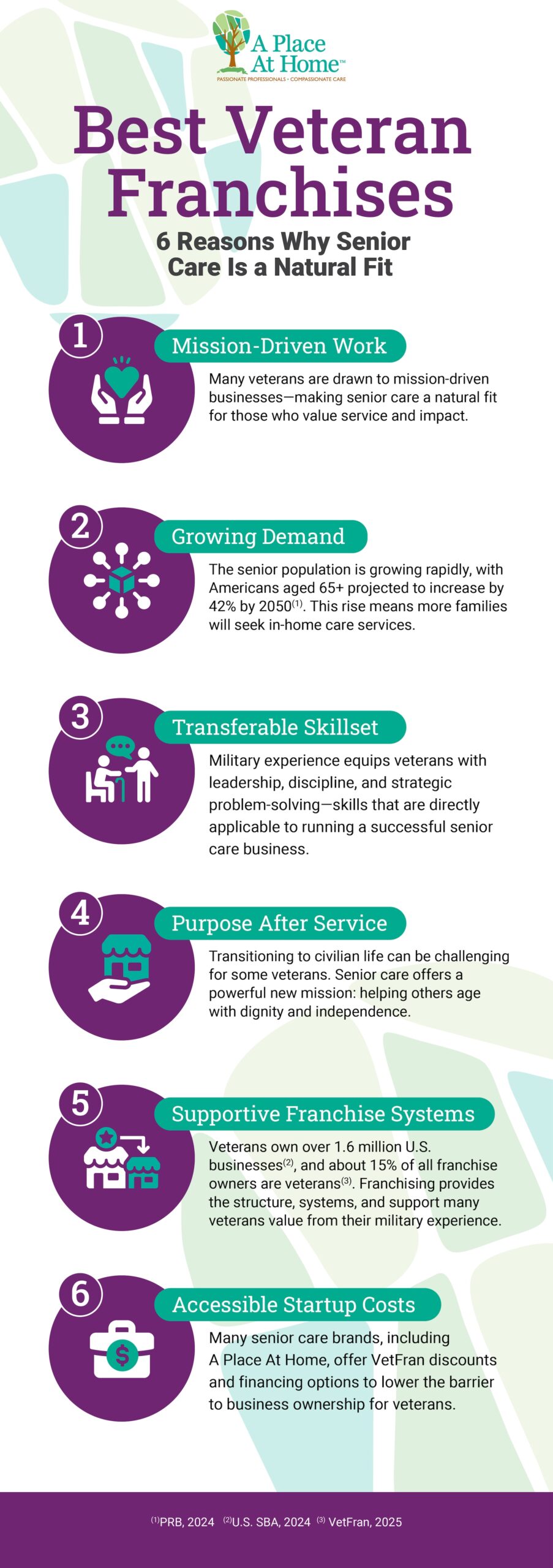
Are you looking for your next mission post military life? Why not consider entrepreneurship? Recent data shows that veterans make up 5.5% of business owners in the U.S.—employing almost 3.3 million people across over 1.6 million businesses. And many of those businesses are franchises, allowing savvy entrepreneur veterans to build their business from a proven playbook.
Senior care stands out as one of the best veteran franchises because it aligns with the values that veterans already have including duty, leadership, and service. Learn more about why senior care is a leading veteran franchise, how to become a successful entrepreneur, and why partnering with a brand like A Place At Home could be the right next step for you.

Are you still on the fence about senior care? Get in touch with our team at A Place At Home today. We’ll take you through our franchise opportunity, detail who makes an ideal franchise partner, review startup costs—including our veteran discount of 10% off our franchise fee—and answer any other questions you may have.
Fill out our inquiry form today and our team will be in touch to set up an introductory call.
Sources
1: PRB, 2024
2: U.S. SBA, 2024
3: VetFran, 2025
Top Veteran Franchise Opportunities: In-Home Senior Care
5 Ways to Open Multiple Revenue Streams in Senior Care Franchising
Building a financially sustainable business starts by embracing multiple revenue streams. Offering one service isn’t enough if your goal is to remain economically resilient—that’s why many entrepreneurs turn to senior care to grow strong businesses. In senior care, there are many ways to diversify your income streams to scale your business. Discover how varying streams of income help fuel franchise growth and why partnering with brands like A Place At Home sets you up for success in the booming senior care market.
What Is a Multi-Stream Franchise Model in Senior Care?
Economic uncertainty can threaten the prosperity of single-service businesses. That’s why A Place At Home is structured to offer a variety of senior care services, giving franchisees the ability to diversify their income through multiple revenue streams.
We offer the following to clients and their families:
- In-home senior care: Often the most common and consistent revenue stream for senior care franchises, in-home care includes a multitude of services such as companion, personal, and memory care. These offerings are typically billed on an hourly basis and provide strong recurring revenue potential—especially when you understand how to get private pay home care clients.
- Specialized care: Specialized care is tailored for seniors living with chronic conditions like dementia, Parkinson’s, or Alzheimer’s disease, as well as those recovering from strokes, falls, or surgeries. Going beyond traditional in-home care, this type of care often requires a more skilled team. However, it allows franchisees to serve a wider range of clients, creating additional revenue opportunities.
- Care coordination: Care coordination services help families navigate the healthcare system. With offerings such as scheduling medical appointments, communicating with physicians, and managing discharge plans, we ensure all aspects of a senior’s care are properly aligned—building trust and loyalty with clients and their families.
- Senior living alternatives: A referral-based service, franchisees earn commissions from local long-term care facilities for successfully placing seniors in their living arrangements. Ideal for families overwhelmed by the placement process, this service provides a low-overhead, scalable stream of income for franchisees.
- Healthcare staffing solutions: A B2B service that complements the B2C side of the business, franchisees can also provide staffing solutions to senior living communities, rehab centers, or medical offices that are short-staffed. With the ongoing shortage of healthcare workers, you can utilize your existing caregiver workforce to open new revenue streams.
How These Multiple Revenue Streams Work Together
Each of these revenue streams is interconnected, creating a cycle of ongoing care. For example:
Frank is a 75-year-old man recovering from a recent surgery. His family brought in specialized care to help him heal at home. However, as Frank ages, his family realizes he may need long-term in-home care to help him with grooming and other personal needs. Eventually, Frank gets to a point where in-home care isn’t enough, and he needs to be placed in a long-term care facility.
Ideally, if you’re offering all the aforementioned services, Frank’s family can work directly with your business to get him the care he needs. This way, you’re not just establishing multiple revenue streams; you’re fostering a trusting relationship with Frank and his family. By supporting him through varying life stages, you’ve generated a sense of brand loyalty by keeping Frank in your care network for years.
Additionally, consider how offering these services under one brand streamlines your operations. Shared staffing, unified branding, and consolidated marketing efforts across services make it easier—and more cost-effective—to scale your business.
Why Franchise with A Place At Home
If you’re looking for a low-overhead, high-potential franchise opportunity, consider partnering with A Place At Home. Offering an affordable business venture, our startup costs range from $91,195 to $166,012, including our initial franchise fee of $49,500. With our diversified revenue stream franchising model, ongoing support, and national brand recognition, our franchisees have ample opportunity to capitalize on their investment.
We have prime territories available nationwide. Each of our protected markets has a minimum of 40,000 senior residents, providingsupplying you with numerous opportunitiesplenty of prospects to grow your business.
To learn more about where our territories are located, the services we offer, or how to get started, pleasesimply contact us today. Once we receive your inquiry, a member of our team will be in touch with you to schedule an introductory meeting.
Can I Own a Senior Care Franchise with No Experience?
A common question often uttered during the franchise discovery process is “Can you buy a franchise with no experience?” The short answer? Yes. Most franchise opportunities are designed specifically for first-time business owners. With a built-in business model, comprehensive training, and ongoing support, many first-time entrepreneurs turn to franchising as a way to enter an industry with reduced risk.
As someone interested in the booming senior care industry, discover how partnering with the right franchise can make all the difference when launching your business—even without experience.
What Matters More Than Experience?
While industry experience can certainly help new business owners, many senior care franchises look for entrepreneurs with the following attributes instead:
- Empathy and people management: The ability to connect with clients, families, and caregivers is crucial to building a relationship-based business, such as senior care.
- Operational discipline: Staying organized and following through on daily tasks helps maintain service standards and ensures compliance with regulatory requirements.
- Community engagement mindset: Owners must be comfortable with outreach, local events, and networking to establish a referral pipeline.
- Financial discipline: You don’t need to be an accountant, but you should have basic financial literacy and a strong focus on profitability to ensure long-term success.
- Service-driven attitude: Franchisors look for franchisees who are passionate about helping others and building purpose-driven businesses.
Keep in mind that many franchise brands prioritize cultural fit over direct industry experience. Established franchisors have the tools and resources needed to help new entrepreneurs feel ready for business ownership. However, while operational processes can be taught, core personality traits—like empathy, discipline, and adaptability—cannot.
Do I Need a Background in Healthcare or Caregiving?
To put it simply: No, you do not need to have a background in healthcare and caregiving to own a senior care franchise. In fact, many franchisees do not have direct experience in the healthcare industry. Instead, they made the switch to business ownership after spending years working in corporate America—ultimately deciding to work hard for themselves instead of someone else.
With a senior care franchise opportunity like A Place At Home, you’ll have a dedicated team of highly trained caregivers who will provide care to seniors. As the owner, you’ll focus on handling administrative tasks, acquiring new clients, and other operational checklist items. Ultimately, your primary responsibility is to manage the business, while your staff delivers high-quality care.
How A Place At Home Helps You Start Strong
Starting a franchise with no experience can seem overwhelming. With A Place At Home, you’re not going into the process alone. We’ll be with you each step of your journey to ensure you’re set up for success from day one.
Our CARE track is designed to provide guidance and support to our new franchisees. During the CARE Launch stage, you’ll complete the CARE Sales and CARE Recruit and Retention virtual training. Then you’ll attend a hands-on 40-hour training program at our flagship location in Omaha, where you’ll learn how to do the following:
- Use our scheduling software
- Track financials
- Manage payroll
- Onboard new clients
- Coordinate services
- Recruit, hire, and train staff
- Launch marketing and branding initiatives
However, support doesn’t stop once you’ve launched your business. Through our CARE Coaching, you’ll have regular calls with expert Franchise Business Coaches to help you understand key performance indicators (KPIs) and best practices so you can grow your business.
Get Started with A Place At Home Today
To learn more about how to become a successful entrepreneur through the A Place At Home franchise opportunity, contact us today. Once we receive your inquiry, a member of our team will be in touch to arrange an introductory meeting.