How to Find Reliable Elderly Care at Home in Woodland Hills, CA

How to Find Reliable Elderly Care at Home in Woodland Hills, CA

Quick Takeaways: Finding Reliable Elderly Home Care in Woodland Hills

  • Nearly 1 in 5 Woodland Hills residents is 65 or older, meaning quality in-home care is in high demand
  • Always verify an agency is licensed through the California Department of Social Services before hiring
  • Ask if caregivers are employees (not contractors) and what the backup plan is when someone calls out
  • Part-time home care in LA can cost significantly less than the $6,281/month flat rate of assisted living
  • A personalized care plan and in-home assessment before day one are non-negotiable
  • Watch for red flags: vague screening processes, pressure to sign contracts, and no dedicated family contact
  • Local resources like IHSS, the LA County Department of Aging, and All Seniors Foundation can help offset costs
  • A Place At Home Woodland Hills serves the full South San Fernando Valley with a free consultation available

Introduction

Making the decision to bring care into your parent’s home is one of the most personal choices a family can make. You want someone who will show up on time, treat your loved one with genuine respect, and actually pay attention to what they need. But knowing how to find that level of care, and knowing you can trust the people and the agency behind it, takes some guidance.
Woodland Hills is home to a sizable and growing senior population. Nearly 17.9% of residents are 65 or older, and the community’s above-average household income means families here often have options, but that abundance of choice can also make the search feel overwhelming. This guide walks you through exactly what to look for, what questions to ask, and how to evaluate your options so you can make a confident decision.

The Reality of Aging in Woodland Hills and the South San Fernando Valley

Understanding the local landscape helps you make a better decision. Here are a few numbers worth knowing:

MetricStatistic
Woodland Hills residents aged 65+17.9%
Older adults (age 60+) in Los Angeles County2 Million+
Projected senior population growth in LA County by 203055%

 The South San Fernando Valley, including Woodland Hills, Tarzana, West Hills, Calabasas, and Canoga Park, has seen steady growth in its older adult population over the past decade. At the same time, demand for quality in-home care has risen sharply. That means families need to be thoughtful and proactive when searching for care.

One in four 65-year-olds today is expected to live past age 90. Planning ahead, rather than in crisis mode, gives you the best chance of finding the right fit.

What Reliable Elderly Home Care Actually Looks Like

Not all home care is created equal. The difference between a good agency and a mediocre one often shows up in the details, how they screen caregivers, how they handle scheduling gaps, and whether they take the time to understand your loved one’s individual needs.
Reliable elderly care at home typically includes:

  • Personal care assistance: bathing, grooming, dressing, toileting
  • Meal preparation tailored to dietary needs or restrictions
  • Medication reminders
  • Light housekeeping and laundry
  • Companionship and social engagement
  • Transportation to appointments, errands, or outings
  • Alzheimer’s and dementia care for those with cognitive decline
  • Respite care for family caregivers who need a break

In Woodland Hills, many families start with part-time help, a few hours several days a week, and adjust over time as needs change. A quality agency will make that transition easy without requiring you to restart the whole intake process.

Key Questions to Ask Before Hiring a Home Care Agency in Woodland Hills, CA

When you call or meet with an agency, come prepared. The answers to these questions will tell you a lot about whether they are the right fit for your family.

About Caregivers

  • Are caregivers employees or independent contractors? Agencies that employ their caregivers directly handle taxes, insurance, and workers’ compensation. This protects your family from liability.
  • What does the background screening process look like? A thorough agency conducts criminal background checks, reference checks, and verifies certifications before placing anyone in a home.
  • How are caregivers trained? Ask specifically about dementia care training, fall prevention, and emergency response protocols.
  • What happens if my assigned caregiver is sick or unavailable? The answer should not be ‘we’ll let you know.’ A reliable agency has a backup plan ready.

About the Agency

  • Are you licensed by the state of California? California requires home care agencies to be licensed through the Home Care Services Bureau under the Department of Social Services.
  • Do you carry general liability and professional liability insurance? This protects your loved one and your home.
  • How do you handle family communication and care updates? Regular check-ins and transparent reporting are signs of an accountable organization.
  • Can we meet caregivers before committing? A good agency welcomes this. It helps ensure compatibility before care begins.

About the Care Plan

  • Do you create a personalized care plan? Generic care rarely fits specific needs. Look for an agency that conducts an in-home assessment before finalizing any arrangement.
  • How often is the care plan reviewed and updated? Needs change. Care plans should too.
  • What happens in a medical emergency? Know the protocol before you need it.

Understanding the Cost of In-Home Care in Los Angeles

Cost is a real factor for most families, and it is worth understanding what you are actually comparing when you look at options.

In the Los Angeles area, professional home care averages roughly $6,436 per month based on a 40-hour week. For seniors who only need 20 to 30 hours of assistance weekly, the cost comes in well below that. For context, the median cost of an assisted living facility in Los Angeles has climbed to approximately $6,281 per month, and that number does not include add-ons for memory care, medication management, or specialized services, which can add another $500 to $3,000 monthly on top of the base rate.
When comparing options, factor in what in-home care preserves that a facility cannot: the comfort of familiar surroundings, one-on-one attention, family flexibility, and the ability to maintain routines that matter to your loved one. Research consistently shows that seniors who remain at home report higher satisfaction and, in many cases, better health outcomes than those who transition to institutional settings.

California in-home care averages approximately $32 per hour, which puts the San Fernando Valley region slightly above the national average, reflecting the higher cost of labor in Greater Los Angeles. For families navigating tighter budgets, some options through IHSS (In-Home Supportive Services) may be available for qualifying seniors, with over 151,000 older adults in LA County currently receiving IHSS services.

How to Verify a Home Care Agency in California

California has clear licensing requirements for home care agencies. Before signing anything, take these steps:

  • Check the California Department of Social Services (CDSS) database. The Home Care Services Bureau maintains a public list of licensed agencies. Search by agency name or zip code to confirm their status.
  • Look up any complaint history. The CDSS website also lists any enforcement actions or substantiated complaints against licensed agencies.
  • Verify caregiver registration. In California, individual home care aides must also be registered with the state. A reputable agency will confirm this without hesitation.
  • Check reviews across multiple platforms. Look at Google, Yelp, and care-specific sites. Pay attention to how the agency responds to negative feedback, that tells you a lot about how they operate.
  • Ask for references. Talk to current or former client families whenever possible.

Warning Signs to Watch Out For

Not every agency advertising in the Woodland Hills area operates at a high standard. Watch for these red flags:

  • Vague or no information about caregiver screening
  • Pressure to sign a long-term contract before completing an in-home assessment
  • No clear answer about what happens if a caregiver does not show up
  • Unlicensed operation or reluctance to share their CDSS license number
  • One-size-fits-all care plans with no personalization process
  • No dedicated point of contact for family questions or concerns
  • Unusually low rates without a clear explanation of what is and is not included

Trust your instincts. If something feels rushed, vague, or evasive, it probably is.

Local Resources for Families in Woodland Hills

Families navigating elderly care in the Woodland Hills and South San Fernando Valley area have access to several helpful local resources:

  1. Los Angeles County Department of Aging (LADOA): Provides information on programs, benefits, and services available to older adults throughout LA County.
  2. Westside Regional Center: Offers services for adults with developmental disabilities, including coordination of in-home supports.
  3. Area Agency on Aging (AAA) for LA County: Connects families with local programs including meal delivery, transportation assistance, caregiver support, and more.
  4. All Seniors Foundation: A Los Angeles nonprofit that helps seniors navigate free support services, including coordination across medical offices, home care agencies, and transportation in the West San Fernando Valley.
  5. West Hills Hospital and Medical Center and Kaiser Permanente Woodland Hills: Both offer discharge planning and referral services for patients transitioning from hospital to home-based care.

Aging in Place in Woodland Hills: Why It Works Here

Woodland Hills is genuinely well-suited for aging in place. The community is walkable in many areas, close to major medical centers, and served by a number of home care agencies with experience in the region.

The neighborhood’s established, suburban character means many seniors have lived in their homes for decades. They know their neighbors, their doctors, and their routines. Keeping that continuity intact while adding the right level of professional support is, for most families, a far better option than relocating to a facility, especially earlier in the care journey.

Woodland Hills is also home to a high concentration of seniors with specific cultural, dietary, and social preferences. Families here benefit from working with agencies that take the time to match caregivers based on more than just availability, whether that means language compatibility, shared background, or experience with specific health conditions common in aging populations.

Ready to Find Trusted Home Care in Woodland Hills or the South San Fernando Valley?

If you are looking for in-home care for a parent, spouse, or loved one in Woodland Hills, West Hills, Calabasas, Tarzana, Encino, Westlake Village, Canoga Park, or anywhere in the South San Fernando Valley, A Place At Home-Woodland Hills is here to provide home care services in Woodland Hills , CA and nearby areas.

A Place At Home – Woodland Hills
Serving Woodland Hills and the South San Fernando Valley

Compassionate home care for seniors

We provide personalized, professional home care services including:

  • Personal care and activities of daily living
  • Alzheimer’s and dementia care
  • Companion and respite care
  • Post-hospital and transitional care
  • Senior transportation and errand assistance

We know Woodland Hills. We understand the families here, the community, and what quality care at home actually looks like in practice. Schedule Your Free Consultation Today

How to Calm an Agitated Dementia Patient at Home: 10 Caregiver-Tested Strategies

Senior man with dementia looking confused and anxious at home while caregiver offers calm support

Quick Takeaways

  • Agitation is communication, not behavior. Your loved one is expressing an unmet need.
  • Your calm is contagious. Regulate yourself before trying to calm them.
  • Validate feelings, never correct facts.
  • Check physical needs first: hunger, thirst, pain, and UTIs are common hidden triggers.
  • Simplify the environment. Less noise and clutter means less agitation.
  • Distraction works better than reasoning once agitation has started.
  • Routine reduces confusion and lowers the risk of agitation daily.
  • Gentle touch can reach someone when words no longer can.

Introduction

If your loved one with dementia has become suddenly upset, fearful, or impossible to reach, you already know how helpless that moment can feel. You want to help, but nothing you say seems to land. The agitation comes out of nowhere, and it can be frightening for both of you.

This guide is written from that place of knowing. As someone who cared for my mother Bimla through both dementia and Parkinson’s disease, I learned these strategies not from a textbook, but from the moments when she needed me to figure it out. Below are 10 practical ways to calm an agitated dementia patient at home, along with the reasoning behind each one, so you can adapt them to your loved one’s specific needs.

Why Dementia Patients Become Agitated

Agitation is not intentional. It is your loved one’s way of expressing something they can no longer put into words.

Research makes clear just how common this is. According to a study published in the NIH’s National Library of Medicine, agitation affects up to 70% of people with cognitive decline, with rates rising as the disease progresses. A separate large-scale analysis of more than 320,000 patients with Alzheimer’s and dementia found that nearly 45% showed evidence of agitation overall, climbing to over 61% among those with a confirmed disease stage, and reaching as high as 74% in moderate to severe cases. The National Institute on Aging confirms that agitation and aggression are among the most challenging behavioral changes families face, and notes that most episodes happen for a reason that can be identified and addressed.

If your loved one is experiencing agitation frequently, you are not alone, and it is not a reflection of how well you are caring for them.

Common causes include:

  • Environmental overload. Noise, clutter, crowds, and unfamiliar surroundings overwhelm a brain already struggling to process information. What feels normal to you can feel chaotic and threatening to someone with dementia.
  • Unmet physical needs. Hunger, thirst, pain, a full bladder, clothing that is too tight or itchy. When a person with dementia cannot communicate physical discomfort clearly, frustration often comes out as agitation instead.
  • Medical factors. Urinary tract infections (UTIs) are a well-known trigger for sudden, severe agitation in older adults with dementia. Medication side effects and untreated illnesses also play a role.
  • Emotional triggers. Feeling rushed, ignored, embarrassed, or unsafe are powerful triggers. As your loved one loses independence, even ordinary tasks can feel overwhelming and distressing.

Knowing the likely cause helps you choose the right response.

10 Ways to Calm an Agitated Dementia Patient at Home

1. Regulate Yourself First

Your emotional state directly affects your loved one. Psychologists call this mirroring. When one person is upset, those around them often become upset too, and vice versa. If you approach an agitated moment with calm, steady energy, you are offering your loved one a way to follow you there.

Before you speak, take a slow breath. Drop your shoulders. Soften your expression. This is not passivity. It is one of the most effective de-escalation tools available to you.

2. Stop and Give Your Full Attention

Trying to calm someone with dementia while continuing another task almost never works. Put down whatever you are holding, turn to face them, and be fully present.

Listen without correcting. Even if what your loved one is saying makes no sense, interrupting or arguing adds conflict and escalates the moment. Silence is also useful. Pausing gives them time to find their words and feel less rushed.

Leaving your phone in another room during care activities can also help. Research has found that smartphone use reduces awareness of those nearby, meaning you may miss early signs of frustration before they escalate.

3. Use Warm, Steady Eye Contact

Eye contact communicates safety. When your loved one sees that you are calm and focused on them, it signals that they are not alone and that there is no immediate threat.

Pair your gaze with a quiet, reassuring tone. Simple phrases like “I’m right here,” “You’re safe,” or “We have plenty of time” can help anchor them in the moment. Avoid asking multiple questions at once. One simple statement or question at a time is easier to process.

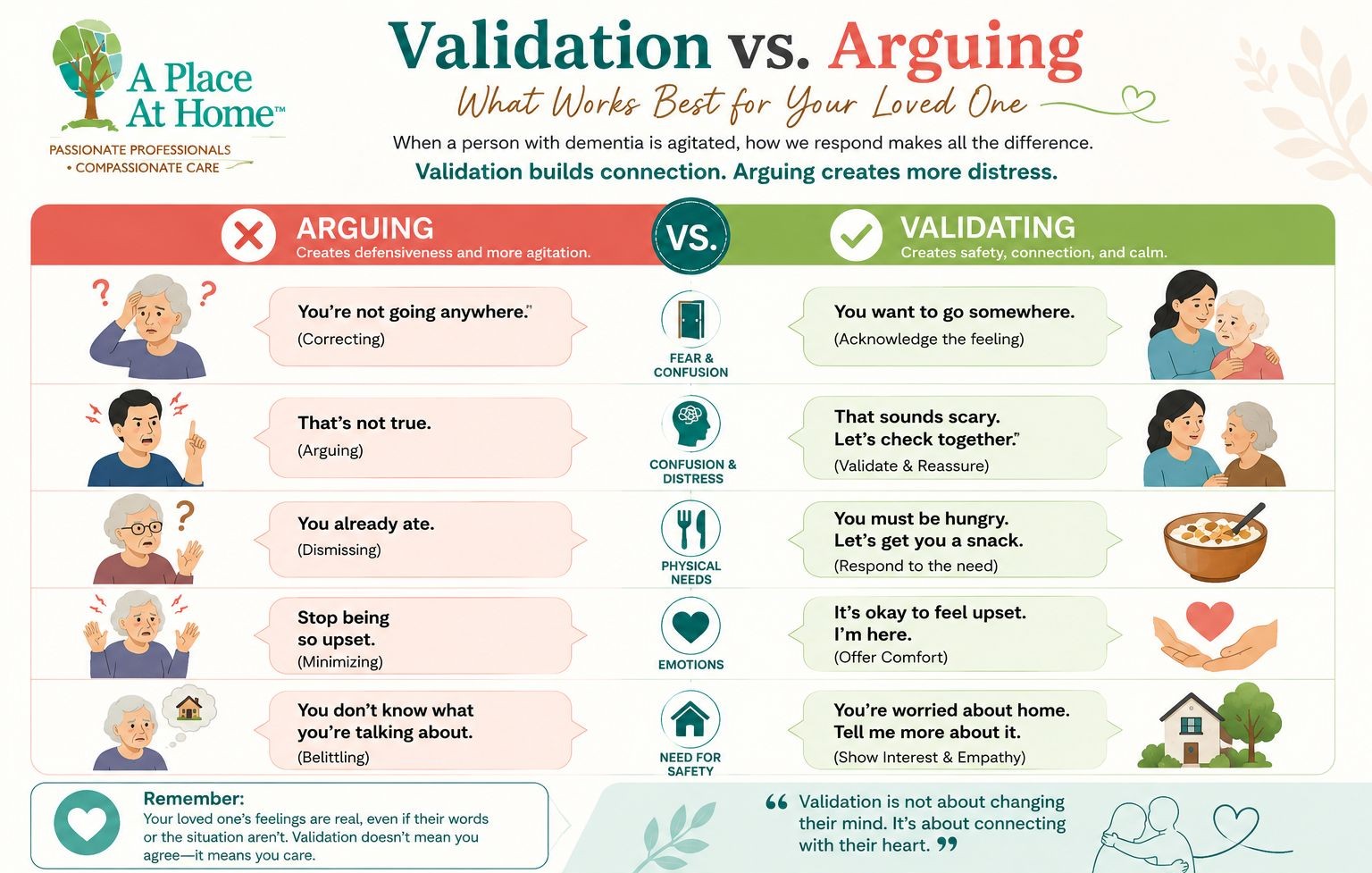
4. Validate, Do Not Argue

One of the most counterintuitive but effective approaches in dementia care is validation therapy. This means entering your loved one’s reality rather than correcting it.

If your mother says there is a stranger in the house when she sees your father, do not say “That’s Dad, you know him.” Instead, respond to the feeling underneath: “That sounds frightening. Let’s go see together.” You are not lying. You are responding to the emotional reality of what she is experiencing, which is the part that matters most in that moment.

Arguing about facts almost never calms agitation. Validating feelings almost always helps.

Validation vs. Arguing: Caregiving Guide

5. Reduce Stimulation in the Environment

When agitation begins, think about what is happening in the room around your loved one. Is the television on? Are multiple people talking? Is the lighting harsh or flickering?

Move to a quieter space if possible. Turn off background noise. Dim bright lights. A simplified, calm environment gives the brain less to process and often reduces distress quickly.

For ongoing care, aim to limit visitors to one or two at a time. Large gatherings are consistently hard for people with dementia to navigate.

6. Declutter the Living Space

A cluttered room is not just visually busy. For someone with dementia, it can feel genuinely threatening and disorienting. Too many objects, patterns, or moving parts make it harder for the brain to settle.

Keep surfaces clear. Store items that are not regularly used. Replace bold, busy patterns on rugs, cushions, or wallpaper with simpler ones. Small environmental changes can have a meaningful impact on baseline agitation levels over time.

One or two personal items, such as a favorite photo, a familiar blanket, or an object with sentimental meaning, can provide reassurance when placed within easy reach.

7. Check for Unmet Physical Needs

Before looking for a behavioral or emotional cause, run through a quick physical checklist:

  • Has your loved one eaten recently?
  • Are they drinking enough fluids throughout the day?
  • Are they showing signs of pain, such as wincing, guarding a body part, or reluctance to move?
  • Does clothing fit comfortably? Is anything too tight, scratchy, or damp?
  • When did they last use the bathroom?
  • Have they shown signs of a UTI, such as sudden confusion, unusual urgency, or cloudy urine?

A surprising number of agitation episodes resolve once a physical need is met. Starting here can save a great deal of stress.

8. Use Distraction and Redirection

When agitation has already started, trying to reason through it rarely works. Redirection is more effective. Gently shifting attention toward something familiar and comforting can break the cycle quickly.

Suggest a short walk outside. Offer a favorite snack. Put on music from their younger years. Bring out a photo album. Ask for their help with a simple, satisfying task like folding towels or sorting objects.

The goal is not to dismiss what your loved one is feeling, but to offer their brain a different path, one that leads somewhere calmer. Keep a few go-to items within easy reach: a playlist ready on your phone, a snack they love in a consistent spot, a photo album on a nearby shelf.

9. Maintain a Consistent Daily Routine

Predictability is protective for people with dementia. When your loved one knows roughly what to expect next, when meals happen, when they bathe, when they rest, there is less room for confusion and fear to take hold.

Set regular times for waking, meals, activities, and bedtime and stick to them as closely as possible. When changes are necessary, introduce them gradually rather than all at once.

Even small rituals matter. A cup of tea at the same time each afternoon, a familiar song before bed, or a consistent order to morning tasks all help create a sense of safety and orientation.

10. Offer Gentle Physical Comfort

When words are not reaching your loved one, human touch sometimes can. A gentle hand on the shoulder, holding their hand, or a quiet hug, when welcomed, communicates care in a way that bypasses the need for language entirely.

Pay attention to how your loved one responds to touch. Some people with dementia find it deeply comforting; others find it startling or unwanted. Follow their cues. If they lean into contact, offer more. If they pull away, give space and try another approach.

When These Strategies Are Not Enough

The strategies above work for many caregivers, many of the time. But dementia is a progressive condition, and there will be stages where agitation becomes more frequent, more intense, or simply more than one person can manage alone.

Signs that additional support may be needed include:

  • Your loved one is wandering or getting lost in familiar surroundings
  • They are forgetting to eat or missing medications regularly
  • Agitation episodes are happening daily or becoming physically unsafe
  • You, as the caregiver, are exhausted or struggling to cope

This is not failure. It is the nature of the disease advancing. Getting support sooner rather than later protects both your loved one and you.

In Home Dementia Care from A Place At Home-Woodland Hills

Family caregivers who struggle to comfort an agitated loved one with dementia are encouraged to consider in-home support, such as memory care from A Place At Home – Woodland Hills. Our experienced dementia caregivers understand the symptoms of this progressive condition and how to calm agitated patients.

Dementia care at home can also be especially valuable when seniors begin wandering, getting lost in familiar places, or struggling to manage personal hygiene on their own. Forgetting to eat meals or missing medications are additional signs that extra support may be needed to help them remain safe and comfortable at home.

Compassionate dementia care at home in Woodland Hills CA

Our compassionate caregivers take the time to build meaningful relationships with seniors, creating a sense of trust, comfort, and familiarity through consistent care. Maintaining structured daily routines helps reduce confusion, anxiety, restlessness, and agitation by giving seniors a greater sense of stability and predictability.

In addition to emotional support, we provide practical non-medical assistance tailored to each senior’s needs. This may include transportation to medical appointments, medication reminders, and preparing nutritious meals that align with dietary guidelines. Caregivers also offer respectful assistance with personal care activities such as bathing, grooming, dressing, and toileting, helping seniors maintain their dignity and quality of life.

Dementia care from A Place At Home – Woodland Hills is centered on the unique needs of each individual. Our approach involves gaining an understanding of the senior’s preferences, routines and personality to deliver the highest quality care. Schedule a free in-home consultation to learn about our elder care for dementia patients in Woodland Hills, CA.


Dementia Care Related FAQs

These are some of the most common questions caregivers ask when managing agitation and behavioral changes in a loved one with dementia.

What medications are used to calm dementia patients?

Doctors may prescribe low-dose antipsychotics, antidepressants, or anti-anxiety medications to help manage severe or persistent agitation in dementia patients. Common options include risperidone, quetiapine, and sertraline. However, medication is typically considered a last resort after non-drug approaches have been tried first, as many carry risks for older adults. Always consult your loved one’s physician before starting or adjusting any medication.

How do you handle a combative dementia patient?

Stay calm and avoid raising your voice or arguing. Give them space and do not try to physically restrain them unless there is an immediate safety risk. Speak slowly and gently, use their name, and try to redirect their attention to something familiar and comforting. Identify if a physical need like pain or discomfort is driving the behavior. If combative episodes are frequent or escalating, speak with their doctor, as a medical cause or medication review may be needed.

Does dementia cause agitation?

Yes. Agitation is one of the most common behavioral symptoms of dementia, affecting up to 70% of people with cognitive decline at some point during their illness. It is caused by the disease’s impact on the brain, which affects how a person processes emotions, communicates needs, and responds to their environment. It is not intentional and typically worsens as the disease progresses.

What can I give a dementia patient to calm down?

Non-drug approaches are always the first step. Offering a favorite snack, playing familiar music, providing gentle touch, or moving to a quieter space can all help de-escalate agitation quickly. Ensuring they are hydrated, comfortable, and not in pain also makes a significant difference. If these strategies are not enough and agitation is severe, consult their doctor about whether medication may be appropriate.