

As the day winds down and the house grows quiet, many older adults experience a rise in anxiety that makes nighttime one of the most difficult parts of their day. At A Place At Home – Weston, our caregivers see this shift often. Seniors who seemed calm earlier in the day may become restless, uneasy, or disoriented by early evening.
Nighttime anxiety in seniors is more than a minor sleep issue. When it is not addressed, it can increase the risk of falls, accelerate cognitive decline, and place added strain on family caregivers. It can also impact a senior’s overall quality of life in a meaningful way. The encouraging part is that many cases improve with a structured and thoughtful approach based on proven care strategies.
This guide explains the common causes of nighttime anxiety in older adults, how to recognize the signs, and what approaches are most effective in reducing it.
 If your loved one is waking frequently or struggling with disrupted sleep patterns, you may also find this helpful: Common Reasons Why Your Elderly Parent Keeps Waking Up at Night
From our caregivers: “Many families don’t realize how quickly nighttime anxiety can escalate. A senior who seems fine at dinner can be deeply confused by 8 PM. Consistency in routine, lighting, and caregiver presence is the single biggest difference-maker we’ve seen.”
— Danielle Smith, Senior Care Coordinator, A Place At Home – Weston
If your loved one is waking frequently or struggling with disrupted sleep patterns, you may also find this helpful: Common Reasons Why Your Elderly Parent Keeps Waking Up at Night
From our caregivers: “Many families don’t realize how quickly nighttime anxiety can escalate. A senior who seems fine at dinner can be deeply confused by 8 PM. Consistency in routine, lighting, and caregiver presence is the single biggest difference-maker we’ve seen.”
— Danielle Smith, Senior Care Coordinator, A Place At Home – Weston

What Is Nighttime Anxiety in Seniors?
Nighttime anxiety refers to a pattern of escalating fear, worry, restlessness, or agitation that consistently worsens in the evening or during nighttime hours. It is distinct from ordinary sleeplessness. It is a behavioral and emotional pattern, not just a difficulty falling asleep. According to the National Institute on Aging, sleep architecture changes significantly with age. Older adults spend less time in deep, restorative sleep stages and more time in lighter sleep, making them far more susceptible to nighttime disturbances, physical, emotional, and environmental.Common Signs of Nighttime Anxiety in Older Adults
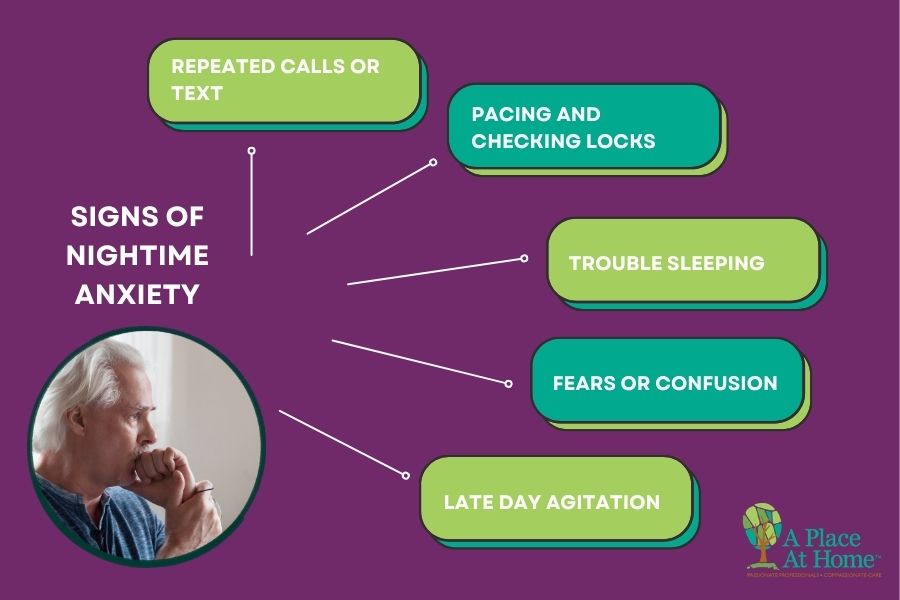
- Repeated phone calls or texts to family members after dark
- Pacing, wandering, or checking doors and locks multiple times
- Difficulty falling or staying asleep accompanied by visible distress
- Expressions of fear about being alone, dying, or losing control
- Waking disoriented, not knowing where they are or what time it is
- Increased confusion or agitation beginning in the late afternoon
If your loved one is waking frequently or struggling with disrupted sleep patterns, you may also find this helpful: Common Reasons Why Your Elderly Parent Keeps Waking Up at Night
From our caregivers: “Many families don’t realize how quickly nighttime anxiety can escalate. A senior who seems fine at dinner can be deeply confused by 8 PM. Consistency in routine, lighting, and caregiver presence is the single biggest difference-maker we’ve seen.”
— Danielle Smith, Senior Care Coordinator, A Place At Home – Weston
Common Causes of Nighttime Anxiety in Older Adults
Nighttime anxiety is rarely caused by a single issue. In our experience providing in home care across Broward County, the most difficult cases are those with multiple overlapping causes. Understanding each one is essential to building an effective response.1. Sundowning Syndrome (Dementia Related)
Sundowning is one of the most common and disruptive causes of nighttime anxiety in seniors with cognitive decline. The Alzheimer’s Association defines sundowning as a state of confusion occurring in the late afternoon and evening in people with Alzheimer’s disease or other forms of dementia. Symptoms typically begin between 4:00 and 6:00 PM and can persist well into the night. The exact cause is not fully understood, but research points to disruption of the brain’s circadian clock, fatigue accumulated over the day, and a reduced ability to process dim or shifting light. Why it happens: As dementia progresses, the suprachiasmatic nucleus, the part of the brain that regulates sleep wake cycles, becomes increasingly damaged. This disrupts the body’s internal clock, making it harder to distinguish day from night.2. Sleep Disorders
The American Academy of Sleep Medicine estimates that 50 to 70% of older adults experience chronic sleep problems. Two are particularly linked to nighttime anxiety:- Insomnia: Difficulty initiating or maintaining sleep leads to a self reinforcing cycle. The bed becomes associated with frustration and wakefulness rather than rest.
- Sleep apnea: Repeated airway obstruction during sleep causes micro arousals throughout the night. Seniors with undiagnosed sleep apnea often wake feeling panicked, short of breath, or deeply disoriented, symptoms that are frequently misattributed to anxiety alone.
3. Medication Side Effects
Many medications commonly prescribed to older adults can disrupt sleep or heighten anxiety, particularly when taken in the afternoon or evening. These include:- Corticosteroids such as prednisone and dexamethasone, which are known to increase alertness and agitation
- Certain antidepressants, especially SSRIs taken in the evening
- Beta blockers, which can suppress melatonin production and impair sleep onset Diuretics, which can cause frequent nighttime bathroom trips and disrupt sleep continuity
4. Physical Discomfort and Pain
Chronic pain is underreported in older adults, partly due to stoicism and partly due to cognitive difficulty articulating discomfort. Arthritis, neuropathy, post surgical pain, and bladder urgency all worsen when the senior is still and has nothing to distract them, exactly the conditions of bedtime. Pain that is manageable during an active day can feel overwhelming at 2 AM.5. Urinary Tract Infections (UTIs)
This is one of the most under recognized causes of sudden nighttime confusion in older adults, particularly women. Unlike younger people, elderly individuals often do not present with typical UTI symptoms such as burning or frequency. Instead, the primary symptom is often sudden behavioral change, confusion, agitation, paranoia, or extreme nighttime anxiety. If a senior’s nighttime symptoms appear suddenly and without an obvious trigger, a UTI should be ruled out immediately with a urine test.6. Emotional and Psychological Factors
The quiet of nighttime removes the distractions of daytime activity. For seniors, particularly those who are widowed, live alone, or have recently experienced loss, evening hours can become dominated by grief, fear of dying, loneliness, and existential worry. Depression in older adults is frequently underdiagnosed and can present primarily as nighttime agitation rather than daytime sadness.Recognizing Sundowning: What Families Should Know
Because sundowning is so common, affecting an estimated 20% of people with Alzheimer’s disease according to the Alzheimer’s Association, it deserves specific attention.Key Signs That Suggest Sundowning (Not Just Anxiety)
| Sign | What It Looks Like |
|---|---|
| Timing | Symptoms reliably worsen after 4–6 PM |
| Confusion | Disorientation to place, time, or familiar people |
| Misperception | Frightened by shadows; believes intruders are present |
| Wandering | Attempts to “go home” even when at home |
| Hallucinations | Sees or hears people who aren’t there |
| Rapid mood shifts | Calm → agitated → tearful within minutes |
Sundowning is not a separate disease. It is a symptom cluster. Identifying it as sundowning rather than general anxiety matters because the interventions are different. Light therapy, structured evening routines, and environmental modifications are more effective than sedation focused approaches.
Caregiver Based Strategies to Reduce Nighttime Anxiety
1. Establish a Consistent Evening Routine
The brain, especially a brain affected by cognitive decline, relies heavily on predictability to feel safe. A routine that begins at the same time each evening and follows the same sequence of calming activities helps signal that sleep is approaching in a non threatening way. Effective routine elements:- Light dinner no later than 6:00 to 6:30 PM
- A short, gentle walk or seated stretching
- Dimming lights throughout the home beginning at 7:00 PM
- Calming music, a familiar TV program, or conversation
- Consistent lights out time, even on weekends
- Avoid stimulating activities, including emotionally charged news programs, in the 90 minutes before bed.
2. Optimize Home Lighting
Lighting is one of the most powerful and underutilized tools in managing nighttime anxiety and sundowning. Research context: A 2019 study published in Sleep Medicine Reviews found that bright light therapy during the day significantly reduced agitation and sleep disturbance in patients with Alzheimer’s disease. Practical steps: Maximize natural light exposure during morning hours by opening curtains and taking walks- Use warm toned bulbs in evening living spaces to reduce stimulation
- Install night lights in every hallway, bathroom, and bedroom
- Avoid abrupt transitions from bright to dark rooms
- Remove or cover mirrors and reflective surfaces that can cause misperception at night
3. Modify Diet and Stimulant Intake
Older adults metabolize caffeine more slowly than younger people. A cup of coffee in the afternoon can still affect sleep at midnight. Recommendations:- No caffeine after 12:00 PM
- Avoid high sugar foods in the evening
- Offer a small protein containing snack before bed such as yogurt or nuts. Blood sugar dips at night can trigger waking and anxiety
- Ensure adequate hydration during the day, but reduce fluid intake after 6:00 PM to minimize nighttime bathroom trips
4. Increase Structured Daytime Activity
A fundamental principle of sleep medicine is that sleep pressure builds during waking hours. Seniors who are sedentary during the day often reach bedtime without enough sleep pressure, making it harder to fall asleep and easier to feel anxious when they cannot. Evidence backed activities:- 20 to 30 minutes of moderate walking per day, associated with improved sleep quality in older adults per a Journal of Sleep Research meta analysis
- Chair yoga or gentle stretching classes Social engagement such as conversation, games, and group activities
- Light gardening or household tasks
- Exposure to outdoor daylight before noon is especially valuable for resetting circadian rhythms.
5. Create an Anxiety Reducing Sleep Environment
- Sound: White noise machines or soft instrumental music can help mask disruptive nighttime sounds. Avoid silence if it increases feelings of isolation.
- Temperature: The ideal sleep temperature for most older adults is between 65 and 68 degrees Fahrenheit or 18 to 20 degrees Celsius.
- Safety cues: Motion sensor night lights, bed rails where appropriate, and a clearly visible clock can reduce disorientation upon waking.
- Comfort objects: For seniors with dementia, familiar items such as a photograph, soft blanket, or meaningful object can provide grounding during nighttime waking.
6. Communication Techniques That Reduce Anxiety
How caregivers and family members respond to a frightened senior matters greatly. What works:- Speak in a calm, low, slow voice
- Use short, clear sentences such as You are safe. You are home.
- Avoid arguing about what is real, as this increases distress
- Use gentle touch if the senior is comfortable with it
- Redirect attention such as suggesting a warm drink rather than confronting the anxiety directly
What does not work:
Raised voices or visible frustration- Long explanations or attempts to reason through confusion
- Dismissing fears such as saying there is nothing to worry about
7. Review Medications with a Physician
Request a medication review with the senior’s primary care physician or geriatrician, ideally supported by a pharmacist led medication reconciliation. Ask specifically:- Are any current medications known to disrupt sleep or increase anxiety
- Are any medications being taken at suboptimal times of day
- Are there safer alternatives to current sleep aids. Benzodiazepines and antihistamine based sleep aids carry significant risks in older adults and are generally not recommended per the American Geriatrics Society Beers Criteria.
When to Call a Doctor
While occasional nighttime anxiety can be common in older adults, certain symptoms may signal an underlying medical issue that requires professional attention. If changes in behavior appear suddenly or become severe, it’s important to contact a healthcare provider for evaluation.- Sudden behavioral changes: If a senior who was previously calm at night suddenly becomes extremely anxious, confused, or disoriented, there may be a medical cause that needs to be addressed. Infections, medication reactions, or metabolic changes can sometimes trigger rapid shifts in mood or cognition.
- Hallucinations: If a senior begins seeing or hearing things that are not there, it could be related to conditions such as Alzheimer’s disease or dementia, but it may also indicate an acute issue like a Urinary Tract Infection, which is a common cause of sudden confusion in older adults.
- Aggression or extreme agitation: Physical or verbal aggression can sometimes occur during episodes of severe anxiety or confusion, and a medical evaluation can help determine the underlying cause.
- Fever: Fevers, complaints of pain, or other physical symptoms may signal infection or illness that is contributing to nighttime distress. Even mild fevers can cause confusion in older adults and should be taken seriously.
- Rapid cognitive or functional decline: Functional or cognitive decline such as worsening memory, increasing disorientation, or a sudden inability to perform normal daily tasks should always be discussed with a healthcare professional. Early evaluation can help identify treatable causes and ensure seniors receive the appropriate care and support.