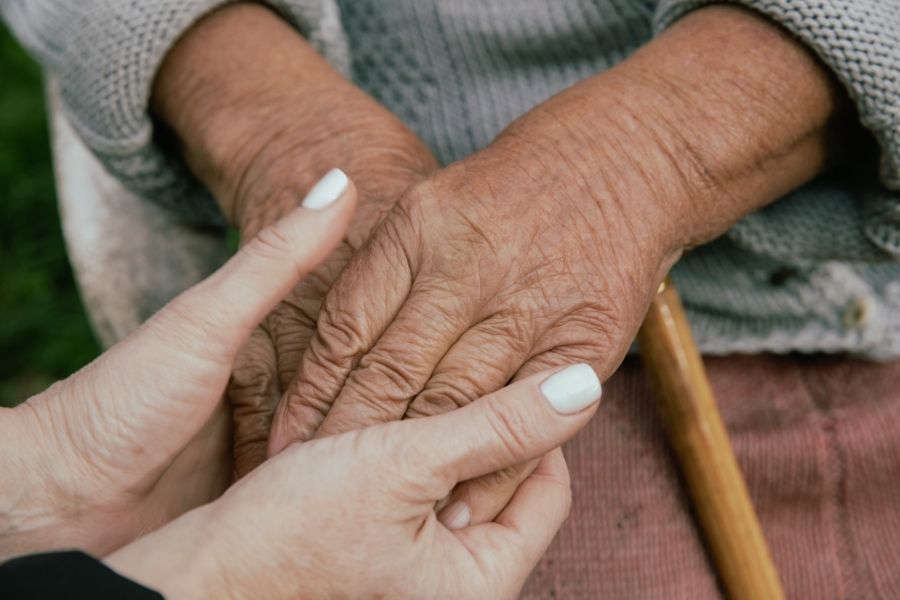
How to Talk to Your Parent About Accepting Help at Home in Summerlin, Las Vegas, Nevada

Rotator-Why-A-Place-At-Home2

You know your parent needs help.

You have seen the signs. The messy kitchen. The weight loss. The bruise they waved off. The medications they missed. The house that used to be spotless and now is not.

You know something has to change.

But every time you try to bring it up — your parent shuts it down.

“I am fine. I do not need stranger coming into my house. I have been taking care of myself for 70 years.”

And the conversation ends before it really begins.

If this sounds familiar — you are not alone. This is the most common situation families in Summerlin tell us about. Not that they could not find help. But that they could not get their parent to accept it.

First — Understand Why They Are Saying No

Before you can have this conversation well, you need to know what is really happening when your parent says no.

It is almost never that they do not realize they need help.

Most seniors know. On some level they know things are getting harder. They know the house is not what it used to be. They know they missed those pills. They know that fall last month was not nothing.

What they are really saying when they refuse is something much deeper than no.

They are afraid of losing independence.

For most older adults, independent status is not just a preference. It is individuality. It is dignity. It is the thing that separates them from being dependent and helpless. Accepting help — especially from a stranger in their own home — can feel like the beginning of the end of who they are.

They do not want to be a burden.

Your parent loves you. They do not want you to worry. They do not want you to spend money on them. They do not want to feel like a problem that needs answering. Saying they are fine is sometimes a way of caring you — even if it is not protecting them.

They are scared of what it means.

Admitting they need help can feel like acknowledging that things are going in one direction and not coming back. Like a door closing. That fear is real and understandable.

They had a bad experience or heard a bad story.

Maybe they knew someone who had a caregiver they did not like. Maybe they picture someone taking over their home and indicative them what to do. Maybe the word caregiver makes them think of hospitals and drop rather than support and company.

They value privacy above almost everything.

Many seniors — especially those of a generation that did not talk openly about struggles — find the idea of a stranger in their personal space deeply uncomfortable. Their home is their sanctuary. Understanding which of these is driving your parent’s resistance is the most important first step. Because the conversation looks very different depending on the real reason.

Before You Have the Conversation — Prepare

Having this conversation without preparation is how it turns into an argument.

Choose the right moment.

Do not bring this up in the middle of a stressful visit. Do not bring it up right after something went wrong — after you discovered the fall, after you found the expired medication. Doing it that way makes it feel like an accusation.

Choose a calm, unhurried time. A Sunday afternoon. A quiet coffee together. A walk if your parent is able. A moment when neither of you is tired, hungry, or already stressed.

Go in with curiosity — not a conclusion.

The conversation goes wrong when it starts as a presentation of facts you have already decided. You have noticed X, Y, and Z. You have already decided they need a caregiver. You need them to agree.

That approach almost always backfires. It puts your parent on the defensive immediately. Go in instead with genuine questions. How have you been feeling lately? Is there anything that has felt harder recently? What parts of the day do you find most tiring?

Let them talk. Let them tell you. You might be surprised what they say when they do not feel like they are being assessed.

Do not do it as a group ambush.

Some families think bringing everyone together — all the siblings, maybe a doctor — will be more convincing. It is usually the opposite. Most seniors experience this as an intervention. It feels like an attack. It triggers defensiveness and humiliation. One trusted person, one conversation, is almost always more effective.

Know what you are actually asking for.

Do not go into this conversation asking for a caregiver. That is too big a first step. Go in asking for something smaller.

Would you be willing to have someone come and help with meals a couple of times a week? Would you be open to someone coming with you to your appointment on Thursday? Would you let me arrange for someone to help with the house once a week?

Small asks are easier to say yes to. And one yes usually leads to another.

How to Have the Conversation

There is no perfect script. But here is what works.

Start with love — not logistics.

Open with what you actually feel. Not the list of things you have noticed. Not the plan you have in mind.

Something like:

“Mom, I want to talk to you about something because I love you and I have been worried. I am not here to tell you what to do. I just want to understand how things have really been for you lately.”

That opening changes the entire tone of the conversation. It is not a confrontation. It is a connection.

Use “I” statements not “you” statements.

There is a significant difference between these two sentences:

“You have not been eating properly and you missed your medications.”

“I have been worried because when I visited last week the fridge was almost empty and I noticed your pills from Tuesday were still in the pack.”

The first one accuses. The second one shares. Your parent will respond very differently to each.

Ask them what they find hard — do not tell them.

“Is there anything that has been harder lately? Anything you wish you had a little more help with?”

A lot of parents will open up when asked directly and gently. They have been waiting for someone to ask. They just did not want to bring it up themselves.

And even if they do not open up right away — you have planted a seed.

Connect it to what they want — not what you want.

Your parent wants to stay in their home. That is almost universal. They do not want to move to a facility. They do not want to give up their independence.

Use that.

“I know how important it is to you to stay in your home in Summerlin. I want that for you too. The best way to make sure that stays possible — for as long as possible — is to have some support in place now. Not because you cannot manage. But because having a little help means you can keep doing things your way, in your home, on your terms.”

That framing changes everything. Help is not the threat to independence. Help is what protects it.

Let them have control over the details.

Your parent needs to feel like they have a say. Because they do.

“You get to decide how often someone comes. You get to decide what they help with. You get to decide what your days look like. We are not taking anything away from you — we are adding support that fits around your life.”

The more control they feel they have, the less threatening the whole conversation feels.

Be honest about your own feelings.

Sometimes the most powerful thing you can say is the simplest.

“I lie awake at night worrying about you. Not because I think you cannot handle things. But because I love you and I would feel so much better knowing someone was there with you. Can you help me feel less worried?”

Most parents do not want their child lying awake worrying. Framing it this way — asking them to help you — can open a door that arguments and logic could not.

Common Objections — and How to Respond

“I do not want a stranger in my house.”

“I understand that completely. What if we just started with one visit — together — so you could meet the person first? You would be there the whole time. If you do not like them we do not continue. You are completely in charge.”

“I can manage fine on my own.”

“I know you can manage. This is not about whether you can manage. It is about making your life a little easier and giving me peace of mind. Would you do it for me?”

“I do not want to waste money.”

“I have looked into the cost and it is more affordable than I expected. And honestly, preventing one fall or one hospital stay would cost far more. Can we just look at the options together?”

“I do not want to end up in a nursing home.”

“That is exactly why I am suggesting this. Having support at home is what keeps people out of facilities. The families who get help early are the ones who stay home the longest.”

“I will think about it.”

“Okay. Can we agree to talk about it again next week? And in the meantime can I just make one call to find out what it would look like — just so we have the information?”

What If They Still Refuse?

Sometimes a parent will not agree no matter what you do. That is genuinely hard. And it is worth acknowledging that you cannot force someone to accept help if they are mentally competent and determined to refuse.

But here is what you can do.

Keep the conversation open. Do not let one refusal become a permanent closed door. Come back to it gently and regularly.

Involve their doctor. Many parents will hear from a doctor what they will not hear from a child. A physician saying “I think having some support at home is really important for your health right now” can carry enormous weight.

Start very small. Do not ask for a caregiver. Ask if someone can come and help in the garden. Ask if a companion can come for coffee once a week. Get a foot in the door. Most parents who accept one small thing gradually accept more.

Let a crisis create an opening. After a fall, after a hospital stay, after a scare — parents are often more open to accepting help than they have ever been. When that moment comes, be ready to move quickly. Have the information already gathered. Have the conversation ready.

Contact A Place at Home, Summerlin. We have helped hundreds of Summerlin families navigate this exact situation. We are happy to talk through your specific circumstances and suggest approaches that have worked for other families in similar situations — at no obligation to you.

A Note to Families Who Are Exhausted by This

If you have been having this conversation — or trying to — for months and getting nowhere, we see you.

This is genuinely one of the hardest parts of caring for an aging parent. You are trying to help someone who does not want to be helped, in a way that preserves their dignity, while managing your own fear and exhaustion.

There is no perfect way to do this. There is no magic sentence. There is just patience, persistence, love, and the willingness to keep showing up.

You are already doing the right things. You are paying attention. You are trying. That matters more than you know.

When a Parent Finally Says Yes — What Happens Next

When your parent agrees — even tentatively — move forward gently and quickly. Do not wait for them to change their mind.

At A Place at Home Summerlin, here is what the process looks like:

Step 1 — Free in-home assessment We come to your parent’s home in Summerlin, meet them in person, listen to their needs and preferences, and get to know them as a person — not a client. This is a conversation, not an evaluation.

Step 2 — Personalized care plan We build a care plan around your parent’s actual life. What they need help with. What they prefer to do independently. What their routines look like. What they enjoy.

Step 3 — Caregiver matching We match your parent with a specific caregiver who fits their personality, preferences, and needs. Consistency matters enormously. Your parent will see the same familiar face — not a different person every visit.

Step 4 — Care begins Usually within 24 to 48 hours of the free assessment. Gently, at whatever pace your parent is comfortable with.

There are no long-term contracts. No locked-in packages. And if at any point your parent does not connect with a caregiver — we find a different match.

You Do Not Have to Figure This Out Alone

Having this conversation with a parent is hard. Doing it well — without it turning into an argument, without damaging the relationship, without making your parent feel like they are losing control — requires patience, preparation, and sometimes a little outside help.

If you are stuck, call us. Not to set up care — just to talk. We can walk you through how other Summerlin families have navigated this conversation, what has worked, what has not, and what specific approaches tend to land well with parents who are resistant.

There is no obligation. No pressure. Just a real conversation with someone who has been through this with hundreds of families.


Signs Your Aging Parent in Summerlin Needs a Caregiver at Home

Supporting each step in a bright home

Noticing small changes in an aging parent is not being dramatic. It is being a good son or daughter.

The truth is most families do not call a home care agency because of one big dramatic moment. They call because of small things. Things that individually seem minor but together tell a bigger story.

A messy kitchen. A half-empty fridge. A bruise they cannot explain. A phone call that just felt different.

This blog covers the real signs — the ones families in Summerlin actually notice — that suggest an aging parent may need more support at home than they are currently getting.

What “Normal Aging” Actually Looks Like

Not every change means something is wrong.

Slowing down a little is normal. Forgetting where you put your keys is normal. Getting tired more easily is normal.

What is not normal — and what is worth paying attention to — is change. A gradual or sudden shift from how your parent has always been. In their home. In their habits. In their mood. In their safety.

One small change on its own might mean nothing. But several changes together — or one thing that keeps getting worse — is a signal worth taking seriously.

Why This Is Hard to See

When you love someone you adjust to what you see slowly.

Each visit your brain normalizes a little more. This is just how they are now. This is just getting older.

And that is exactly why so many families miss the early signs. Not because they are not paying attention. But because they are too close to see clearly.

You are not failing your parent by not noticing sooner. But now that something has caught your attention — this post will help you know what to look for.

The Signs — What Families in Summerlin Actually Notice

Medications are Not Being Managed

Walk through your parent’s medications. Are there bottles that should be empty but are not — meaning doses are being skipped? Are there multiple bottles of the same medication because they refilled without checking? Are they uncertain about what they take or when?

Medication mismanagement in seniors is extraordinarily common and genuinely dangerous. A missed blood pressure pill. A double dose of a blood thinner. Insulin not taken because the routine slipped. These are not minor issues — they are medical emergencies waiting to happen.

Managing multiple medications correctly requires consistent memory, organization, and routine. All three of those things can become harder as people age — and especially for anyone in the early stages of cognitive decline.

Watch for:

  • Confusion about what medications they take or what they are for
  • Pills left in the blister pack when they should have been taken
  • Multiple bottles of the same prescription
  • Bottles that are not running low when they should be

A caregiver who provides daily medication reminders — making sure the right pill is taken at the right time — is one of the most straightforward and impactful forms of support available.

Personal Hygiene Has Slipped

This one is uncomfortable to notice and even more uncomfortable to bring up. But it matters enormously.

If your parent — who has always cared about how they look and felt — is now wearing the same clothes for days, not bathing regularly, not combing their hair, or showing up to things looking noticeably unkempt — something has changed.

This can happen for different reasons. Getting in and out of the shower is physically difficult and risky when balance has declined. Depression significantly reduces motivation to care for oneself. Early dementia can make the sequence of getting washed and dressed confusing and overwhelming.

Your parent is not going to bring this up. They may not fully realize it is happening. And if it is pointed out directly, most seniors feel deeply embarrassed — which can make them defensive and resistant to help.

What to notice:

  • The same outfit worn across multiple visits
  • Hair that is consistently unwashed or unstyled
  • A noticeable body odor that was not present before
  • Dental hygiene that has clearly slipped
  • Nails that have grown very long

A caregiver who helps with personal care does so with professionalism and dignity — making it feel like part of a routine rather than a problem to be addressed.

Unexplained Bruises or Mentions of Falls

If your parent has a bruise they cannot quite explain — or a vague story about bumping into something — take that seriously.

Falls are the leading cause of injury and death among adults 65 and older in the United States. And the majority of falls happen at home — in the bathroom, the kitchen, the bedroom, the hallway at night.

Most seniors do not tell their families when they fall. They do not want to worry anyone. They do not want to give anyone a reason to suggest they need help or need to move. So they downplay it. They wave it off. They call it nothing.

But a fall is almost never truly nothing. A person who falls once has a significantly higher chance of falling again. And a fall that causes a hip fracture — the most feared senior injury — can permanently change the trajectory of a person’s independence and health.

Signs to look for:

  • Bruises on arms, hips, knees, or the side of the body
  • Holding onto walls, furniture, or door frames while walking
  • Moving significantly more slowly or carefully than before
  • Wincing when they sit down or stand up
  • New scratches or marks on the car they cannot explain

If your parent is having falls — even small ones, even near-falls — they need someone with them.

Memory and Confusion Are Becoming More Noticeable

Everyone forgets things. That is not what we are talking about here.

We are talking about a pattern. The same question asked three times in one conversation. A story told to you twice without your parent realizing they already told it. Confusion about what day it is, what year it is, or what happened yesterday. Getting disoriented in places they know well. Difficulty following a conversation or finding words they are looking for.

These kinds of changes can be early signs of dementia or another form of cognitive decline. They can also be signs of other treatable conditions — depression, thyroid issues, medication interactions, dehydration. Which is why they are worth taking seriously and worth discussing with a doctor.

What a dementia caregiver provides in this situation is consistency. Familiar routines. A calm, patient presence that reduces confusion and anxiety. Someone who notices when things are getting worse and communicates that to the family.

Pay attention to:

  • Repeating questions or stories within the same conversation
  • Confusion about time, dates, or recent events
  • Getting lost in familiar places or on familiar routes
  • Difficulty managing tasks that used to be simple
  • Noticeable personality changes — more anxious, more irritable, more withdrawn

For families in Summerlin who are navigating a parent with early to mid-stage dementia — in-home care is often what makes it possible for their loved one to stay safely at home for longer.

They Have Stopped Doing the Things They Used to Love

Your parent used to walk around the neighborhood in the morning. Used to have lunch with a friend. Used to garden, read, do the crossword, watch their favorite shows.

And now they do not. Or barely do.

Gradual withdrawal from the activities and routines that gave someone’s day meaning and structure is one of the clearest signs of depression in older adults — and depression is widely underdiagnosed and undertreated in the senior population.

Isolation makes almost everything worse. It accelerates cognitive decline. It deepens depression. It removes the daily reasons to get up and get dressed and engage with the world.

Seniors in Summerlin who live alone — especially those who have lost a spouse or moved here to be near family and do not have their own long-standing social network — are particularly vulnerable to this kind of quiet withdrawal.

Notice if:

  • Hobbies and activities they used to enjoy have completely stopped
  • They rarely leave the house anymore
  • Phone calls have become shorter and less engaged
  • They express hopelessness or that things do not matter
  • They seem flat or emotionally withdrawn in a way that is new

Companion care — a caregiver who comes specifically to be present, to talk, to engage, to do things together — is genuinely transformative for seniors experiencing this kind of isolation.

You Are Hearing From Neighbors or Others

If a neighbor has knocked on your door when you visited to mention they are worried. If a friend of your parent’s has called you. If someone from their building has sent a message. Take it seriously.

Neighbors and community members see the daily reality of your parent’s life in ways that families who do not live next door simply cannot. They see the lights on at 3am every night. They see your parent looking confused in the parking lot. They have heard a fall. They have noticed that your parent has not come outside in two weeks.

People do not reach out to family members unless they have been watching with concern for a while and finally decided to say something. These calls are meaningful.

You Feel Worried — and You Cannot Let It Go

This belongs on the list.

If you are lying awake thinking about whether your parent is okay — if you call more often than you used to because something just does not feel right — if every visit leaves you with a low-level anxiety that you carry for days — that worry is telling you something.

You know your parent better than anyone. You know what they look like when they are doing well. And something is telling you that what you are seeing now is different.

Families who work with us almost universally say the same thing: they wish they had called sooner. Not because things were terrible before — but because once care was in place, the constant background worry they had been living with for months finally lifted.

What Does In-Home Care Actually Look Like?

A lot of Summerlin families picture in-home care as a last resort — something that happens when things are very bad. It is not.

In-home care is flexible. It can start with just a few hours three times a week. It can be as simple as a caregiver coming to make lunch, tidy up, and spend time with your parent in the afternoon.

Our caregivers at A Place at Home Summerlin help with:

Personal care — bathing, grooming, and dressing with dignity and respect

Meal preparation — fresh, home-cooked meals tailored to dietary needs and personal preferences

Light housekeeping — keeping the home clean, safe, and free of fall hazards

Medication reminders — making sure the right medications are taken at the right time

Companion care — being present, having real conversations, and keeping your loved one engaged with their life

Transportation — getting to doctor appointments, errands, and activities

Overnight and 24-hour care — for parents who need support through the night or around the clock

There are no long-term contracts. You are not locked into a package. Care is built around your parent’s actual life — and adjusted as their needs change.

Why Families Across Summerlin Trust A Place at Home

We are not a national franchise with a call center in another state. We are a locally operated home care agency that has been building relationships with Summerlin families for years.

Every caregiver we place is thoroughly background-checked, referenced, and in-person interviewed. We match your parent with a consistent caregiver — not a different face every visit — because consistency matters. Especially for seniors with memory concerns.

We are licensed, bonded, and insured in Nevada. We communicate with families regularly. And we genuinely care about the people we work with — not as clients, but as people.

We serve: Summerlin · Sun City Summerlin · Spring Valley · Henderson · Centennial Hills · The Lakes · Peccole Ranch · Desert Shores · Queensridge · Red Rock · and surrounding Las Vegas communities within 20 miles


Indoor Activities for Seniors in Las Vegas During Summer

Las Vegas summers can be extremely difficult for older adults. With temperatures regularly climbing above 100 degrees, spending too much time outdoors may increase the risk of dehydration, fatigue, dizziness, and heat-related illness — especially for seniors living alone.

But staying indoors all summer does not mean seniors have to feel isolated or inactive.

In fact, having meaningful indoor activities can help older adults stay mentally engaged, physically active, socially connected, and emotionally healthier throughout the hottest months of the year.

Whether your loved one lives independently at home, in a senior community, or receives in-home care support, these indoor activity ideas can help make summer in Las Vegas safer, more enjoyable, and more fulfilling.

Why Indoor Activities Matter for Seniors During Las Vegas Summers

Extreme heat can affect seniors differently than younger adults. Aging bodies often have a harder time regulating temperature, and many older adults may not recognize dehydration symptoms until they become serious.

Seniors who live alone are especially vulnerable because they may:

  • avoid drinking water
  • spend long hours inactively
  • feel socially isolated
  • skip meals
  • become less physically active during hot weather

Indoor activities help create structure, movement, social interaction, and mental stimulation while reducing heat exposure.

Gentle Exercise Classes at Home

Gentle Exercise at Home

Staying physically active is important even during extreme summer heat. Fortunately, many senior-friendly exercises can be done safely indoors.

Low-impact activities may include:

  • Chair yoga
  • Stretching routines
  • Light resistance band exercises
  • Indoor walking
  • Balance exercises
  • Guided senior fitness videos

Even short daily movement sessions can help improve circulation, flexibility, balance, and overall energy levels.

For seniors living alone, caregiver support or companionship during exercise may also help improve motivation and safety.

Arts, Crafts, and Creative Hobbies

Arts and Crafts

Creative activities are excellent for reducing boredom and supporting emotional wellness.

Many seniors enjoy:

  • Painting
  • Coloring books
  • Knitting or crocheting
  • Scrapbooking
  • Puzzles
  • Jewelry making
  • Sewing projects

Creative hobbies can provide a sense of accomplishment while also helping reduce stress and anxiety.

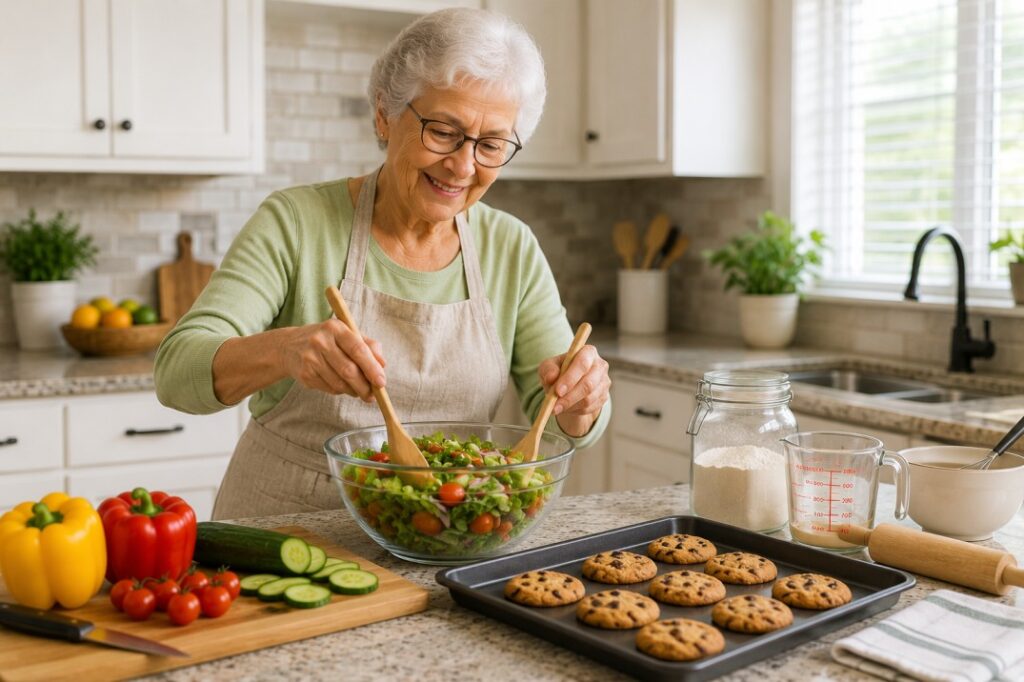
Cooking and Baking Simple Summer Recipes

Cooking and Baking

Preparing light meals or healthy snacks indoors can become a fun and meaningful daily activity.

Simple summer-friendly ideas may include:

  • Fruit parfaits
  • Smoothies
  • Homemade popsicles
  • Sandwiches and wraps
  • Fresh salads
  • Hydrating fruit bowls

Cooking also encourages seniors to maintain better nutrition and hydration during hot weather.

For seniors with mobility concerns, caregivers can help with meal preparation and kitchen safety.

Virtual Tours and Online Learning

Home office joy with virtual exploration

Technology offers seniors more ways than ever to stay mentally active without leaving home.

Many older adults enjoy:

  • Virtual museum tours
  • Online church services
  • Educational YouTube channels
  • Senior-friendly online classes
  • Travel documentaries
  • Audiobooks and podcasts

Learning something new helps stimulate memory, concentration, and cognitive function.

Indoor Gardening and Plant Care

Small indoor plants can brighten a senior’s home while also providing a calming daily routine.

Easy indoor gardening ideas include:

  • Herb gardens
  • Succulents
  • Small flower pots
  • Window plants

Caring for plants encourages movement, responsibility, and relaxation.

Board Games, Cards, and Brain Activities

Mental stimulation is important for seniors who spend long periods at home alone.

Games and brain activities may include:

  • Crossword puzzles
  • Sudoku
  • Card games
  • Dominoes
  • Word searches
  • Chess
  • Bingo

These activities help support memory and cognitive engagement while also creating opportunities for social interaction with family, friends, or caregivers.

Video Calls With Family and Friends

Video Calls With Family and Friends

Social isolation becomes more common during extreme heat when seniors avoid going outside.

Scheduling regular video calls with loved ones can help seniors feel more connected and emotionally supported throughout the summer months.

Even short conversations can significantly improve mood and reduce loneliness.

Movie Nights and Music Therapy

Simple indoor entertainment can provide far more than just something to pass the time. For many seniors living alone, movies, television programs, and music can create emotional comfort, reduce feelings of loneliness, and help stimulate meaningful memories.

Many older adults enjoy revisiting familiar entertainment that feels relaxing, nostalgic, and emotionally uplifting. Popular choices often include:

  • Classic movies from earlier decades
  • Old television shows and sitcoms
  • Big band and jazz music
  • Gospel and worship music
  • Relaxing instrumental playlists
  • Family photo slideshows and home videos
  • Travel documentaries and nature programs

Music, in particular, can have a powerful emotional impact on seniors. Familiar songs often trigger positive memories connected to family, friendships, milestones, and important life experiences. For some older adults — including seniors living with dementia or memory loss — music may help improve mood, reduce anxiety, and encourage social interaction.

Creating simple “movie nights” at home can also provide structure and enjoyment during long summer evenings indoors. Families and caregivers can make the experience more meaningful by:

  • Watching favorite classic films together
  • Creating personalized music playlists
  • Looking through old family photos
  • Sharing stories connected to songs or movies
  • Scheduling virtual watch parties with loved ones

Las Vegas also offers senior-friendly indoor entertainment opportunities throughout the year, including classic movie screenings, live music performances, and daytime theater events that may be more comfortable during the summer heat.

Helpful local resources:

For seniors who spend much of the summer indoors, small moments of entertainment and connection can play an important role in supporting emotional well-being and overall quality of life.

How to Keep Seniors Safe During Extreme Las Vegas Heat

Elderly couple indoors during extreme Las Vegas heat

Las Vegas summers are no joke. With temperatures regularly climbing above 100°F, the extreme desert heat can pose serious health risks—especially for seniors.

The Centers for Disease Control and Prevention emphasizes that staying hydrated is one of the most effective ways to prevent heat-related illnesses, especially during extreme temperatures.

For families in Summerlin and across Las Vegas, keeping aging loved ones safe during the summer months isn’t just important—it’s critical.

Whether your parent lives alone or you’re checking in regularly, understanding how to prevent heat-related issues can make all the difference.

Why Are Seniors More Vulnerable to Heat?

Seniors are more vulnerable to heat because the body becomes less efficient at regulating temperature with age. According to the National Institute on Aging, older adults are at a higher risk for heat-related illnesses due to changes in how the body responds to temperature and certain medications.

Seniors are more likely to experience:

  • Dehydration
  • Heat exhaustion
  • Heat stroke
  • Medication-related sensitivity to heat

In Las Vegas, where temperatures often exceed 100°F, this risk is significantly higher, making preventive care essential.

How to Prevent Dehydration in Seniors

Preventing dehydration in seniors requires consistent fluid intake throughout the day, even if they don’t feel thirsty. Older adults are more prone to dehydration because their sense of thirst decreases with age, making it essential to proactively monitor hydration—especially during extreme heat in places like Las Vegas.

Seniors can become dehydrated quickly, which may lead to dizziness, confusion, urinary issues, or even hospitalization if not addressed early.

Best Ways to Prevent Dehydration

  • Encourage small, frequent sips of water throughout the day
  • Offer hydrating foods like watermelon, cucumbers, oranges, and soups
  • Limit caffeine and alcohol, which can increase fluid loss
  • Set reminders or use alarms to prompt regular hydration
  • Keep water easily accessible in multiple areas of the home
  • Monitor urine color (light yellow = well hydrated)

Staying ahead of dehydration is one of the simplest and most effective ways to protect seniors during extreme heat conditions.

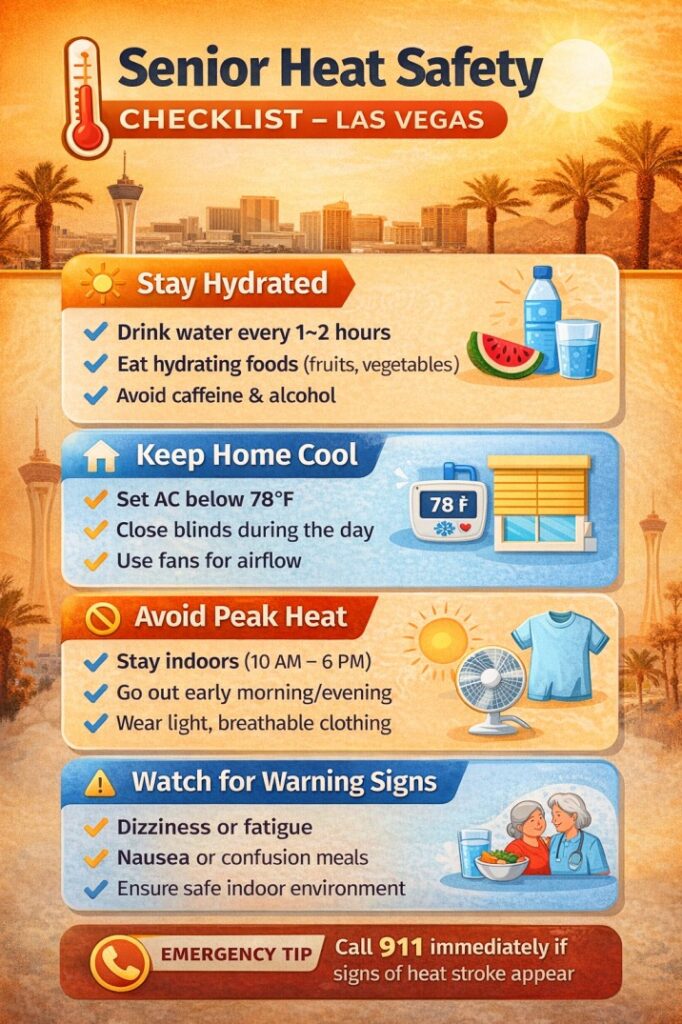
Senior heat safety checklist – Las Vegas

How to Keep a Senior’s Home Cool During Summer

Keeping a senior’s home cool during summer is essential to prevent heat exhaustion and heat stroke, especially in extreme climates like Las Vegas. Seniors are more sensitive to temperature changes, so maintaining a consistently cool indoor environment can significantly reduce health risks.

A properly cooled home not only improves comfort but also helps prevent dehydration, fatigue, and other heat-related illnesses.

Key Steps to Keep the Home Cool

  • Keep air conditioning set at or below 78°F for safe indoor temperatures
  • Close blinds or curtains during the day to block direct sunlight
  • Use fans to improve air circulation throughout the home
  • Avoid using ovens or heat-generating appliances during peak heat hours
  • Seal windows and doors to prevent cool air from escaping
  • Use lightweight bedding and breathable fabrics

What to Do If the AC Stops Working

If air conditioning fails, act quickly to prevent dangerous heat exposure:

  • Move to a cooler location such as a shopping center or cooling center
  • Visit a family member or friend’s home
  • Use fans, cold compresses, and hydration as temporary relief
  • Contact an HVAC professional immediately

When Should Seniors Avoid Going Outside?

Seniors should avoid going outside during extreme heat, especially between 10 AM and 6 PM in Las Vegas, when temperatures are at their highest. During these peak hours, the risk of heat exhaustion and heat stroke increases significantly, even with short exposure.

Limiting outdoor activity during these times is one of the most effective ways to protect seniors from dangerous heat-related illnesses.

Safe Tips If Going Outside Is Necessary

  • Go out early in the morning or later in the evening when temperatures are lower
  • Wear lightweight, loose-fitting, and breathable clothing
  • Stay in shaded areas as much as possible
  • Limit time outdoors and take frequent breaks indoors
  • Bring water and stay hydrated at all times
  • Avoid strenuous activities during hot weather

What Are the Signs of Heat Exhaustion and Heat Stroke?

The signs of heat exhaustion and heat stroke in seniors include symptoms like dizziness, nausea, confusion, and changes in body temperature. Recognizing these warning signs early is critical, as heat stroke can become a life-threatening emergency if not treated immediately.

Seniors in hot climates like Las Vegas are especially at risk, making it important for caregivers and family members to monitor symptoms closely during extreme heat.

Following guidance from Ready.gov can help families recognize warning signs early and respond quickly to prevent serious complications.

Signs of Heat Exhaustion

  • Heavy sweating
  • Weakness or fatigue
  • Dizziness or lightheadedness
  • Nausea or vomiting
  • Cool, pale, or clammy skin

Signs of Heat Stroke (Medical Emergency)

  • High body temperature (103°F or higher)
  • Confusion or disorientation
  • Rapid or strong pulse
  • Hot, dry, or flushed skin
  • Possible loss of consciousness

What to Do in an Emergency

  • Call 911 immediately if heat stroke is suspected
  • Move the person to a cooler area
  • Apply cool cloths or ice packs
  • Offer water only if they are conscious

Do Medications Increase Heat Risk for Seniors?

Yes, certain medications can increase heat risk for seniors by affecting hydration levels, body temperature regulation, or the ability to sweat. These side effects can make older adults more vulnerable to dehydration, heat exhaustion, and heat stroke—especially in extreme heat conditions like Las Vegas.

Understanding how medications interact with heat is an important step in preventing serious health complications.

Common Medications That Increase Heat Risk

  • Blood pressure medications – May reduce the body’s ability to respond to heat
  • Diuretics (water pills) – Increase fluid loss, raising the risk of dehydration
  • Antihistamines – Can interfere with sweating and cooling mechanisms
  • Antidepressants and antipsychotics – May impact temperature regulation
  • Heart medications – Can affect circulation and heat tolerance

How to Reduce Heat Risk from Medications

  • Review all medications with a healthcare provider before summer
  • Ask about side effects related to heat sensitivity
  • Monitor for signs of dehydration or overheating
  • Increase fluid intake as recommended
  • Avoid prolonged exposure to high temperatures

Why Regular Check-Ins are Critical During Extreme Heat

Regular check-ins are critical for seniors during extreme heat because they help detect early signs of dehydration, overheating, or home safety issues like AC failure. Seniors who live alone are at a much higher risk, especially in hot climates like Las Vegas, where conditions can quickly become dangerous.

Consistent communication ensures that small issues are addressed before they turn into serious health emergencies.

Helpful Strategies for Checking In

  • Schedule daily phone calls or in-person visits
  • Use smart monitoring devices or alert systems
  • Coordinate with neighbors, friends, or nearby family members
  • Set reminders for hydration and meals
  • Check indoor temperature and AC functionality

How Caregivers Help Protect Seniors in Las Vegas Heat

Caregivers help protect seniors during extreme Las Vegas heat by monitoring hydration, maintaining a safe indoor environment, and identifying early signs of heat-related illness. Their support reduces the risk of dehydration, heat exhaustion, and other serious health complications.

In high-temperature climates like Las Vegas, having consistent caregiver support can make a significant difference in a senior’s safety and overall well-being.

How Caregivers Keep Seniors Safe

At A Place At Home- Summerlin, caregivers provide essential support by:

  • Monitoring hydration levels and encouraging regular fluid intake
  • Preparing nutritious meals to support overall health
  • Ensuring the home stays cool and comfortable
  • Assisting with daily activities to reduce physical strain
  • Minimizing the need for outdoor exposure during peak heat
  • Recognizing early warning signs of heat exhaustion or heat stroke

This proactive care helps seniors stay safe, comfortable, and independent at home—even during extreme Las Vegas temperatures.

Is In-Home Care a Good Option During Summer?

Yes, in-home care is one of the safest and most effective options for seniors during extreme Las Vegas heat. It allows older adults to remain in a cool, familiar environment while receiving the support they need to stay safe, hydrated, and comfortable.

In-home care reduces exposure to high temperatures and ensures that seniors are monitored throughout the day.

Sources & References


In-Home Senior Care in Peccole Ranch, Summerlin & Las Vegas: Helping Seniors Live Safely at Home

Caregiver sitting with senior at home

Many families in Peccole Ranch, Summerlin, and Las Vegas want the same thing for their aging loved ones: the ability to remain safe, comfortable, and independent at home.

As seniors age, everyday activities such as cooking, bathing, mobility, and transportation can become more challenging. Families may also worry about fall risks, medication reminders, or loneliness when seniors spend long periods alone.

Professional in-home senior care services provide a supportive solution. Caregivers can assist with daily tasks, companionship, and safety monitoring while allowing seniors to continue living in the place they know best — their home.

For families in Las Vegas communities like Peccole Ranch and Summerlin, in-home care provides peace of mind knowing that loved ones are receiving compassionate support tailored to their needs.

Why Many Seniors Prefer Aging at Home

Aging in place has become increasingly popular among seniors. Remaining at home allows older adults to maintain independence, familiar routines, and a sense of control over their daily lives.

Moving into assisted living or a nursing facility can feel overwhelming for many seniors. In contrast, in-home care allows support to come to them, creating a comfortable and familiar environment.

Benefits of aging at home include:

  • Maintaining independence and dignity
  • Staying in a familiar environment
  • Remaining close to family and neighbors
  • Reduced stress compared to relocating to a facility
  • Personalized one-on-one care

In-home caregivers support these goals by providing assistance that adapts to each senior’s lifestyle and level of need.

Types of In-Home Senior Care Services Available

Every senior has different needs. Some may require occasional help with errands, while others may need daily support with personal care or mobility.

Professional caregivers typically offer a range of flexible services.

Companion Care for Seniors

Social interaction plays an important role in emotional and mental health. Many seniors experience loneliness when family members are busy with work or live far away.

Companion caregivers help seniors stay engaged and connected.

Companion care services often include:

  • Friendly conversation and companionship
  • Light housekeeping assistance
  • Grocery shopping and errands
  • Transportation to appointments or social activities
  • Help with hobbies, reading, or walks

For seniors living in Summerlin and Peccole Ranch, companion care helps maintain a fulfilling daily routine.

Personal Care and Private In-Home Care

Some seniors require assistance with personal daily activities that may become difficult with age or illness.

Private in-home caregivers can help with:

  • Bathing and grooming
  • Dressing assistance
  • Toileting and hygiene support
  • Mobility assistance
  • Fall prevention and safety monitoring

These services help seniors maintain dignity while receiving the help they need to stay safe at home.

Overnight Care for Seniors

Many families worry about their loved one being alone overnight, especially if the senior has mobility challenges, dementia, or medical concerns.

Overnight caregivers stay with seniors during nighttime hours to provide assistance and monitoring.

Overnight care may include:

  • Bathroom assistance during the night
  • Fall prevention support
  • Medication reminders
  • Monitoring sleep and safety
  • Providing reassurance for seniors who wake during the night

This service allows family members to rest easier knowing their loved one is not alone during vulnerable nighttime hours.

After-Surgery Home Care

Recovery after surgery can be especially challenging for seniors. Limited mobility, medication schedules, and fatigue can make daily tasks difficult.

After-surgery caregivers assist seniors with:

  • Mobility support and fall prevention
  • Medication reminders
  • Transportation to medical appointments
  • Meal preparation and hydration
  • Assistance with daily routines during recovery

With proper support at home, seniors can often recover more comfortably and avoid unnecessary hospital readmissions.

Signs a Loved One May Need In-Home Senior Care

Families often begin searching for senior care services after noticing certain changes in their loved one’s health or behavior.

Common signs include:

  • Difficulty managing household tasks
  • Forgetting medications or appointments
  • Increased fall risk or mobility problems
  • Poor nutrition or difficulty preparing meals
  • Declining hygiene or home cleanliness
  • Social isolation or loneliness
  • Difficulty recovering after illness or surgery

Recognizing these signs early can help families put supportive care in place before small concerns turn into serious health risks.

The Benefits of Choosing Local Senior Care in Las Vegas

Working with a local caregiver provider in Las Vegas, Summerlin, or Peccole Ranch offers several advantages.

Local caregivers understand the community and nearby resources, including:

  • Hospitals and healthcare providers
  • Pharmacies and medical clinics
  • Local senior programs and activities
  • Transportation options within the community

This familiarity allows caregivers to provide more personalized and responsive care for seniors living in the area.

In-Home Senior Care Services in Peccole Ranch, Summerlin & Las Vegas

Located in Clark County, Nevada, Peccole Ranch is a beautiful residential community in the Las Vegas area. The neighborhood is known for its quiet streets, walking paths, parks, and strong sense of community.

Many seniors who live in Peccole Ranch have spent years building their lives in the neighborhood. Remaining in their homes allows them to stay connected to familiar surroundings and the community they love.

However, as seniors age, they may need extra help with daily activities or health-related challenges.

Professional in-home senior care services in Peccole Ranch and Summerlin help seniors remain safely at home while receiving the support they need.

Caregivers can provide assistance such as:

  • Companion care and social engagement
  • Personal care and daily living support
  • Overnight monitoring and safety assistance
  • After-surgery recovery care
  • Private in-home care tailored to individual needs

By providing compassionate and personalized care, seniors in Peccole Ranch, Summerlin, and throughout Las Vegas can continue living independently while families gain peace of mind.

At A Place At Home – Summerlin, NV, caregivers provide personalized senior care services designed to support independence, dignity, and quality of life. Whether a loved one needs companion care, personal care, overnight support, or after-surgery assistance, professional caregivers are available to provide the help families need.

By offering trusted in-home senior care services in Peccole Ranch, Summerlin, and Las Vegas, A Place At Home helps seniors remain safe, comfortable, and supported in the place they love most — home.

If you are exploring senior care options for a loved one, A Place At Home – Summerlin, NV can help you create a care plan that fits your family’s needs.

Is Forgetting Names a Sign of Dementia?

senior with memory issue

Forgetting names is a common experience for seniors and aging adults, and occasional lapses are usually a average part of aging. However, if your parent or loved one frequently forgets names, repeats questions about familiar people, or shows waning memory over time, it could be an early sign of dementia. Caregivers and families should pay attention to patterns of memory loss, as recognizing changes early can help provide timely support, in-home senior care, and strategies to maintain independence for aging adults.

Understanding memory and the aging brain

Memory is a complicated process that involves determining, storing, and saving information. As adults age, it is natural for some cognitive changes to occur:

  • Slower recall: Names and details may take longer to remember.
  • Occasional lapses: Forgetting items, forgetting appointments, or struggling to recall names temporarily is common.
  • Distracted memory: Busy schedules or stress can make it harder to remember details, including people’s names.

These experiences are normally mild and do not affect daily life, but understanding the difference between normal forgetfulness and signs of dementia is key for families and older adults alike.

Why seniors forget names

Forgetting names is a common experience for seniors and older adults, and it is usually a normal part of aging. Names are often harder to remember because they are arbitrary labels with no inherent meaning, making them more difficult for the brain to store and memory. Additionally, seniors may use certain names infrequently, so the lack of repetition can make recall even harder. Everyday stress, distractions, or multitasking can also affect memory, as the brain battles to focus on and retain information. Finally, normal intellectual slowing that occurs with age means the brain procedures information more slowly, which can make retrieving names feel more challenging. While these factors are typical for aging adults, repeated or persistent struggles may signal the need for further evaluation.

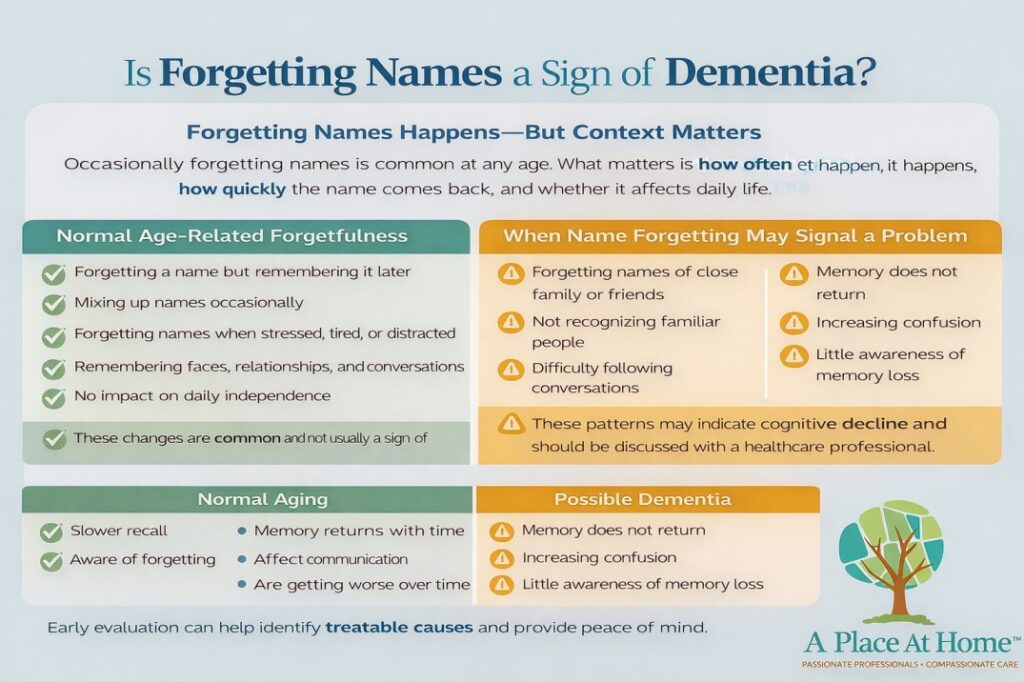
Infographic explaining whether forgetting names is a sign of dementia

Signs that forgetting names may indicate dementia

For seniors and aging parents, it’s important to differentiate normal memory lapses from early signs of dementia. Warning signs include:

  • Forgetting names of close friends or family members frequently
  • Memory problems that interfere with daily routines, such as missing appointments or repeating conversations
  • Difficulty recalling recent events or discussions
  • Misunderstanding in familiar settings, like getting lost in a neighborhood they know well
  • Trouble finding the right words or completing conversations
  • Changes in mood or personality, including increased anxiety, irritability, or social withdrawal

Persistent memory loss that influences daily life is often an early symptom of dementia and warrants a medical evaluation.

How can you tell if a senior is showing early signs of dementia?

Telling if a senior is showing early signs of dementia needs careful observation and practical assessment in everyday life. Instead of just observing memory lapses, you can use real-life approaches to see if cognitive changes are continuing and impactful.

Ways to tell if a senior may have early dementia:

  • Observe daily activities: Watch how they handle routine tasks like cooking, managing medications, paying bills, or following simple instructions. Difficulty completing these tasks can indicate cognitive decline.
  • Track memory patterns: Keep a journal of what the senior forgets, how often, and in what situations. Frequent, repeated forgetfulness—especially about names, appointments, or recent events—is more concerning than occasional lapses.
  • Test orientation subtly: Ask questions about the day, date, or location during casual conversation. Confusion that appears repeatedly may signal early cognitive changes.
  • Notice communication changes: Involve them in conversation and observe if they struggle to find words, substitute incorrect words, or have trouble following discussions.
  • Monitor judgment and decision-making: Watch for unusual or risky decisions, such as mismanaging money, ignoring safety, or forgetting personal hygiene.
  • Watch social behavior: Notice if they start withdrawing from interests, friends, or activities they once enjoyed, or if mood changes suddenly without clear cause.

The key is constant observation over time. One or two isolated incidents are usually normal aging, but persistent patterns in multiple areas should prompt a professional evaluation.

Factors that can mimic dementia

Not every memory problem in older adults is caused by dementia. Other factors can temporarily affect memory, including:

  • Stress or anxiety, which can interfere with attention and recall
  • Sleep deprivation, which impairs brain function and consolidation of memories
  • Medication side effects that cause confusion or forgetfulness
  • Vitamin deficiencies, particularly vitamin B12, which can impact cognitive function
  • Depression or mood disorders, which often mimic memory decline in seniors

Addressing these factors can improve memory without the need for dementia-specific interventions.

How Families Can Help Seniors Who Often Forget Names

Frequent forgetfulness, especially when it comes to names, can be concerning for both seniors and their families. Taking early, proactive steps can help your loved one maintain independence and support their cognitive health. One of the first things families can do is keep a memory log, recording when forgetfulness occurs, any patterns, and how often it happens. This record becomes an important tool for doctors to understand whether memory lapses are occasional or part of a larger cognitive issue.

It’s also important to observe how memory challenges affect daily life. Forgetting names can impact routines, safety, and social interactions, making it clear whether additional support is needed. Seeking a professional evaluation is a crucial next step. A healthcare provider can assess overall cognitive function and rule out treatable causes of memory loss, such as medication side effects, vitamin deficiencies, or sleep problems.

Doctors may recommend formal cognitive testing, including exams like the Mini-Mental State Exam (MMSE) or the Montreal Cognitive Assessment (MoCA), to detect early changes and provide a baseline for monitoring. Beyond professional evaluation, families can encourage brain-healthy habits that support memory. Regular physical activity improves blood flow to the brain, while a balanced diet rich in fruits, vegetables, and healthy fats supports cognitive function. Social engagement, including conversations with friends or family and participation in community activities, keeps the mind active and connected. Mentally stimulating activities, such as reading, puzzles, or learning new skills, can further reinforce memory and focus.

How a Home Caregiver Can Help When Memory Changes Appear

As seniors experience memory changes, even mild forgetfulness can make daily routines more challenging and affect their independence. This is where a trained home caregiver from A Place at Home – Summerlin, NV can make a real difference. Caregivers provide support with daily tasks, companionship, and safety monitoring, helping seniors continue to live comfortably at home.

A home caregiver can assist with:

  • Managing daily activities, like cooking, bathing, medication reminders, and housekeeping
  • Ensuring safety, such as preventing accidents, helping seniors navigate their environment, and keeping routines consistent
  • Providing companionship and mental engagement, reducing feelings of isolation and supporting cognitive health
  • Observing changes in memory or behavior, so families can notice patterns early and respond appropriately

With in-home care, seniors can maintain their independence, feel secure, and enjoy personalized support tailored to their needs, while families have peace of mind knowing their loved ones are cared for.

Also Read: How Long Can Someone Live with Dementia?

Is 60 or 65 Considered Elderly? Understanding Age, Aging, and What It Really Means

Senior Couple smiling

As people live longer, healthier lives, the question of when someone is considered elderly has become less clear. Is it 60? Is it 65? Or does age alone even tell the full story?

Understanding just what defines an age-for seniors, families, and caregivers-can help with planning, decision-making, and conversations about aging and health independence and eventual care needs. The short answer is that both 60 and 65 are in common use, depending on context. The longer answer is more complicated:

Is 60 Considered Elderly?

Yes, in some settings-60 is considered the beginning of older adulthood, but not necessarily “elderly” in the traditional sense.

It is used by, commonly: Age 60

  • Central organizations for international health
  • Programs for Seniors in the Community
  • Social and cultural definitions of aging

Many senior centers, wellness programs, and public health discussions begin using the term older adult or senior at age 60. However, most people at this age are still active, independent, and working or newly retired.

Because of this, age 60 is more accurately described as the start of later adulthood rather than old age.

Is 65 the Start of Old Age?

The age of 65 was quite arbitrary, as this is usually considered the age when one is labeled elderly, primarily because it coincides with retirement, senior benefits, and age-related healthcare planning. However, it is less of a rule and more of an outline than an actual measure of health or competency. The majority of people at age 65 live active, independent, and productive lives.

This is largely because age 65 marks eligibility for major milestones such as:

  • Medicare health insurance
  • Certain retirement and senior benefits
  • Age-based healthcare screenings

For decades, age 65 has been used as a benchmark in healthcare, policy, and retirement planning. As a result, it has become the most widely accepted definition of when someone is considered elderly—at least administratively.

Still, many adults at 65 remain healthy, active, and fully independent.

Why There’s No Single Definition of “Elderly”

There is no definition of the word elderly, since aging is a different process for each person.

Chronological age, or the age a person is, does not always reflect:

  • Physical ability
  • Cognitive health
  • Emotional well-being
  • Independence in daily life

Two persons aged 70 years may have very different health profiles and support needs. That is why many professionals today focus less on age alone and more on functional aging.

What is Functional Age and Why Should It Matter?

Functional age describes how well a person functions in daily life, other than how old they are by years. It is a reflection of factors such as one’s mobility and balance, the ability to manage activities of everyday living, memory and decision-making, and overall health and stamina. From a care perspective, functional age often means more than chronological age. Whereas some people in their late 70s are still fully independent, some others in their early 60s may require daily support as a result of illness, injury, or health changes.

Does turning 60 or 65 mean a person needs care?

No–an increase in years does not make any person pop into the care category. Many adults remain independent, living in their communities well into their 80s and beyond. The basis for most care decisions includes:

  • Safety at home
  • Ability to perform daily activities
  • Health changes
  • Recovery after surgery or illness
  • Level of family support

Age may be a reference point, but care needs are driven by function and safety, not a number.

At What Age Qualifies Seniors for Federal Programs and Senior Benefits?

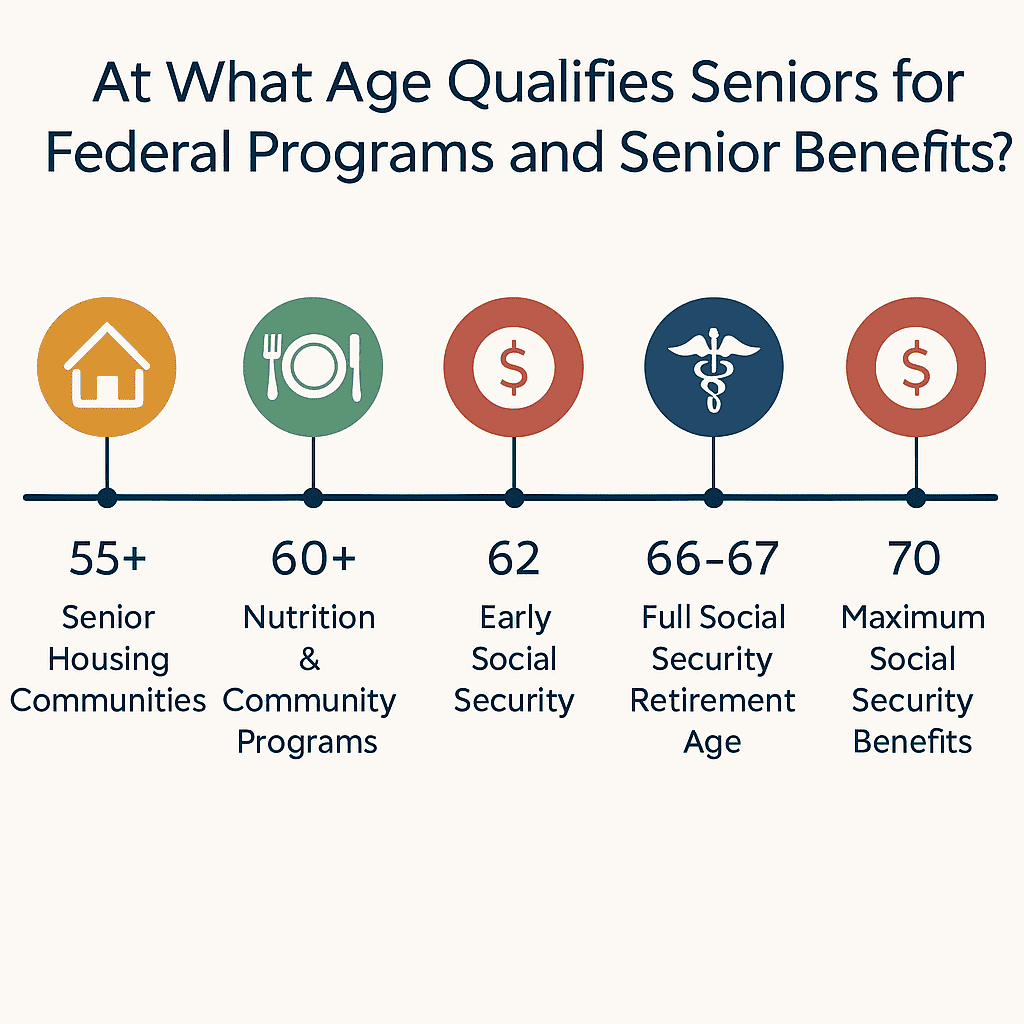
Senior benefits eligibility timeline by age

Most of the senior benefits are attached to an age threshold instead of a single definition of “elderly” in the United States. These programs are made for healthcare access, income security, housing, and daily living as one is aging. The most widely applied benchmark is 65, although under or over this level of age, eligibility can begin for different programs.

Medicare (Age 65)

Attains Medicare eligibility at an elderly stage of life, which begins at 65 years, providing them with health insurance. The programs offered under Medicare cover hospital and medical treatment and prescription drugs. Attaining Medicare is one of the reasons why a person attains senior status when they reach 65 years.

Social Security Retirement Benefits (Ages 62–70)

Benefits for retirement under Social Security can be drawn from as early as 62 years of age, but they are reduced if one wishes to start taking them before attaining full retirement age. Benefits are available from 66 to 67 years of age, with an option to raise them if one delays taking them until 70 years of age.

Supplemental Security Income (SSI) (Age 65 or Disability-Based)

SSI offers financial assistance to senior citizens with limited income and resources. Although eligibility can start at 65, some people can become eligible before this time if they have a disability. Assistance from this social service will cover basic living needs such as food and shelter.

Medicaid and Long-Term Care Assistance (Varies by State)

Eligibility for Medicaid benefits is determined by income and resources, but not by age, and many people can become eligible when their care requirements escalate in old age. Medicaid benefits include assistance with long-term healthcare such as in-home and SNF care.

Housing Assistance and Senior Housing Programs (Age 55+ or 62+)

Numerous government and local programs exist for senior citizens beginning at either age 55 or 62 years. Such programs can include rent subsidies, senior-only apartment buildings, and senior-friendly living communities.

Benefits for Veterans Aged 65 and Older (Varies by Benefit)

Veterans may be eligible for healthcare benefits, pensions, and assistance programs when they reach advanced age. Benefits come with eligibility based on age, military service, financial need, or disability.

Nutrition and Community Support Programs (Often Age 60+)

Programs such as congregate meal services, home-delivered meals, and senior community services often begin at age 60. These services support nutrition, social engagement, and independent living for older adults.

Apart from benefits and eligibility, other dimensions of life in which aging might be considered include phases of life in order to address varying requirements at different stages.

Is “Senior” the Same as “Elderly”?

Often, people will use these terms interchangeably, but “older adult” or “senior” can be a better option because it sounds more respectful and less concentrated on vulnerability. “Elderly” may be a common term in a medical or a government setting, but usage is moving toward someone-first languages.

Although it does not in itself define aging or need, age is a factor in establishing eligibility for two very important government programs.

Care Coordinator and Management Weston FL

What are the Stages of Aging?

Aging can be described in terms of phases in order to have a better understanding of health, autonomy, and function. Although different authors describe phases in different ways, a generally accepted model consists of four phases:

  • Early Older Adulthood (commonly 50s to early 60s): Here, people are active and self-sufficient but may have to deal with chronic ailments or lifestyles.
  • Young-old (commonly 65-74 years old): Generally, it involves transitions into retirement, a heightened emphasis on preventive health care, maintaining mobility, and autonomy.
  • Middle-old (often 75–84): Some adults may need assistance occasionally with transportation, household chores, taking medications, or personal safety at home.
  • Old-old (85+): Needs for assistance are more likely to increase, especially with fall risk, memory changes, and help with activities of daily living.

These stages aren’t strict rules. They’re a helpful way to talk about aging in a realistic, respectful way—because people age differently based on health, environment, and support systems.

At What Age Do Seniors Commonly Begin Requiring Assistance?

There is no specific age at which someone suddenly needs care. Most support needs develop gradually and are driven by functional changes, not birthdays. Challenges such as loss of mobility, balance problems, forgetfulness, managing daily activities, taking medications, or safety in and around the dwelling are more likely considerations before support is actually required. Some people can continue to look after themselves well into their 80s, where others will require support in their early 60s.

When Should Families Start Planning for Senior Care?

The best time to plan for senior care is before a crisis occurs. Families often benefit from starting conversations and exploring options once a loved one begins experiencing falls, trouble managing medications, difficulty cooking or keeping up with household tasks, or needs extra support after a hospital stay. Early planning allows families to make thoughtful, less stressful decisions and put the right support in place before safety or health becomes urgent.

Is the Term “Elderly” Still Appropriate?

The word elderly is increasingly being replaced with terms like:

  • Older adult
  • Senior
  • Aging adult

This shift reflects a more respectful and accurate view of aging. Many people associate “elderly” with frailty, which does not represent most adults in their 60s or even 70s.

Using people-first language helps focus on ability, not limitation.

Senior Home Care from A Place At Home – Summerlin

Every individual grows old in a different way, and when they need help, it is not based on a certain age. The most important factor is safety, independence, and a good life at home. A Place At Home – Summerlin residents will have access to tailor-made senior home care, which will address each individual in a manner in which they can be assisted either occasionally or on a continual basis.

Our caregivers assist senior citizens in being comfortable and self-reliant in their homes by providing assistance with personal care, meal service, medication reminders, mobility support, friendship, and post-illness recuperation. We assist the family in adjusting this support based on their evolving requirements, keeping in mind their dignity and continuity of care.

If you are just starting to think about planning for the future or if you notice some signs that a loved one in your life may need a little extra assistance, our local team is available to walk you through this next step.

Final Takeaway
Whether a person can be labeled as senior at 60 or at 65 can very much depend on the context in which they are being assessed. The truth is, aging is far more a function of health, independence, and functionality relative to a number.


Top Senior-Friendly Events in Las Vegas for 2026

seniors are having fun at event

Staying active, social, and connected plays a huge role in healthy aging. Fortunately, Las Vegas and the Summerlin area offer plenty of opportunities for older adults to get out, meet others, and enjoy life. Whether your loved one prefers community expos, cultural performances, or wellness fairs, 2026 promises a full calendar of fun, senior-friendly events.

Here are some of the top gatherings to mark on your calendar this year.

1. Senior Idol Showcase – January 22, 2026

Location: Charleston Heights Arts Center | 800 Brush St, Las Vegas

Think “America’s Got Talent”—but for the 50+ crowd! This cheerful talent show features local singers, dancers, and performers who prove that creativity never retires. Families and friends are encouraged to attend and cheer.
Why go: Great entertainment, uplifting atmosphere, and community pride in action.

2. LV Senior Expo – April 7, 2026

Location: Centennial Hills YMCA | 6601 N Buffalo Dr, Las Vegas, NV
🕘 10 a.m.–1 p.m.

This annual event brings together health providers, local businesses, and community organizations that serve adults 55 and older. Attendees can explore wellness booths, enjoy live entertainment, and discover resources that support healthy living and independence.
Why go: Free admission, indoor location, easy parking, and plenty of seating—perfect for seniors in and around Summerlin.

3. Senior Wellness Festival – September 2026 (TBD)

Location: Las Vegas Convention Center | 3150 Paradise Rd

Hosted by community partners and nonprofits such as Nevada HAND, this lively festival focuses on senior health, fall prevention, fitness, and nutrition. There’s also music, demonstrations, and friendly wellness challenges.
Tip: Bring comfortable shoes and arrive early for screenings and giveaways.

4. Aloha Day Senior Expo – November 2026 (TBD)

Location: The Orleans Hotel & Casino | 4500 W Tropicana Ave

Bringing island vibes to the desert, the Aloha Day Senior Expo celebrates culture, community, and connection. Expect Hawaiian music, hula dancers, local vendors, and resource tables for active adults.
Why go: It’s fun, festive, and free—ideal for a day out with family or friends.

5. Active Adult Center Programs – Year-Round

Location: Howard Lieburn Active Adult Center | 6230 Garwood Ave, Las Vegas NV

For seniors who prefer smaller gatherings, Las Vegas’ Active Adult Centers offer ongoing classes and activities such as:

  • Chair yoga and low-impact fitness
  • Art and craft workshops
  • Social dances and movie afternoons
  • Day trips and hobby clubs

These centers make it easy to stay social, healthy, and mentally engaged all year long.

Planning Ahead: Tips for Seniors and Family Caregivers

Attending events should be fun—not stressful. Keep these quick tips in mind when making plans:

  • Check accessibility: Confirm parking, ramps, and seating options before attending.
  • Stay cool: Las Vegas heat can rise quickly; bring water, sunscreen, and light layers.
  • Plan transportation: Arrange rides in advance if driving or walking long distances is difficult.
  • Know limits: Schedule rest periods, especially after surgeries or health procedures.

Need a Helping Hand to Attend Events Safely?

Whether your loved one wants company for a community festival or assistance moving around safely, A Place At Home – Summerlin is here to help. Our compassionate caregivers provide reliable transportation, mobility support, and companionship—so seniors can stay active and enjoy the Las Vegas lifestyle with confidence.


Quality Care Starts with One Call

From personal care to round-the-clock support, we provide trusted in-home care tailored to your family’s needs. Experience peace of mind knowing your loved one is in safe, compassionate hands. Call us now to speak with a care specialist.


(702) 903-2985

Why do seniors wake up at night so often? Understand sleep challenges in aging

Many older adults in Summerlin, Nevada finds getting a full night’s sleep more and more difficult. What was once a simple thing-for sleeping, staying asleep, and waking refreshed-can slowly devolve into nights of tossing and turning, trips to the bathroom, and waking up well before one is ready.

If this sounds familiar, you’re not alone. Sleep disturbances are one of the most common complaints among seniors. But understanding why they happen can help families take meaningful steps toward better rest and well-being.

Why Sleep Changes as We Age

As we grow older, it’s common to notice that sleep simply doesn’t come as easily as it once did. What used to be a solid eight hours can turn into restless nights, frequent awakenings, or early morning wake-ups long before sunrise. These changes don’t happen overnight; they are part of how the body and brain evolve with age.

Beginning in our 50s and continuing in our 60s, several biological and lifestyle changes can make it harder to fall asleep and stay asleep:

  • Less deep, restorative sleep (slow-wave sleep):
    Time spent in the deepest stage of sleep, the stage in which the body repairs tissues and strengthens memory, decreases with age. Older adults are more likely to spend time in the lighter stages of sleep, which is easier to wake from.
  • Changes in circadian rhythm:
    As people age, their internal body clocks tend to shift forward, so seniors feel tired earlier in the evening and wake up earlier in the morning. This “phase advance” makes it difficult for them to stay asleep throughout the night.
  • Decreased melatonin production:
    The brain produces less melatonin, the hormone that signals bedtime; thus, it is much harder to fall and stay asleep, especially in cases where evening light exposure is high, like with screens or bright lamps.
  • Increased sensitivity to environmental factors:
    Older adults are more likely to wake up if there are small noises, changes in light, or temperature changes. In a desert climate such as Summerlin, hot nights, dry air, and low humidity indoors can make staying asleep comfortably even more challenging.
  • Overall health and activity level changes:
    Reduced daytime activity, chronic pain, or medical conditions such as arthritis or diabetes can all disrupt nighttime rest.
  • More frequent nighttime awakenings:
    Age-related changes in bladder function and medications like diuretics can lead to nocturia—frequent nighttime urination—causing repeated sleep interruptions.

It’s important to remember that these shifts are common but not inevitable. With the right environment, routines, and support, seniors can still enjoy high-quality, restorative rest well into later life.

sleeping and aging

Common Reasons Older Adults Wake Up During the Night

Occasional nighttime wakings can be normal, but when it happens a number of times each night-or leads to daytime exhaustion-it sometimes points to the existence of an underlying cause that can be managed or treated. Understanding these reasons is the first step toward helping your loved one get the rest they deserve.

1. Health Conditions That Disrupt Rest

The body changes throughout our lives, which can make sleep more precarious with age. Many medical conditions directly interfere with nighttime comfort and breathing:

  • Arthritis and chronic pain: Aching joints and stiffness often worsen while lying still, making it hard to fall or stay asleep. Even minor movement can trigger discomfort that breaks sleep cycles.
  • Sleep apnea: When sleepers stop breathing for short periods, they often wake with a gasp or snore loud enough to rouse themselves and their bed partners. Many older adults with untreated sleep apnea report feeling tired after “sleeping” eight hours.

Restless leg syndrome or neuropathy: Tingling, burning sensations, and a need to move one’s legs can cause continuous tossing and turning. These sensations often become worse in the evening.

  • Heartburn and reflux: Lying flat may increase acid reflux, which many elderly individuals already suffer from.
  • Respiratory or heart problems: Diseases such as COPD or heart failure can lead to shallow breathing while sleeping and result in frequent awakenings.
  • Nocturia: Due to the decreased elasticity of the bladder and increased nocturnal production of urine by the kidneys, the elderly could experience nocturia.

2. Medication Side Effects

Some prescriptions—particularly those commonly taken by older adults—can interfere with sleep unintentionally.

Common culprits include:

  • History of diuretics for high blood pressure that induce nighttime urination
  • Steroids that cause energy spikes or restlessness
  • Antidepressants or beta-blockers which interfere with melatonin production
  • Decongestants or pain medications that are nervous system stimulants

If sleep disturbances started with a new prescription, be sure to discuss it with the prescribing physician. Sometimes adjusting the dosage timing or exploring an alternative medication can help restore better rest.

3. Emotional and Cognitive Factors

Sleep is closely linked with emotional well-being, especially in elderly individuals who may experience life transitions or isolation.

  • Anxiety and racing thoughts may keep the mind active long after bedtime.
  • It can cause early morning awakening and difficulty getting back to sleep. • Loneliness or bereavement can worsen night-time anxiety or make the home uncomfortably quiet. In the case of Alzheimer’s or dementia, changes in brain function may completely alter sleep cycles, leading to confusion and wandering at night.

4. Environmental and Temperature Changes

Even minor environmental disturbances may rouse a light-sleeping senior.

  • Temperature fluctuations: Overnight temperature drops, as well as a dry indoor air environment in Summerlin and across the Las Vegas Valley, can make sleeping uncomfortable. Seniors can get overheated, thirsty, or chilled.
  • Noise and light: Noises from the street, as well as early morning light filtering in through the blinds, can be bothersome.
  • Uncomfortable bedding or mattress: A very hard or very soft mattress can aggravate a back or joint pain problem.

A few simple modifications-such as blackout curtains, a white noise machine, or a cooling mattress pad-can diminish these disturbances.

5. Lifestyle Habits and Daily Routines

Poor sleep often reflects daily life. Irregular habits or stimulants can make restful nights harder to achieve.

  • Late caffeine intake: Even a cup of tea or chocolate dessert in the evening can affect seniors more strongly.
  • Irregular sleep schedule: Sleep and wake times are different each day, which confuses the system.
  • Daytime napping: While short ones help refresh energy, long or late ones negatively affect night sleeping.
  • Limited physical activity: Reduced movement during the day means less energy spent—and less sleep drive at night.

These would encompass regular routines, light exercises, and exposure to daylight during the day, which help in regulating sleep patterns naturally.

Read: Is 60 or 65 Considered Elderly?

How Dementia and Alzheimer’s Affect Sleep

Sleep challenges among seniors living with Alzheimer’s disease or other forms of dementia are not only common; they can also be among the most distressing symptoms both for the individual and the family caregivers. These conditions affect areas of the brain that help govern sleep, thereby making the body unable to follow a normal day-night rhythm.

As a result, many people with dementia experience:

  • Difficulty falling asleep or staying asleep
  • Frequent nighttime awakenings
  • Increased confusion or agitation in the evening

Reversed sleep cycles, where they feel awake at night and sleepy during the day

This pattern is often known as “sundowning,” a term used to describe increased restlessness, anxiety, or disorientation that typically occurs in the late afternoon or evening hours. During this time, seniors may pace, call out, or attempt to leave the home—behaviors that can leave families exhausted and worried for their loved one’s safety.

Why These Sleep Changes Happen

Several biological and environmental factors contribute to disrupted sleep in individuals with dementia:

  • Damage to the brain’s circadian clock: Dementia affects the part of the brain that controls the sleep-wake cycle, leading to irregular sleep patterns.
  • Reduced exposure to natural daylight: Spending more time indoors can confuse the body’s internal sense of time.
  • Medication side effects: Certain prescriptions for memory or mood may increase wakefulness.
  • Physical discomfort: Pain, hunger, or the need to use the bathroom can cause restlessness when the person cannot communicate what’s wrong.
  • Environmental triggers: Shadows, dim lighting, or household noises may heighten confusion and agitation after dark.

Practical Tips for Better Sleep for seniors at Home

You don’t always need a prescription or a major lifestyle overhaul to help seniors sleep better. Often, a few thoughtful adjustments to daily routines and the sleep environment can make a noticeable difference. Consistency, comfort, and calm are the cornerstones of restful sleep—especially as we age.

Here are some simple, effective ways families can promote better sleep at home:

1. Stick to a regular routine.

Going to bed and getting up at the same time every day regulates the internal clock of the human body. Even on weekends or holidays, maintaining this rhythm helps solidify a healthy sleep pattern. Where possible, schedule mealtimes, light exercises, and relaxation at similar times each day to support this natural cycle.

2. Limit Naps to Short Bursts

While daytime rest can indeed be refreshing, long and late naps usually disrupt nighttime sleep. Encourage short naps of 20–30 minutes, ideally before 3 p.m. This way, seniors are able to recharge without disrupting nighttime rest.

3. Encourage Daytime Activity and Sunlight

Staying active during the day helps build natural sleep pressure for the evening. Light activities like short walks, gardening, and light stretching improve both mood and nighttime rest. In Summerlin, the best walks will be either early morning or evening to avoid midday heat but still get in some beneficial sunlight exposure for circadian balance.

4. Create a Cool, Comfortable Sleep Environment

Temperature plays a huge role in how well one sleeps, and it’s especially true in the warm desert climates. Keep your bedroom at approximately 68°F (20°C) with good airflow. Use lightweight, breathable bedding and consider investing in a humidifier to offset dry interior air. Blackout curtains and a quiet fan can further reduce disturbances.

5. Avoid Stimulants and Heavy Meals Before Bed

Caffeine, nicotine, and even chocolate can disrupt sleep for many hours after intake. Advise abstaining from these after mid-afternoon. Similarly, large meals or spicy foods too near bedtime can cause heartburn or discomfort. Recommend a light evening snack, such as fruit or yogurt, if hunger arises before bed.

6. Create a Relaxing Bedtime Routine

The body is responding to the familiar cues that it is time to sleep. Wind down by engaging in quiet activities: listening to soft music, reading a light book, or doing some light stretching. Avoid screens and bright lights for at least an hour before bedtime because these can suppress melatonin and delay sleep onset.

7. Keep the Bedroom a Sleep-Only Space

Encourage that the bedroom should be used only for sleeping and relaxation, without television or scrolling through devices. This helps your brain make associations with the bedroom as a sleep cue.

How In-Home Care Can Help Seniors Sleep Better

For many Summerlin families, the greatest challenge is not simply a loved one struggling to go to sleep; it’s also keeping them safe, calm, and cared for through the night. Sleep disturbances can be incredibly taxing for both seniors and family members who care for them, especially when restlessness, confusion, or wandering at night begins to occur regularly.

That’s where professional in-home care can make all the difference. Not only do trained caregivers bring peace of mind, but they provide practical, compassionate support that allows for a healthy, restorative rest.

Here’s how overnight or 24-hour in-home care helps improve sleep quality:

  • Gentle reminders and assistance: Caregivers can help ensure seniors take nighttime medications safely, drink enough water, and follow their bedtime routine without stress or confusion.
  • Mobility support for nighttime safety: Many seniors wake during the night to use the bathroom or adjust their position. A caregiver can offer steady assistance—reducing the risk of slips or falls, especially in dimly lit areas.
  • Comforting companionship: Seniors who live alone or experience anxiety, loneliness, or dementia-related confusion often sleep more soundly when someone is nearby to provide reassurance and calm conversation.
  • Monitoring and immediate response: Caregivers remain attentive throughout the night, observing changes in breathing, movement, or behavior. Quick response to restlessness, discomfort, or disorientation helps prevent accidents and ensures uninterrupted rest.
  • Support for family caregivers: When families know their loved one is cared for overnight, they too can rest easier—avoiding burnout and improving their own health and focus during the day.

When Professional Support Becomes Essential

When sleeplessness or wandering becomes frequent, family caregivers may find themselves staying up all night to ensure safety. Over time, this lack of rest can lead to burnout and emotional strain.

Overnight caregiving services can make a profound difference—providing peace of mind while ensuring your loved one remains safe, calm, and comforted through the night. Trained caregivers can monitor for movement, redirect agitation, and offer reassurance, allowing family members to get the rest they need too.

At A Place At Home – Summerlin, our dementia-trained caregivers understand how to create secure, comforting environments that promote both sleep and dignity.

As clark county’s senior population booms, focus turns to shortcomings in the state’s care economy (2025 outlook)

caregiver playing chess with elderly couple

In 2025, Clark County, Nevada, continues to experience one of the fastest-growing senior populations in the western U.S. Once known primarily for the bright lights of Las Vegas, the region has become a popular destination for retirees drawn to its warm climate, tax advantages, and active-living communities like Summerlin, Henderson, and Green Valley.

According to Nevada’s Department of Health and Human Services, adults aged 65 and older now make up more than 15.5% of Clark County’s population, and that figure is projected to approach 17% by the end of the decade. (UNR Cooperative Extension)

Yet, as the population ages, one reality becomes increasingly clear: Nevada’s care economy isn’t fully keeping up with the growing demand for home-based support, caregiving staff, and affordable long-term care options.

The silver wave meets a strained care system

Across Clark County, from Las Vegas to Summerlin and Boulder City, families are feeling the pressure of an evolving care landscape. The demand for qualified caregivers, home health aides, and memory care professionals continues to surge, but the supply hasn’t kept pace.

A 2024 report from the Las Vegas Sun highlighted that while the state celebrates its thriving senior population, the “care economy”—the network of professionals who provide daily living support, home health, and companionship—remains underfunded, undertrained, and overstretched.

Key challenges include:

  • Workforce shortages: Nevada’s ratio of direct-care workers to seniors is below the national average, leaving families struggling to find consistent help.
  • Rising care costs: The average cost of non-medical home care in Clark County rose by nearly 8% between 2023 and 2025, according to Genworth’s Cost of Care Survey.
  • Limited training resources: Many caregivers lack formal training in dementia care, fall prevention, or specialized chronic condition support.
  • Regulatory complexity: Smaller agencies and independent caregivers face challenges meeting compliance standards amid evolving state oversight.

For families seeking in-home assistance, this combination creates both access barriers and uncertainty—especially for middle-income households who don’t qualify for Medicaid but can’t afford full-time private care.

The emotional cost for families

The impact isn’t just logistical—it’s deeply emotional.

Take the example of Mary, a 72-year-old widow in Summerlin whose eyesight and mobility have declined since developing diabetes. Her daughter, Rachel, manages her care from across town while working full time. Finding reliable caregivers has been a challenge. “We went through three agencies in one year,” Rachel shares. “Everyone was kind, but scheduling and consistency were constant problems. Mom needs routine, and every time we had a new caregiver, it set her back.”

Stories like Mary’s are increasingly common across Clark County, where more than one in four seniors live alone (U.S. Census, 2024). For many, in-home care isn’t just about convenience—it’s about preserving dignity, safety, and connection in the place they call home.

in-home care: the frontline of nevada’s care economy

In-home care providers play an essential role in bridging the gap between medical services and independent living. Agencies like A Place At Home – Summerlin are part of a growing movement that focuses on preventative, relationship-based care—helping seniors stay in their homes longer and avoid unnecessary hospitalizations.

This model emphasizes:

  • Personalized care plans tailored to health conditions and routines
  • Companionship to combat loneliness and isolation
  • Support with daily activities such as bathing, dressing, and meals
  • Respite care to relieve family caregivers
  • Specialized training for Alzheimer’s and dementia care

These services don’t just ease the strain on families—they also reduce healthcare costs by preventing accidents, malnutrition, and hospital readmissions.

Statistic Insight Source
15.58% Clark County residents aged 65+ (2024) Neilsberg Demographics
17% Projected 65+ share of Nevada’s population by 2025 UNR Cooperative Extension
+8% Increase in average home care costs since 2023 Genworth Cost of Care Survey
25% Seniors in Clark County living alone U.S. Census Bureau, 2024 Data
2,000+ Estimated shortage of qualified caregivers statewide Las Vegas Sun, 2024

Moving forward: building a stronger care infrastructure

Experts say Nevada must invest in its caregiving infrastructure to meet the growing needs of its residents. That includes:

  • Expanding training and certification programs for caregivers
  • Offering financial incentives for people entering home care professions
  • Improving Medicaid reimbursement rates to attract and retain talent
  • Encouraging public-private partnerships that strengthen community-based care

Until those systemic changes happen, local in-home care providers and family caregivers remain the backbone of Clark County’s care economy.

A local perspective from a place at home – Summerlin

“Families don’t just need someone to show up—they need consistency, compassion, and understanding,” says a local care coordinator at A Place At Home – Summerlin.
“Our caregivers aren’t just performing tasks—they’re building relationships that restore confidence and peace of mind.”

As Clark County’s senior population continues to rise, those personal connections will play an increasingly critical role in ensuring older adults can live safely and happily in the homes they love.