
When deciding what type of care your loved one needs, several important factors should be considered. These include their specific medical condition, the level of support required throughout the day and night, and the financial implications of ongoing care. Having an open and honest conversation with your loved one is essential to ensure the chosen care plan truly reflects their needs and preferences.
The main difference between live-in care and 24-hour home care is that a live-in caregiver sleeps overnight in the home, while 24-hour home care uses multiple caregivers working shifts, so someone is always awake and available. Live-in care is often best for seniors who need daily assistance and companionship, while 24-hour care is better for individuals who require continuous supervision, nighttime monitoring, or advanced dementia care.
Once you have a clearer understanding of the level of care required, the next step is to contact a home care agency. A professional assessment will help determine the appropriate services and ensure your loved one is matched with a qualified caregiver who can provide the right level of support.
Is Live-In Care the Same as 24-Hour Home Care?
No, live-in care and 24-hour home care are not the same. Many families assume these terms are interchangeable because both services provide support in the home. However, the biggest difference is what happens overnight.
With live-in care, the caregiver remains in the home and sleeps during designated nighttime hours. They can assist if needed, but they are not expected to provide continuous awake supervision. With 24-hour home care, caregivers work in shifts to ensure someone is awake, alert, and available at all times. This allows for continuous monitoring throughout the day and night.
What Is 24-Hour Home Care?
Understanding 24-hour home care is important when determining whether it is the right option for your loved one. This level of care provides continuous support to ensure safety, comfort, and supervision both day and night.
- 24-hour care involves a team of caregivers working in scheduled shifts so that a caregiver is always awake, alert, and available.
- Typically, this is arranged through two caregivers working 12-hour shifts, or three or more caregivers working shorter shifts of 8 hours or less.
- The goal of 24-hour care is to provide uninterrupted supervision and immediate assistance whenever it is needed.
Who Typically Needs 24-Hour Care?
If you are unsure whether 24-hour care is appropriate, it helps to consider your loved one’s condition and the level of support they require. This type of care is often best suited for individuals who:
- Are living with advanced Alzheimer’s disease or dementia
- Have significant mobility challenges or a high risk of falls
- Are recovering from surgery and require close monitoring
- Have medical instability or complex ongoing care needs
- Require end-of-life or hospice support
Services Included in 24-Hour Home Care
24-hour home care typically includes a wide range of non-medical support services designed to maintain safety, dignity, and quality of life, such as:
- Assistance with personal care, including bathing, grooming, and toileting
- Medication reminders and basic monitoring
- Support with mobility, transfers, and fall prevention
- Overnight supervision and safety monitoring
- Meal preparation, light housekeeping, and cleanup
- Hydration reminders and general daily wellness support
What Is Live-In Home Care?
Understanding live-in home care is essential when determining whether it is the right fit for your loved one’s needs. This type of care provides ongoing support within the comfort of home while still allowing for rest periods and structured scheduling for the caregiver.
- A live-in caregiver resides in the home with the client and typically provides care for four to five days per week, with other caregivers rotating in on weekends and holidays.
- The caregiver sleeps in the home at night and must be provided with appropriate breaks throughout the day, as well as a private, comfortable sleeping space.
- Live-in care is designed to offer consistency, companionship, and daily support, helping to build a trusting relationship between the caregiver and the client while maintaining a stable routine.
Who Typically Needs Live-In Care?
Live-in care is best suited for individuals whose needs can be safely met with periodic assistance rather than continuous overnight supervision.
It is often a good option for:
- Seniors who are relatively independent but need some daily support
- Individuals who benefit from consistent routines and familiar companionship
- Those who do not require frequent overnight care or continuous nighttime monitoring
- Families who value continuity of care and emotional familiarity for their loved one
Services Included in Live-In Care
Live-in care can be tailored to each individual’s needs, offering flexible support that promotes comfort and independence at home.
Common services include:
- Assistance with personal care such as bathing, grooming, and haircare
- Meal planning, preparation, and cleanup
- Light housekeeping and general home support
- Medication reminders and basic daily prompts
- Help with mobility and transfers
- Companionship and emotional support
- Occasional nighttime assistance, depending on need
24-Hour Care vs. Live-In Care: Key Differences Explained
Understanding the differences between 24-hour care and live-in care is essential when deciding which option best meets your loved one’s needs. While both provide in-home support, they differ in structure, supervision, and level of coverage.
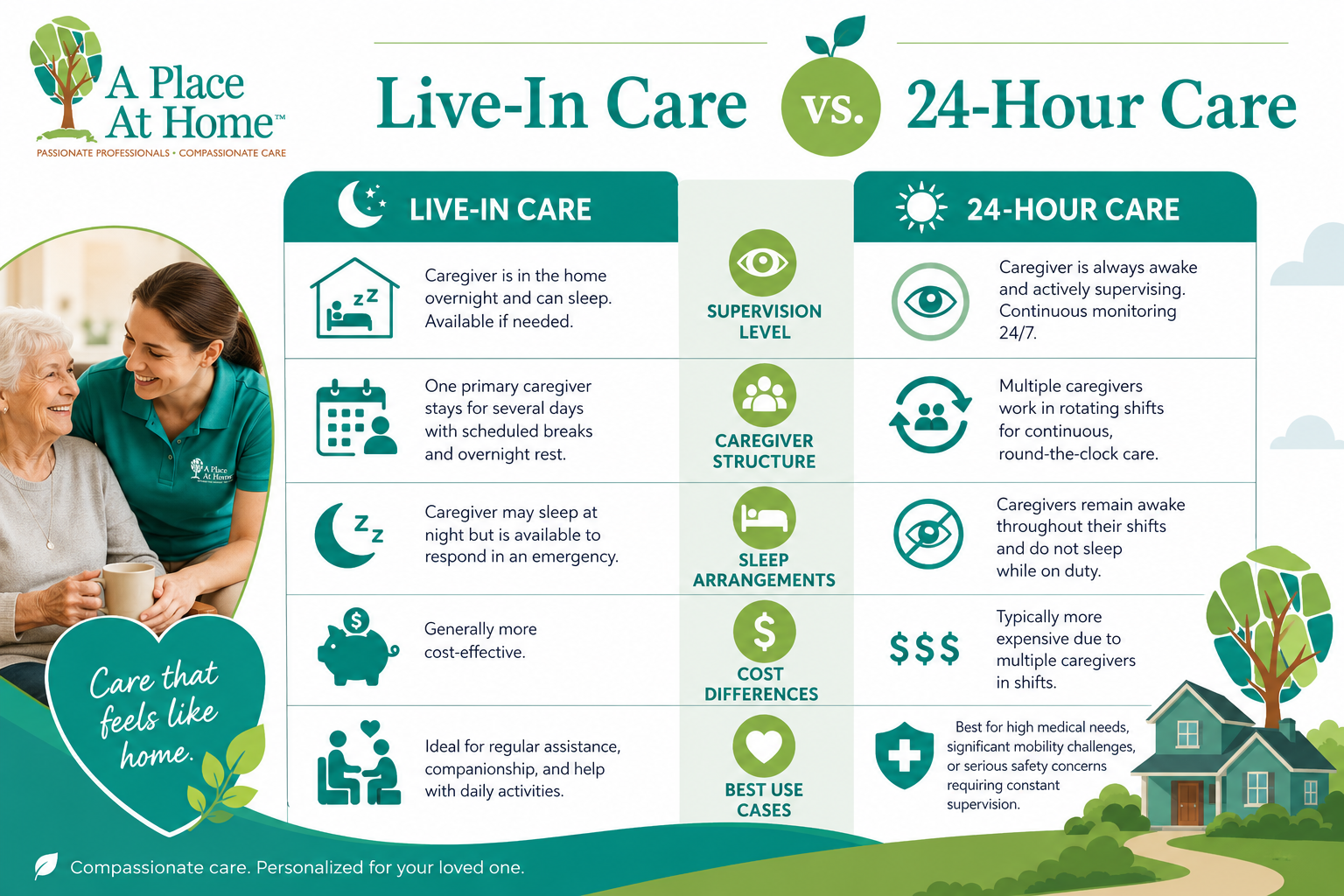
Supervision Level
One of the main differences between these two care options is the level of supervision provided:
- 24-hour care: A caregiver is always awake and actively supervising your loved one, ensuring continuous monitoring and immediate assistance at all times, day and night.
- Live-in care: The caregiver remains in the home overnight but is permitted to sleep. While they are available if needed, supervision is not continuous during sleeping hours unless there is an emergency.
Caregiver Structure
The way caregivers are scheduled also differs significantly between the two options:
- 24-hour care: Care is provided by multiple caregivers working in rotating shifts to ensure continuous, around-the-clock coverage without interruption.
- Live-in care: One primary caregiver provides care for several days at a time, living in the home and taking scheduled breaks as well as an overnight rest period.
Sleep Arrangements
Sleep policies are another key distinction between these care models:
- 24-hour care: Caregivers remain awake throughout their shifts and do not sleep while on duty.
- Live-in care: Caregivers are allowed to sleep during the night, provided they are still available to respond in case of an emergency.
Cost Differences
Cost is often an important factor when choosing between care options:
- 24-hour care: Typically more expensive due to the need for multiple caregivers working in shifts to provide uninterrupted coverage.
- Live-in care: Generally more cost-effective, as one caregiver covers a longer period with scheduled rest times.
Best Use Cases
Each care type is designed to support different levels of need:
- 24-hour care: Best suited for individuals with high medical needs, significant mobility challenges, or serious safety concerns requiring constant supervision.
- Live-in care: Ideal for those who need regular assistance, companionship, and support with daily activities but do not require continuous overnight monitoring.
Safety Considerations: Which Option Provides More Protection?
Safety is often the deciding factor when families choose between 24-hour care and live-in care. While both options provide valuable support in the home, they differ in how closely a loved one is monitored, especially during high-risk situations such as nighttime wandering or medical emergencies.
Wandering Prevention
For individuals who are prone to wandering, especially those living with memory loss conditions, supervision is critical.
- 24-hour care: Offers continuous, awake supervision, which significantly reduces the risk of unsafe wandering at any time of day or night.
- Live-in care: Provides a caregiver in the home overnight, but since they are asleep, there may be limited immediate intervention unless the caregiver is alerted.
Emergency Response Coverage
The ability to respond quickly in an emergency is another important safety consideration.
- 24-hour care: A caregiver is always awake and available to respond immediately to falls, sudden illness, or other urgent situations.
- Live-in care: The caregiver is on-site and can respond if awakened, but response time may be slightly delayed during sleep hours.
Overnight Monitoring Differences
Nighttime safety is often one of the biggest differences between the two care models.
- 24-hour care: Ensures active monitoring throughout the night, which is especially important for individuals who are restless, disoriented, or medically fragile.
- Live-in care: Provides overnight presence in the home, but monitoring is passive while the caregiver sleeps unless they are called upon.
Cognitive Decline Considerations
For individuals experiencing Alzheimer’s disease or other forms of dementia, the level of supervision needed often increases as the condition progresses.
- 24-hour care: Typically better suited for advanced cognitive decline, where confusion, agitation, or wandering may occur unpredictably and require immediate attention.
- Live-in care: May be appropriate in earlier stages of memory loss when symptoms are milder and nighttime supervision needs are less intensive.
Ultimately, the right choice depends on the level of risk involved and how much overnight and emergency support your loved one requires to remain safe and comfortable at home.
Which Type of Care Is Better for Alzheimer’s Disease and Dementia?
Families caring for a loved one with Alzheimer’s disease and related dementias often struggle to determine whether live-in care or 24-hour home care is the better choice. The answer largely depends on the condition’s stage and the individual’s safety risks.
Live-in care may be appropriate for individuals in the early stages of dementia who benefit from companionship, reminders, routine assistance, and occasional nighttime support. The consistency of having the same caregiver can also help reduce anxiety and confusion. However, as dementia progresses, many families find that 24-hour home care becomes necessary.
Individuals with advanced dementia may experience:
- Nighttime wandering
- Sundowning symptoms
- Sleep disturbances
- Increased fall risk
- Disorientation and confusion
- Unpredictable behaviors
Because 24-hour home care provides continuous awake supervision, it often offers greater protection for seniors living with advanced cognitive decline.
Read: How to Tell the Difference Between Normal Aging and Dementia
Which Type of Home Care Is Right for Your Loved One?
Choosing the right type of home care involves carefully considering several factors, including safety needs, mobility, cognitive health, personal preferences, and budget. Understanding these elements can help you determine which level of support will provide the most comfort and security for your loved one.
Signs Your Loved One May Need 24-Hour Care
Sometimes the need for 24-hour care develops gradually. Families may notice subtle changes before realizing that continuous supervision has become necessary.
Common signs include:
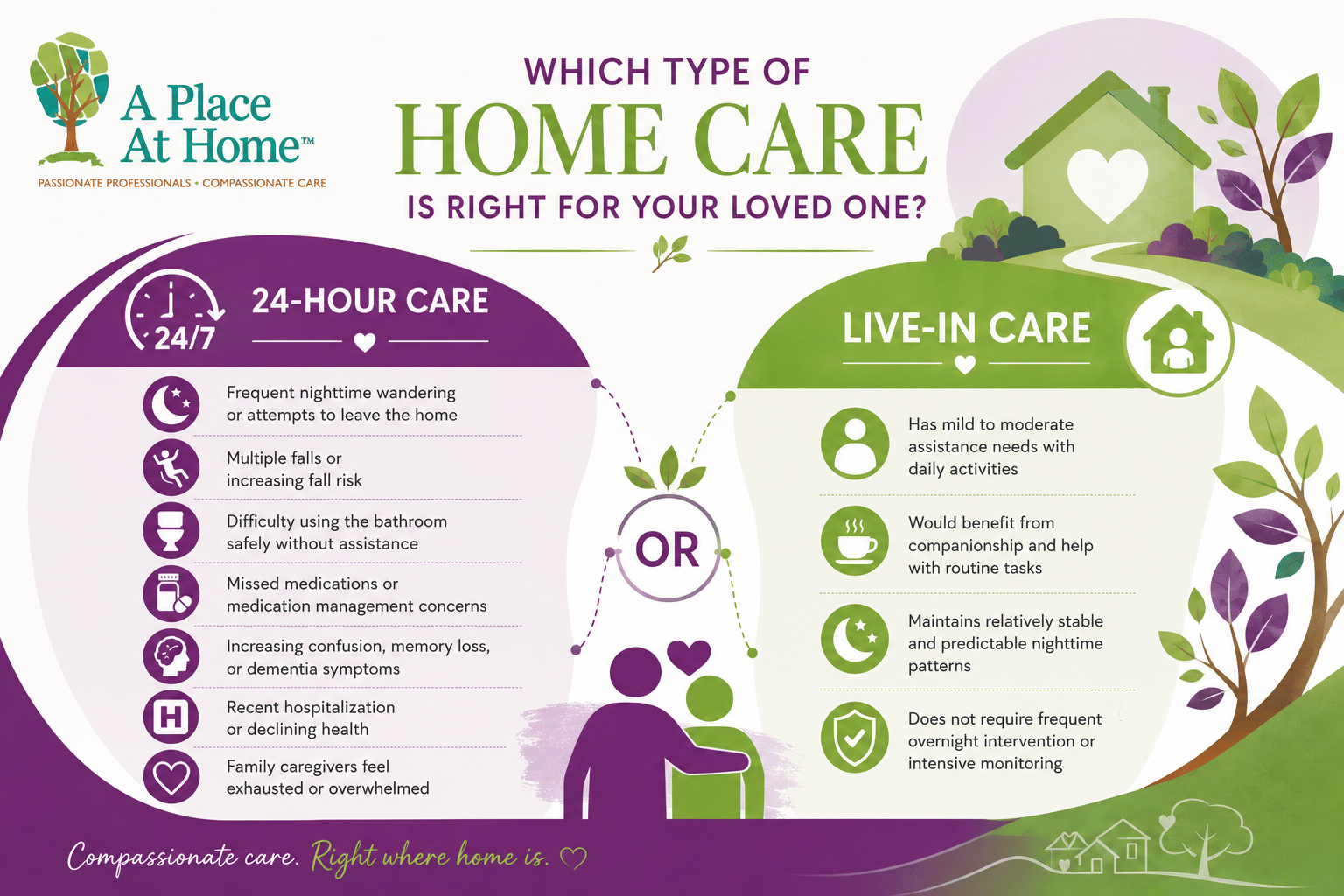
- Frequent nighttime wandering or attempts to leave the home
- Multiple falls or increasing fall risk
- Difficulty using the bathroom safely without assistance
- Missed medications or medication management concerns
- Increasing confusion, memory loss, or dementia symptoms
- Recent hospitalization or declining health
- Family caregivers feel exhausted or overwhelmed
When Live-In Care May Be Enough
Live-in care can be a suitable option for individuals who need regular support but do not require continuous, awake supervision throughout the night.
It may be the right fit if your loved one:
- Has mild to moderate assistance needs with daily activities
- Would benefit from companionship and help with routine tasks
- Maintains relatively stable and predictable nighttime patterns
- Does not require frequent overnight intervention or intensive monitoring
Cost of 24-Hour vs. Live-In Home Care (What Families Should Expect)
When comparing 24-hour care and live-in care, cost is often one of the most important considerations for families. While both options provide valuable in-home support, several factors influence overall pricing, and expenses can vary widely depending on individual circumstances.
General Cost Drivers
The overall cost of home care is shaped by a variety of factors, including:
- Geographic location, as rates can differ significantly by region and local demand
- The level of care required, especially if specialized or high-acuity support is needed
- Whether services are arranged through a care agency or a private hire caregiver
- The number of hours of care and the complexity of daily support needs
Because of these variables, costs can look very different from one family to another, even for similar types of care.
Why 24-Hour Care Is More Expensive
24-hour care typically involves a higher overall cost due to its staffing structure. Since caregivers work in rotating shifts to ensure someone is always awake and alert, more staff hours are required to provide continuous coverage.
This around-the-clock staffing model increases labor costs, but it also ensures uninterrupted supervision, which is essential for individuals with higher medical or safety needs.
Why Live-In Care May Offer Cost Savings
Live-in care can often be a more cost-effective option because it is typically provided by a single caregiver who resides in the home for extended periods. While the caregiver receives breaks and overnight rest, the overall staffing requirement is lower compared to shift-based care.
As a result, families may find that live-in care offers a more budget-friendly solution for loved ones who need consistent support but do not require awake supervision throughout the night.
A Note on Variability
It’s important to remember that there is no one-size-fits-all pricing model for home care. Costs can vary significantly based on individual needs, care schedules, and provider structures. The best approach is to consult with a professional care agency to receive a personalized assessment and a clearer understanding of expected costs based on your loved one’s specific situation.
Can Medicare Pay for Live-In or 24-Hour Home Care?
Many families are surprised to learn that Medicare generally does not cover long-term live-in care or 24-hour non-medical home care services.
Depending on the situation, payment options may include:
- Private pay
- Long-term care insurance
- Veterans benefits
- Certain Medicaid waiver programs
- Other state-specific assistance programs
Because eligibility varies, families should speak with a home care agency or financial advisor to better understand available funding options and benefits.
Can Care Levels Be Combined or Adjusted Over Time?
As a loved one’s needs change, home care plans are not fixed; they can be adjusted to provide the right level of support at every stage. Many families find that care evolves, shifting between live-in care and 24-hour care depending on health, safety, and independence.
Transitioning from Live-In to 24-Hour Care
It is common for families to start with live-in care and later transition to 24-hour care as needs increase.
This change may be recommended when:
- Nighttime supervision becomes more important due to wandering or confusion
- Mobility declines and fall risk increase
- Medical conditions become more complex or less stable
- A higher level of continuous monitoring is needed for safety
Care agencies can help manage this transition smoothly by reassessing needs and adjusting caregiver scheduling accordingly.
Scaling Down When Condition Improves
In some cases, care needs may decrease over time, such as after recovery from surgery or stabilization of a health condition.
When appropriate, families may scale down from 24-hour care to live-in care if:
- The individual becomes more independent with daily activities
- Nighttime supervision is no longer required at an intensive level
- Safety risks have significantly reduced
- Ongoing support is still needed, but at a lighter level
This flexibility allows families to avoid unnecessary care while still maintaining appropriate support.
Flexible Care Planning for Aging Progression
A key advantage of professional home care is its flexibility. Care plans are designed to adapt as needs change, ensuring continuity without disruption. Regular reassessments help identify when adjustments are needed, allowing care to increase or decrease in response to evolving health conditions.
Ultimately, this adaptable approach ensures your loved one receives the right level of care at the right time, supporting safety, independence, and quality of life throughout the aging journey.

Choosing the Right Level of Care for Your Loved One
Deciding between 24-hour care and live-in care is never an easy choice, but understanding the key differences can help you feel more confident in your decision. The right option ultimately depends on your loved one’s health, safety risks, level of independence, and overall care needs, along with your family’s preferences and budget.
Both care models are designed to support aging adults in the comfort of their homes while promoting dignity, safety, and quality of life. Whether your loved one needs continuous, awake supervision or consistent daily support with occasional overnight assistance, the most important goal is ensuring they receive the right level of care at the right time.
Live-In and 24-Hour Home Care in North Tucson, AZ
Families throughout North Tucson and surrounding communities often choose home care services to help loved ones age safely and comfortably in familiar surroundings. Whether your loved one lives in Oro Valley, Catalina Foothills, Casas Adobes, Marana, or SaddleBrooke, the right level of care can provide peace of mind while helping maintain independence.
A Place At Home – North Tucson provides compassionate, reliable in-home support tailored to each individual’s needs. Whether you are considering live-in care or require the safety and reassurance of 24-hour care, our team is here to help you make the best decision for your loved one.
To learn more about 24-hour home care and live-in care services, or to schedule a consultation, give us a call at (520) 317-5991. With the right support in place, families can feel confident knowing their loved one is safe, comfortable, and cared for at home.
24-Hour Care vs. Live-In Care FAQs
Do live-in caregivers sleep at night?
Yes. Live-in caregivers are permitted to sleep during the night in a designated sleeping space within the home. They remain available to assist if needed, but they are not required to stay awake unless there is a specific situation that requires attention.
Which option is better for dementia patients?
It depends on the stage and severity of dementia. 24-hour care is often better for individuals with advanced dementia who may wander, experience frequent confusion, or require constant supervision. Live-in care may be appropriate in earlier stages when symptoms are more stable and overnight supervision needs are less intensive.
How do agencies staff 24-hour home care?
24-hour home care is typically staffed by multiple caregivers working in rotating shifts. This ensures that a caregiver is always awake, alert, and available, providing continuous supervision and immediate response to any needs at any time of day or night.
Can families switch between care types easily?
Yes. Most home care agencies can adjust care plans as needs change. Families can transition between live-in care and 24-hour care based on updated assessments, ensuring the level of support always matches the individual’s current safety and health needs.
What is the difference between overnight care and 24-hour care?
Overnight care typically involves one caregiver providing assistance during nighttime hours and may include periods of rest. In contrast, 24-hour care uses multiple caregivers working rotating shifts so that someone is always awake and actively available to provide assistance.
How do I know when it is time to move from live-in care to 24-hour care?
A transition may be necessary when a loved one begins wandering, experiences frequent falls, requires repeated overnight assistance, develops advanced dementia symptoms, or needs continuous supervision for safety.
What happens if a live-in caregiver needs time off?
Most professional home care agencies arrange substitute caregivers to ensure continuity of care when a live-in caregiver takes scheduled time off, vacations, or personal leave.
Can couples receive live-in home care together?
Yes. Many home care agencies provide live-in care for couples. Depending on the level of assistance needed, one caregiver may support both individuals or additional care may be recommended.