
How Much Does Home Care Cost in Broward County, FL?

Home-much-home-care-costs-in-Broward-County-Florida

If you’re trying to figure out what home care actually costs in Broward County, here’s the short answer: most families pay somewhere between $24 and $38 an hour, depending on the level of care needed, and the type of arrangement (hourly, live-in, or full 24-hour coverage) makes a big difference in the monthly total. Below is a full breakdown, with real numbers, so you can budget with confidence instead of guessing.

We put this together the way we’d walk a family through it in person: what the numbers actually mean, why Broward County costs more than the rest of Florida, and what programs exist if private pay isn’t realistic for your situation.

Quick Answer

  • Hourly home care in Broward County: $24 to $38 per hour, depending on the type of care
  • Part-time care (about 20 hours a week): roughly $2,600 a month
  • Full-time care (about 40 hours a week): roughly $5,200 a month
  • Live-in care: $4,500 to $6,500 a month
  • 24-hour care with multiple caregivers: $9,000 to $13,500 a month
  • Compared to assisted living: roughly $3,500 to $5,600 a month in Broward County
  • Compared to a nursing home: $9,000 to $10,500+ a month for a semi-private room

Why Home Care Costs More in Broward County Than the Florida Average

Statewide, Florida families typically pay $25 to $29 an hour for home care. In Broward County, and South Florida generally, that number runs 10 to 25 percent higher. It’s not arbitrary. A few things are driving it.

Broward has one of the largest senior populations in the state, so demand for experienced caregivers is high and steady. The cost of living here, housing, insurance, gas, is higher than in most of Florida’s interior, and that gets built into what agencies pay their caregivers and, in turn, what they charge families. And because Broward is home to major hospitals like Memorial Regional and Memorial Regional Hospital South, there’s a real concentration of post-surgery and recovery care needs that push demand for skilled, reliable caregivers even higher.

What You’ll Pay for Each Type of Home Care in Broward County

Type of CareBroward County Hourly RateFlorida State AverageMonthly Estimate
Companion / homemaker care$24–32/hr$22–28/hr~$2,600 (20 hrs/week)
Personal care / Home Health Aide$26–35/hr$25–32/hr~$5,200 (40 hrs/week)
Dementia / Specialized care$32–38/hr$28–34/hrVaries
Live-in careFlat daily rateFlat daily rate$4,500–6,500/mo
24-hour careBilled by shiftBilled by shift$9,000–13,500/mo
Companion / Homemaker Care
Broward Rate
$24–32/hr
Florida Average
$22–28/hr
Monthly Estimate
~$2,600 (20 hrs/week)
Personal Care / Home Health Aide
Broward Rate
$26–35/hr
Florida Average
$25–32/hr
Monthly Estimate
~$5,200 (40 hrs/week)
Dementia / Specialized Care
Broward Rate
$32–38/hr
Florida Average
$28–34/hr
Monthly Estimate
Varies
Live-in Care
Billing
Flat daily rate
Monthly Estimate
$4,500–6,500
24-Hour Care
Billing
Billed by shift
Monthly Estimate
$9,000–13,500

Rates are estimates based on 2025-2026 industry data and will vary by agency, caregiver experience, and the specific needs of your loved one. Ask any agency you’re considering for a written rate sheet before committing.
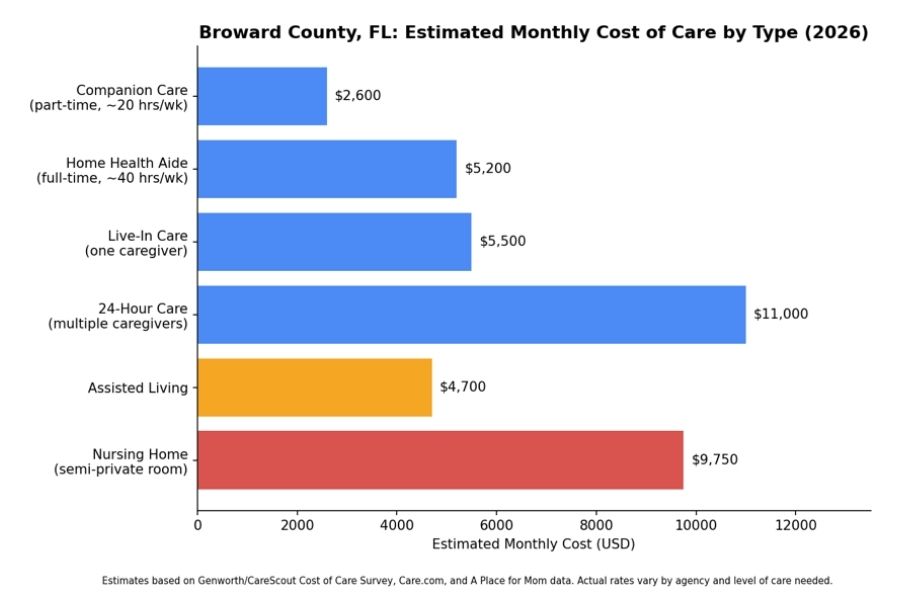
Broward County Estimated Monthly Cost of Care By Type (2026)

How Home Care Compares to Assisted Living and Nursing Homes

This is the question we get asked the most, and it’s a fair one, because on paper, home care can look more expensive per hour than a facility’s monthly rate. The comparison only makes sense once you look at actual hours of care.

Care SettingEstimated Monthly Cost (Broward County)
Home Care, Part-Time (~20 hrs/wk)~$2,600
Assisted Living$3,500–$5,600
Home Care, Full-Time (~40 hrs/wk)~$5,200
Home Care, Live-In$4,500–$6,500
Nursing Home (Semi-Private Room)$9,000–$10,500+
Home Care, 24-Hour (Multiple Caregivers)$9,000–$13,500
Home Care, Part-Time
Hours
~20 hrs/week
Estimated Monthly Cost
~$2,600
Assisted Living
Estimated Monthly Cost
$3,500–$5,600
Home Care, Full-Time
Hours
~40 hrs/week
Estimated Monthly Cost
~$5,200
Home Care, Live-In
Estimated Monthly Cost
$4,500–$6,500
Nursing Home (Semi-Private Room)
Estimated Monthly Cost
$9,000–$10,500+
Home Care, 24-Hour
Coverage
Multiple caregivers
Estimated Monthly Cost
$9,000–$13,500

For a lot of families, home carе ends up costing less than assisted living, as long as the person doesn’t need round-the-clock supervision. It’s only once you get into full 24-hour coverage that home care starts to cost more than a facility. That’s usually the point where families start weighing whether a move makes more sense, or whether a hybrid approach (family caregiving during the day, paid overnight care) can bridge the gap.

How to Pay for Home Care in Broward County

  • Private pay is the most common way families cover home care, but it’s not the only option.
  • Florida Medicaid (Statewide Medicaid Managed Care Long-Term Care Program). This program can cover home and community-based care for eligible seniors. In 2026, the income limit is $2,982 a month for an individual, with a $2,000 asset limit. It’s a real option, but be aware that most regions, Broward included, have waitlists, so it’s worth applying early rather than waiting until care is urgently needed.
  • VA Aid and Attendance. Veterans and surviving spouses who qualify can receive a monthly benefit that can be put directly toward home care costs. As of 2026, the maximum monthly benefit for a veteran with a dependent is just over $2,700. It won’t cover the full cost of care on its own for most families, but it makes a meaningful dent.
  • Long-term care insurance. If your loved one purchased a policy years ago, now is the time to pull it out and check what it actually covers, home care, facility care, or both, and what the daily or monthly benefit cap is.
  • A combination approach. Many of the families we work with use more than one of these at once, a bit of VA benefit, a bit of savings, and private pay to fill the gap. A good care coordinator should be able to help you figure out what combination makes sense before you commit to a plan.

Frequently Asked Questions

Is home care cheaper than assisted living in Broward County?

For part-time or moderate care needs, usually yes. Home care becomes more expensive than assisted living once a person needs live-in or 24-hour supervision, since you’re paying for one-on-one attention rather than shared facility staffing.

How much does 24-hour home care cost in Broward County?

Most families pay between $9,000 and $13,500 a month for true round-the-clock coverage with multiple caregivers rotating in shifts. This is different from live-in care, where one caregiver stays in the home and typically costs $4,500 to $6,500 a month.

Does Medicaid pay for home care in Florida?

Yes, through the Statewide Medicaid Managed Care Long-Term Care program, for those who meet the income and asset limits. There are often waitlists, so it’s worth starting the application process as early as possible.

Finding the Right Home Care Fit for Your Budget

If you’d like help figuring out what level of care your loved one actually needs and what it would cost, reach out to A Place At Home Weston for a free consultation. Get home care in Hollywood, Weston,  Pembroke Pines, and throughout Broward County, Florida. Call (954) 335-9284.

A Place At Home Weston is a private-pay home care agency, so while we’re happy to help you think through options like VA benefits or long-term care insurance, our own care services are paid privately rather than billed through Medicaid.

Understanding Freezing of Gait in Seniors

Why-Do-Parkinsons-Patients-Freeze-While-Walking

If you’ve watched your mom or dad suddenly stop mid-step, feet planted as if glued to the floor, you know how unsettling freezing of gait in Parkinson’s can be. One moment they’re walking normally; the next, their upper body wants to keep going but their legs simply won’t cooperate. It looks alarming, and it raises an obvious question: why do Parkinson’s patients freeze when walking at all?

Parkinson’s disrupts the brain circuits that make walking automatic, and that breakdown is what triggers a freeze. Here, we’ll cover what causes freezing episodes, when they’re most likely to happen, practical cueing techniques that get feet moving again, what medication can and can’t do, and how families can reduce the fall risk that comes with freezing.

What Causes Freezing of Gait in Parkinson’s Disease?

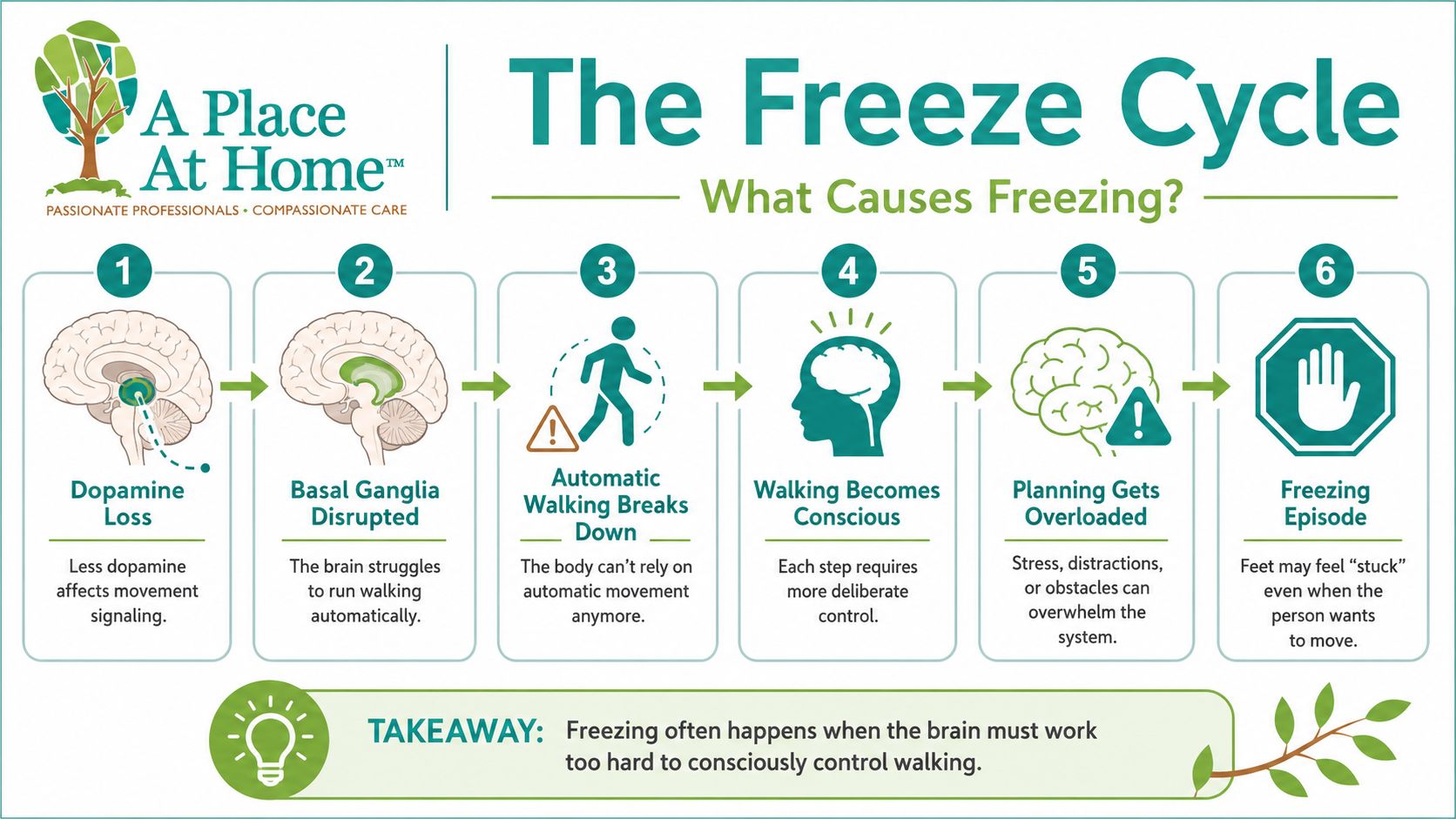
Freezing of gait happens because Parkinson’s disease damages the dopamine-producing cells that feed the basal ganglia, the deep brain structures responsible for making movement automatic. When those circuits misfire, walking stops being something the body does on autopilot and becomes something the brain must consciously plan, step by step. Freezing is what happens when that conscious planning momentarily fails (NIH/PMC, pathophysiology review).

Think about how you normally walk through your house. You don’t decide to lift your left foot, swing it forward, and shift your weight; it just happens, because the basal ganglia handle the sequencing in the background. In Parkinson’s, dopamine loss degrades that background system. Most of the time, the brain compensates by routing walking through more deliberate, attention-driven pathways. But those pathways are easily overloaded. Add a doorway to judge, a turn to execute, or a conversation to hold, and the system can stall entirely. The result is a freezing episode: a temporary, involuntary inability to move, most often felt as feet stuck to the floor while the person’s intention to walk is fully intact (Parkinson’s Foundation).

This is also why freezing episodes cluster around transitions: starting to walk from a standing position, passing through doorways, turning a corner, or stepping from one type of surface to another. Each of these moments demands extra motor planning at exactly the point where the Parkinson’s brain has the least capacity to spare.

Two things are worth stressing for families. First, your loved one is not being stubborn, lazy, or dramatic. Freezing is a neurological event, not a choice. Second, not everyone with Parkinson’s experiences freezing episodes, and among those who do, frequency and severity vary widely from person to person and even day to day.

The freeze cycle understanding movement disruptions

What Is the Freezing Stage of Parkinson’s Disease?

There is no single “freezing stage” of Parkinson’s. Freezing typically appears in mid-stage to advanced Parkinson’s disease and tends to become more frequent as the disease progresses. On the Hoehn and Yahr scale, which neurologists use to describe Parkinson’s progression from Stage 1 (mild, one-sided symptoms) through Stage 5 (requiring a wheelchair or full-time assistance), freezing most commonly emerges around Stage 3, when balance problems begin, and becomes more prominent in Stages 4 and 5.

That said, the timeline isn’t rigid. Some people develop freezing earlier, some never develop it at all, and its severity doesn’t always track neatly with other symptoms like tremor. If your parent has started freezing, it usually signals that their Parkinson’s has entered a phase where gait and balance deserve focused attention from their care team, ideally a movement disorder specialist and a physical therapist trained in Parkinson’s.

When Are People with Parkinson’s Most Likely to Freeze?

Freezing episodes are most likely during transitions in movement or environment, during moments of divided attention, and when medication is wearing off. The most common triggers include:

  • Starting to walk: especially rising from a chair and taking the first step
  • Doorways and narrow spaces: where the brain must judge clearance mid-stride
  • Turning, particularly tight pivot turns: this is when many falls happen
  • Changes in flooring: like stepping from tile onto carpet, or pavement onto grass
  • Dual-tasking: walking while talking, carrying a plate, or searching for keys
  • Stress, time pressure, and crowds: including something as ordinary as a ringing phone or an elevator door closing
  • Medication “off” periods: the window before the next levodopa dose, when dopamine levels dip. Many people with Parkinson’s freeze when they’re due for their next dose, and episodes usually lessen after taking it

Once you know the triggers, patterns emerge quickly. If your dad freezes in the same hallway every morning, or your mom locks up whenever someone talks to her mid-walk, that’s not coincidence. It’s information you can use.

How to Stop Freezing in Parkinson’s Disease in Seniors

The most effective way to break a freezing episode is cueing: giving the brain an external signal (visual, auditory, or rhythmic) that bypasses the stalled automatic system and jump-starts movement. Strategies that work for many people include:

  • Visual targets: imagine a line on the floor to step over, aim for a specific tile, or use a laser-cue device or laser cane that projects a real line in front of the feet
  • Rhythm and counting: march in place (“left, right, left, right”), count aloud, hum a song with a strong beat, or step in time with music
  • The march or goose step: deliberately swinging the leg high and forward often succeeds when a normal step won’t
  • Weight shifting: rock gently from one leg to the other before attempting a step; freezing often involves weight stuck evenly on both feet, and shifting it frees the stepping leg
  • Stop, reset, restart: fighting a freeze usually makes it worse; pausing, standing tall, taking a breath, and starting with a cue works better than straining forward
  • Wide turns: turning in a half circle instead of pivoting dramatically reduces freezes during direction changes

Beyond in-the-moment techniques, two longer-term measures matter. Physical therapy with a Parkinson’s-trained therapist teaches personalized cueing strategies and builds the balance reserves that prevent freezes from turning into falls. Home modifications remove triggers at the source: clear cluttered walking paths, widen furniture arrangements so routes avoid tight squeezes, remove throw rugs, improve hallway lighting, and consider contrasting floor tape at known freezing spots like doorways to serve as a built-in visual cue.

What Is the Best Medication for Parkinson’s Freezing?

There is no single best medication for Parkinson’s freezing, and freezing of gait often responds only partially to standard dopaminergic medication, even when the same drugs control tremor and stiffness well. That’s frustrating for families who expect the next prescription adjustment to fix it, but it reflects how freezing works: it involves brain circuits beyond the purely dopamine-dependent ones.

What physicians typically can do is optimize the medication picture around freezing. If episodes cluster during “off” periods before the next dose, a neurologist may adjust levodopa timing or dosing, add extended-release formulations, or explore other medication classes to smooth out the wearing-off pattern. For “off”-period freezing specifically, these adjustments often help meaningfully. Freezing that occurs even when medication is working (“on” freezing) is harder to treat pharmacologically, which is exactly why cueing techniques and physical therapy carry so much weight in a freezing management plan.

Medication decisions in Parkinson’s are highly individual, so bring a specific log of when freezing happens relative to medication doses to your loved one’s neurologist or movement disorder specialist. That timing detail is often the single most useful thing you can hand them.

How Caregivers Can Help Reduce Fall Risk in Parkinson’s Seniors

Freezing and falling are tightly linked. About 60% of people living with Parkinson’s fall each year, and roughly 80% of those falls are tied to postural instability and freezing episodes, most often during turns or direction changes. The danger comes from the mismatch: the body’s momentum keeps moving while the feet don’t.

When a freeze happens, the most important thing you can do is stay calm and never pull, push, or rush your loved one. Well-meaning attempts to force a person through a freeze are a common cause of loss of balance and falls. Instead, wait a few seconds, then offer a cue: count a rhythm out loud, suggest marching, or place your foot perpendicular in front of theirs and ask them to step over it. If they remain stuck, gently helping them rock from side to side can release the freeze.

Day to day, keep walking routes clear and well-lit, watch for freezing during the riskiest windows (early morning, end-of-dose periods, and nighttime bathroom trips), and call the doctor promptly if episodes suddenly become more frequent, last longer, or result in a fall or near-fall.

For many Weston families, the hardest part is coverage. You can’t be there for every hallway transition, and a person who freezes shouldn’t be navigating doorways alone during their “off” periods. A trained in-home caregiver who understands cueing, knows your loved one’s specific triggers, and provides steady standby assistance during walking can close that gap without taking away independence.

Managing Freezing of Gait: What Families Should Do Next

Freezing of gait is common in mid-to-late-stage Parkinson’s, it has a real neurological cause, and it is manageable. Your loved one isn’t imagining it, and you didn’t cause it by doing something wrong. Between cueing techniques, physical therapy, medication timing adjustments, and a safer home layout, most families can significantly cut both the frequency of freezes and the falls they cause. The single best next step: schedule a visit with a movement disorder specialist and ask for a referral to a Parkinson’s-trained physical therapist. And if walking safely at home has become a daily worry, extra hands can help.

A Place At Home – Weston provides specialized Parkinson’s home care throughout Weston, FL and Broward County, with caregivers trained to assist with mobility, medication reminders, and fall prevention for seniors living with Parkinson’s. Call (954) 335-9284 to schedule a free in-home assessment.

In-Home Care for Seniors with Parkinson’s Disease in Weston Florida

Related Reading

Frequently Asked Questions

What is the freezing stage of Parkinson’s disease? Freezing isn’t a formal stage of Parkinson’s. It’s a symptom that usually appears in mid-to-late-stage disease, most often around Hoehn and Yahr Stage 3 or later, and tends to become more frequent as Parkinson’s progresses. Not everyone with Parkinson’s develops freezing.

How do you stop freezing in Parkinson’s disease? The most reliable approach is cueing: stepping over a real or imagined line on the floor, marching in place, counting or stepping to a rhythm, or shifting weight from one leg to the other before stepping. Pausing to reset rather than straining forward, taking wide turns instead of pivoting, and working with a Parkinson’s-trained physical therapist all reduce freezing over time.

What is the best medication for Parkinson’s freezing? No single medication is best for freezing, and freezing often responds only partially to standard Parkinson’s drugs. When freezing clusters during “off” periods before the next dose, neurologists may adjust levodopa timing or dosing to smooth out the wearing-off. Ask a neurologist or movement disorder specialist about your loved one’s specific medication pattern.

When are people with Parkinson’s most likely to freeze? Freezing happens most often during transitions: starting to walk, passing through doorways or narrow spaces, turning, and stepping onto a different floor surface. Stress, crowds, multitasking while walking, and the wearing-off period before the next medication dose also raise the likelihood of an episode.

How can home care help with Parkinson’s freezing? A trained in-home caregiver provides standby assistance during walking, uses cueing techniques when a freeze occurs, keeps walking paths free of trip hazards, and offers medication reminders that help prevent “off”-period freezing. This reduces fall risk during everyday moments, like nighttime bathroom trips, when family can’t always be present.