
Choosing a dementia caregiver is about more than availability. Families should ask about caregiver training, experience with Alzheimer’s and other forms of dementia, emergency procedures, communication, care planning, and how the agency matches caregivers with clients. Asking the right questions can help your loved one receive safe, compassionate, and consistent care.
Why Choosing the Right Dementia Caregiver Matters
Dementia affects more than memory. Depending on the type and stage of dementia, a person may experience difficulty with judgment, communication, mobility, personal hygiene, eating, medication routines, or recognizing familiar people and surroundings.
A caregiver who does not understand dementia may unintentionally increase frustration by arguing, correcting, rushing, or asking too many questions. An experienced dementia caregiver knows how to slow down, offer reassurance, redirect attention, and adapt daily activities to the person’s abilities.
Professional in-home dementia care may help a senior remain in familiar surroundings while receiving assistance with daily routines, companionship, personal care, meal preparation, safety monitoring, and respite for family caregivers.
Here are 15 important questions to ask before deciding.
1. What Experience Do You Have Caring for Someone With Dementia?
General senior care experience is helpful, but dementia care requires additional patience, awareness, and communication skills.
Ask whether the caregiver has supported people with:
- Alzheimer’s disease
- Vascular dementia
- Lewy body dementia
- Frontotemporal dementia
- Parkinson’s-related dementia
- Mild cognitive impairment
- Advanced memory loss
You can also describe your loved one’s current challenges and ask the caregiver to explain how they would provide support.
For example:
“My mother becomes anxious in the evening and sometimes believes she needs to leave the house. How would you respond?”
A strong answer should focus on remaining calm, identifying possible triggers, reassuring the person, redirecting their attention, and protecting their safety rather than arguing with them.
2. Have You Received Dementia-Specific Caregiver Training?
Ask what dementia training the caregiver has completed and whether that training is updated regularly.
Training may cover:
- Dementia-related communication
- Confusion and repetition
- Agitation and anxiety
- Wandering risks
- Changes in eating and sleeping
- Personal care resistance
- Fall prevention
- Meaningful activities
- Emergency response
- Recognizing changes that should be reported
Avoid relying only on statements such as “I am good with seniors.” Ask for specific examples of what the caregiver learned and how those techniques are used during a typical visit.
3. How Do You Respond to Agitation, Confusion, or Repetitive Questions?
A person with dementia may repeat the same question, accuse someone of taking an item, resist bathing, or become upset when a routine changes. Ask the caregiver how they handle these situations.
A dementia-informed caregiver should avoid:
- Arguing about what is true
- Shaming or embarrassing the person
- Raising their voice
- Physically forcing an activity
- Taking accusations personally
- Overloading the person with instructions
Instead, the caregiver should use a calm voice, acknowledge the person’s feelings, simplify choices, redirect attention, and look for unmet needs such as hunger, pain, fatigue, fear, or overstimulation.
4. How Will You Learn My Loved One’s Routine and Preferences?
Consistency can help reduce confusion and anxiety for someone living with dementia. Ask how the caregiver will learn about your loved one’s:
- Preferred wake-up and bedtime
- Favorite meals
- Personal hygiene routine
- Hobbies and interests
- Religious or cultural preferences
- Music preferences
- Former occupation
- Family relationships
- Communication style
- Common sources of anxiety
- Comforting activities
Good dementia care should be personalized. The caregiver should learn who the person is, not simply what diagnosis they have.
5. Can You Help With Personal Care?
Dementia may eventually make bathing, dressing, grooming, toileting, and oral hygiene difficult. Ask whether the caregiver can safely and respectfully assist with:
- Bathing or showering
- Dressing
- Grooming
- Toileting
- Incontinence care
- Oral hygiene
- Mobility
- Transfers
- Skin-care routines
Also ask how the caregiver protects dignity when a senior refuses or becomes embarrassed by personal care. The caregiver should explain each step, preserve privacy, offer simple choices, and allow additional time rather than rushing.
6. How Do You Handle Wandering or Exit-Seeking Behavior?
Wandering can happen at different stages of dementia and may create serious safety risks. A person may leave home because they believe they need to go to work, find a family member, or return to a previous residence.
Ask the caregiver:
- How they supervise someone with a wandering history
- How they respond when the person wants to leave
- What they do if the person cannot be located
- How they document wandering attempts
- When they contact family members or emergency services
- Whether they identify patterns or triggers
The caregiver should never depend only on locked doors. Effective support also includes meaningful activities, regular movement, bathroom access, hydration, reassurance, and awareness of the person’s usual behavior.
7. How Do You Support Medication Routines?
Nonmedical caregivers typically provide medication reminders rather than administering medications. Ask the agency to explain exactly what its caregivers are permitted to do under Nevada requirements and company policy.
Depending on the care plan, a caregiver may be able to:
- Remind the senior that it is time for medication
- Bring a prefilled medication organizer to the senior
- Observe whether the medication was taken
- Document missed or refused doses
- Notify the appropriate family member
- Watch for visible changes or concerns
Make sure the caregiver understands whom to contact when medication is missed, refused, or appears to cause a concerning reaction.
8. How Will You Support Meals and Hydration?
Dementia can affect appetite, food recognition, swallowing, coordination, and the ability to prepare meals safely.
Ask whether the caregiver can help with:
- Meal planning
- Grocery lists
- Light meal preparation
- Hydration reminders
- Monitoring food intake
- Creating a calm mealtime environment
- Following dietary instructions
- Reporting changes in appetite or swallowing
The caregiver should know that sudden changes in eating, drinking, or swallowing should be reported promptly to the family and appropriate healthcare professional.
9. What Activities Will You Do With My Loved One?
Dementia care should involve more than sitting nearby or watching television.
Ask how the caregiver will provide meaningful, ability-appropriate engagement.
Activities may include:
- Listening to familiar music
- Looking through family photographs
- Folding towels
- Gardening
- Taking supervised walks
- Completing simple puzzles
- Reading together8. How Will You Support Meals and Hydration?
Dementia can affect appetite, food recognition, swallowing, coordination, and the ability to prepare meals safely.
Ask whether the caregiver can help with:
- Meal planning
- Grocery lists
- Light meal preparation
- Hydration reminders
- Monitoring food intake
- Creating a calm mealtime environment
- Following dietary instructions
- Reporting changes in appetite or swallowing
The caregiver should know that sudden changes in eating, drinking, or swallowing should be reported promptly to the family and appropriate healthcare professional.
10. How Do You Identify and Report Changes in Condition?
Caregivers often notice small changes because they spend time with the senior in their everyday environment.
Ask how the caregiver documents and reports changes such as:
- Increased confusion
- New weakness
- Reduced appetite
- Changes in walking
- Unusual sleepiness
- Skin concerns
- Increased agitation
- Bathroom changes
- Falls or near-falls
- Refusal of medication
- New difficulty swallowing
- Sudden personality changes
Caregivers should not diagnose medical problems, but they should recognize and promptly communicate meaningful changes.
11. What Screening and Background Checks Do Caregivers Complete?
When hiring a caregiver privately, the family may be responsible for screening, employment verification, payroll, scheduling, supervision, and backup coverage.
When working with an in-home care agency, ask whether it handles:
- Criminal background checks
- Identity verification
- Reference checks
- Employment verification
- Driving-record checks when transportation is provided
- Caregiver orientation
- Ongoing training
- Performance supervision
- Insurance and bonding
- Payroll and employment responsibilities
Ask for clear explanations rather than assuming every home care company follows the same procedures.
12. What Happens if the Regular Caregiver Is Unavailable?
Dementia care often depends on consistency, but caregivers can become sick, take time off, or face emergencies.
Ask:
- Is backup coverage available?
- How quickly will the family be notified?
- Will the replacement caregiver have access to the care plan?
- How will the substitute be introduced?
- Can the family meet backup caregivers in advance?
- Is after-hours support available?
An agency with an established caregiver team may be able to coordinate replacement coverage more easily than a family relying on one independently hired caregiver.
13. How Will Our Family Receive Updates?
Families need regular information, particularly when adult children live outside Summerlin or elsewhere in the Las Vegas Valley. Ask how communication will be handled.
Updates may include:
- Daily care notes
- Arrival and departure confirmation
- Meal and hydration information
- Mood and activity observations
- Medication-reminder documentation
- Safety concerns
- Changes in behavior
- Family phone calls
- Care-plan reviews
Designate a primary family contact whenever possible. This helps prevent conflicting instructions and ensures important information reaches the right person.
14. Can Care Be Increased as Dementia Progresses?
A person who currently needs a few hours of companionship may later require daily personal care, overnight supervision, or continuous support.
Ask whether the provider offers:
- Part-time dementia care
- Hourly home care
- Companion care
- Personal care
- Respite care
- Overnight care
- Live-in care
- 24-hour home care
- Weekend care
- Hospital-to-home support
Choosing an agency that can adjust the schedule may help the family maintain greater continuity as needs change.
15. How Will You Create a Personalized Dementia Care Plan?
Before services begin, the agency should learn about the senior’s current abilities, risks, routines, home environment, and family priorities.
Ask whether the care-planning process includes:
- An in-home consultation
- A review of daily routines
- Mobility and fall concerns
- Personal care needs
- Dementia-related behaviors
- Meal preferences
- Medication-reminder needs
- Family communication preferences
- Scheduling requirements
- Emergency contacts
- Caregiver matching
- Regular reassessments
The care plan should be reviewed as the person’s condition, preferences, or schedule changes.
Warning Signs That a Caregiver May Not Be the Right Fit
Continue your search when a caregiver or agency:
- Cannot explain its dementia training
- Dismisses your family’s concerns
- Promises to stop all difficult behaviors
- Uses language that is disrespectful or infantilizing
- Does not ask about routines or preferences
- Cannot explain its emergency procedures
- Avoids questions about screening or insurance
- Has no reliable backup plan
- Provides unclear pricing
- Pressures you to make an immediate decision
- Does not communicate consistently
- Frequently arrives late or changes the schedule
Trust is important, but it should be supported by clear policies, reliable communication, appropriate training, and consistent care.
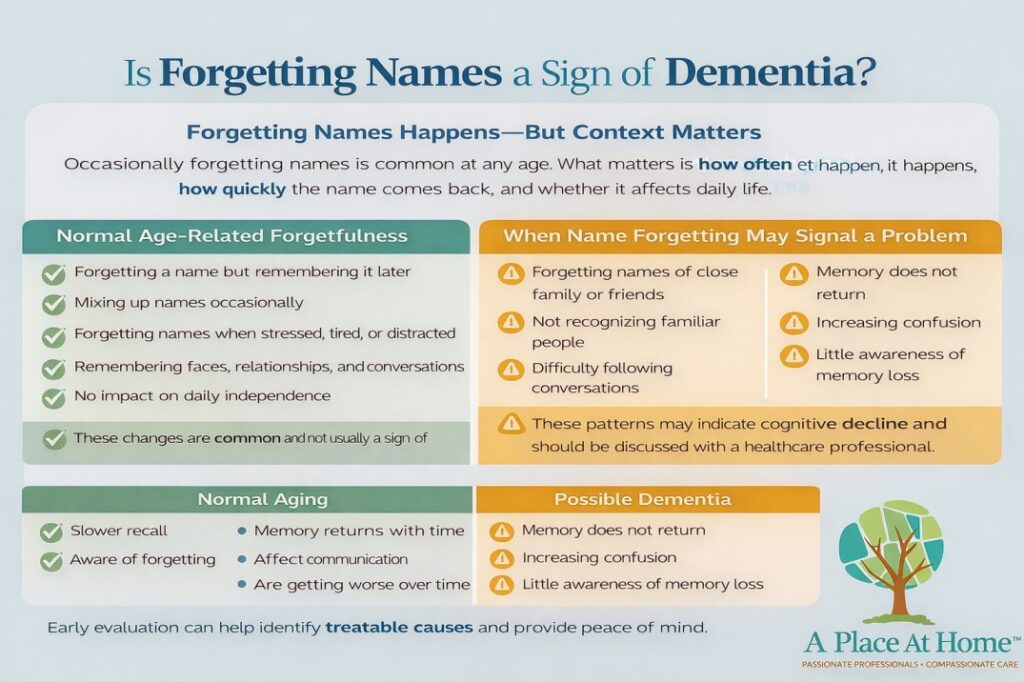
Read: Is Forgetting Names a Sign of Dementia?
Working With a Home Care Agency
An established agency may manage caregiver recruitment, screening, training, scheduling, supervision, payroll, and replacement coverage.
Before choosing an agency, ask what is included and how caregivers are matched with clients who have dementia.
When Should a Family Consider In-Home Dementia Care?
It may be time to speak with a home care provider when your loved one:
- Forgets meals or medications
- Has difficulty bathing or dressing
- Experiences falls or near-falls
- Becomes confused when left alone
- Wanders or attempts to leave home
- No longer prepares food safely
- Has increased nighttime confusion
- Withdraws from familiar activities
- Needs more supervision after hospitalization
- Requires more support than the family can consistently provide
Family caregiver exhaustion is also an important reason to seek help. Respite care can provide time to work, rest, attend appointments, or spend time with other family members.
Dementia Home Care in Summerlin and the Las Vegas Area
A Place At Home – Summerlin provides personalized in-home senior care and dementia support for families in Summerlin and surrounding areas of the Las Vegas Valley.
Care may be available for families in communities such as:
- Summerlin
- Sun City Summerlin
- Summerlin South
- The Lakes
- Peccole Ranch
- Desert Shores
- Spring Valley
- Queensridge
- Canyon Gate
- Centennial Hills
- Western Las Vegas
- Nearby Clark County communities
Service availability can vary by address and caregiver scheduling. Contact the local team to confirm whether care is available in your neighborhood.
Get Help Finding Dementia Care in Summerlin, NV
You do not have to manage every stage of dementia care alone.
A Place At Home – Summerlin works with families to create personalized care plans based on each senior’s routine, abilities, safety concerns, and preferred schedule. Support may include companionship, personal care, meal preparation, medication reminders, safety monitoring, respite care, and assistance with daily activities.
Whether your loved one needs occasional support, daily dementia care, overnight supervision, or a more consistent caregiving schedule, the first step is a conversation about what is happening at home.
Call A Place At Home – Summerlin at (702) 903-2985 to schedule a free consultation and discuss in-home dementia care for your loved one.
A Place At Home’s Summerlin location promotes personalized in-home senior care, dementia support, companion care, free assessments, and specialized Alzheimer’s and dementia care.