

When an aging parent begins needing more help at home, many families face the same question: Should we hire one private caregiver directly, or work with a professional home care agency?
For families in River Oaks, West University, Upper Kirby, Montrose, Highland Village, Afton Oaks, and nearby Houston Inner Loop neighborhoods, the answer often depends on more than hourly cost. You may be balancing a demanding career, frequent travel, siblings who live in different cities, medical appointments throughout the Texas Medical Center, household staff, and a parent who is determined to remain in the home they love. In that situation, the real question becomes:
Who will manage everything when you cannot?
Hiring one caregiver privately can offer familiarity and flexibility. Working with a home care agency can provide broader oversight, backup staffing, caregiver screening, scheduling support, and a care plan that can expand as needs change. Neither choice is automatically right for every family. Understanding the differences can help you make a more informed decision before a care situation becomes urgent.
Key Takeaways
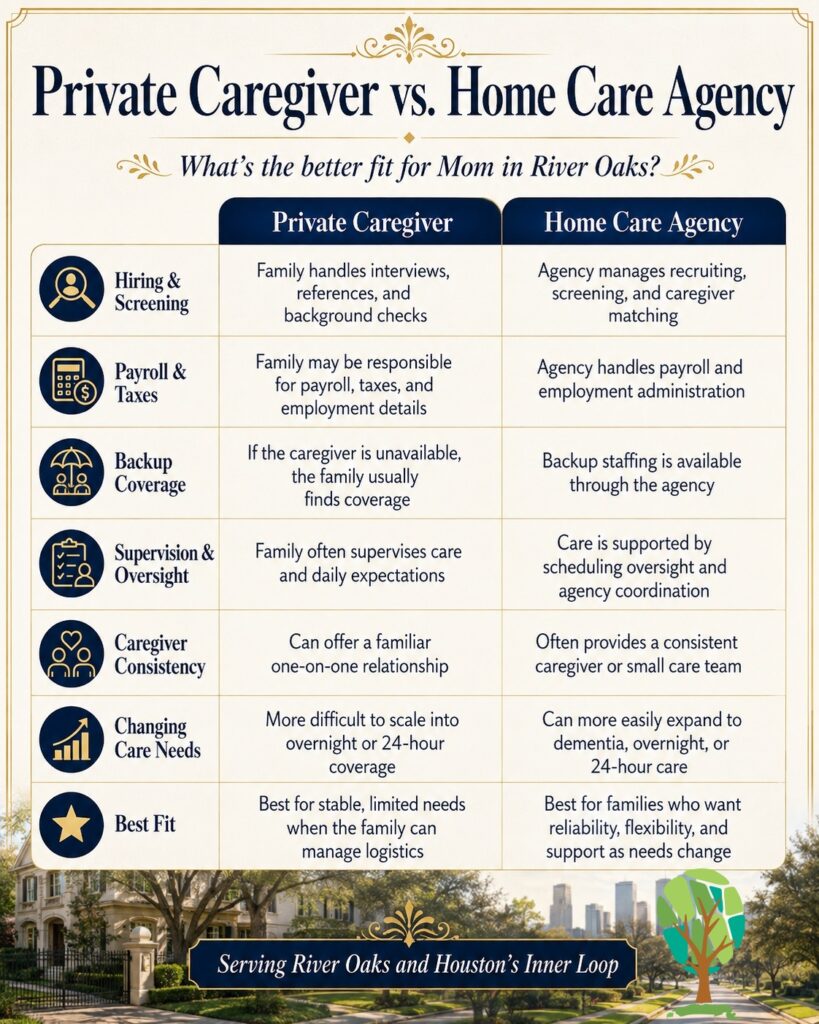
- Hiring a private caregiver directly may offer flexibility and a close one-on-one relationship, but the family usually takes on more responsibility for hiring, payroll, scheduling, backup care, and supervision.
- A home care agency generally manages caregiver screening, staffing, scheduling, supervision, and replacement coverage.
- Families hiring an individual caregiver directly may also have household-employer tax responsibilities depending on the working arrangement. The IRS notes that in-home caregivers are commonly household employees when the person receiving care controls what work is performed and how it is done.
- Texas regulates Home and Community Support Services Agencies through the Texas Health and Human Services Commission.
- For families needing overnight, dementia, Parkinson’s, post-hospital, or 24-hour care, the ability to provide reliable backup coverage can become especially important.
What Does Hiring a Private Caregiver Mean?
A private caregiver is someone your family hires directly rather than receiving through a home care agency. Families may find caregivers through personal referrals, friends, neighborhood groups, online listings, physicians, senior communities, or recommendations from other families. The appeal is understandable.
Your parent may develop a strong relationship with one caregiver. You may be able to negotiate the schedule directly. And because there is no agency managing the arrangement, the hourly rate may sometimes appear lower. For a relatively independent senior who needs limited help a few times per week, that arrangement can work well.
The important thing to understand is that when you hire someone directly, your family may effectively become the employer and care manager.
That can mean responsibility for:
- Interviewing candidates
- Checking references
- Running appropriate background checks
- Determining employment classification
- Handling payroll and applicable taxes
- Creating the work schedule
- Arranging coverage when the caregiver is sick or takes vacation
- Addressing performance or attendance problems
- Finding a replacement if the caregiver leaves
- Supervising changes in the care routine
- Communicating expectations among siblings and other family members
The IRS states that a person hired to perform household work may be considered a household employee when the family controls both the work being performed and how that work is performed. In-home caregivers frequently fall into this category.
Texas also has unemployment-tax rules that can apply to domestic employment, making payroll and tax responsibilities something families should evaluate carefully with an appropriate tax professional.

What Does a Home Care Agency Handle?
When you work with a home care agency, you are generally purchasing more than an individual caregiver’s time. You are also paying for the infrastructure around the care.
A professional agency may manage:
- Caregiver recruiting and screening
- Background checks
- Training
- Payroll
- Scheduling
- Caregiver matching
- Supervisory oversight
- Backup staffing
- Family communication
- Care-plan updates
- Escalation when needs change
In Texas, Home and Community Support Services Agencies are licensed and regulated by Texas Health and Human Services.
For a busy adult child, that distinction can be significant. Instead of personally finding someone to cover a Saturday night shift when the regular caregiver calls in sick, you have a team responsible for trying to maintain coverage. Instead of beginning another caregiver search when Mom’s needs change, the agency may be able to adjust the schedule or introduce caregivers with different experience.
For families managing complex lives, the value often comes from delegating the care logistics as much as from the caregiving itself.
What Happens If the Private Caregiver Calls Off?
This is one of the most important questions to ask before hiring anyone. Imagine your mother lives alone in River Oaks and now needs help transferring safely out of bed each morning. Her private caregiver is scheduled Monday through Friday. At 6:15 a.m. on Tuesday, the caregiver texts that she is sick. Who goes to Mom’s house? If you live ten minutes away and have a flexible schedule, you may be able to step in.
But what if you are:
- Already at work in the Texas Medical Center
- Flying to New York for business
- In court all morning
- Managing children of your own
- Living in Dallas, Austin, or another state
With one private caregiver, the family is typically responsible for arranging the backup.
A home care agency operates differently because there is usually a larger pool of caregivers and centralized scheduling. No agency can promise that every staffing situation will be effortless, but a formal backup process can significantly reduce how often the family has to solve coverage problems personally.
For many Inner Loop families, reliability matters more than finding the lowest possible hourly rate.

Which Option Provides More Caregiver Consistency?
This is where private caregivers can have an advantage. If you hire one excellent caregiver privately and the arrangement works for several years, your parent may benefit from seeing the exact same person every day. That familiarity can be valuable, particularly for someone with dementia.
But there is another side to consistency. If everything depends on one person, that individual can become a single point of failure.
What happens if the caregiver:
- Moves away
- Becomes ill
- Needs extended leave
- Retires
- Changes careers
- Can no longer work the hours your parent requires
With an agency, families may have a primary caregiver or small care team rather than one individual carrying the entire responsibility. For a senior with Alzheimer’s, Parkinson’s, or complex mobility needs, a small consistent team can offer familiarity while also making backup coverage more practical.
What If Mom Eventually Needs 24-Hour Care?
This question is particularly important when your family’s long-term goal is aging in place. Your parent may only need four hours of companion care today. In a year, she may need eight hours. Later, she may need overnight care. Eventually, she may require someone awake and available 24 hours a day.
One private caregiver cannot safely provide continuous care around the clock. The family would need to recruit, schedule, supervise, and retain multiple caregivers across multiple shifts. At that point, you are effectively operating your own small staffing operation.
A home care agency is already structured around scheduling multiple caregivers and adjusting coverage as the level of care changes.
That can make the transition from:
Companion care → personal care → overnight care → 24-hour care
much easier to manage.

What About Alzheimer’s, Dementia, or Parkinson’s Care?
Specialized conditions create another consideration. A wonderful companion is not automatically the right caregiver for every stage of dementia or Parkinson’s disease.
As conditions progress, your loved one may experience:
- Wandering
- Sundowning
- Freezing episodes
- Increased fall risk
- Difficulty transferring
- Changes in communication
- Toileting needs
- Nighttime confusion
- Behavioral changes
- Greater dependence with personal care
Families should ask what training and experience a caregiver has with the specific challenges their loved one faces.
With a private caregiver, your family is responsible for evaluating those qualifications and deciding when a different skill set may be necessary.
An agency can potentially match caregivers based on changing needs and adjust the care team as the condition progresses.
Who Handles Payroll and Taxes With a Private Caregiver?
This issue surprises many families. Paying someone directly does not automatically make that caregiver an independent contractor. The IRS explains that if you hire a person to perform household work and you control not only what work is done but how the work is performed, that worker may be your household employee even if the person works part-time or was initially found through a referral list. Caregivers providing in-home services to older or disabled individuals are commonly treated as employees under these rules.
That may create responsibilities involving:
- Payroll records
- Social Security and Medicare taxes
- Federal household employment requirements
- State unemployment requirements
- Tax forms and reporting
Texas Workforce Commission guidance also addresses domestic employment and unemployment-tax reporting requirements. Families considering a direct-hire arrangement should speak with a qualified tax or employment professional about their specific situation rather than assuming they can simply pay the caregiver as a contractor.
When you use an agency that employs its caregivers, the agency generally handles its own payroll and employment responsibilities.

What About Insurance and Liability?
Liability is another area that deserves attention. Families should understand what happens if a caregiver is injured while working in the home or if property is damaged.
Texas does not require most private employers to carry workers’ compensation insurance, although employers may choose to carry coverage. That does not mean families should ignore risk. If you are directly hiring someone who will assist with transfers, bathing, mobility, transportation, or other physically demanding tasks, discuss insurance and liability exposure with your insurance professional or attorney.
When comparing home care agencies, ask:
- Are caregivers employees?
- Is the agency insured?
- What insurance coverage is carried?
- Are caregivers bonded where applicable?
- What happens if someone is injured?
- How are incidents handled?
For families living in high-value River Oaks residences, these questions may be particularly important.
What About Privacy and Discretion?
Inviting a caregiver into a private home is personal. For some River Oaks and Inner Loop families, the caregiver may also be working around:
- Household managers
- Housekeepers
- Private drivers
- Personal assistants
- Building concierges
- Doormen
- Security staff
- Visiting healthcare professionals
Families may have additional concerns about discretion, privacy, property access, alarm systems, keys, building credentials, and information shared about the senior.
Whether you choose an individual or an agency, discuss expectations clearly.
With a home care agency, ask specifically how privacy is addressed and how caregivers are prepared to work professionally within private residences or high-rise environments.
Could a Private Caregiver Be the Better Choice?
Yes. A private caregiver can be an excellent option when:
- Your parent needs a limited and predictable schedule
- You have found someone you know and trust
- A family member is available to supervise the arrangement
- You have reliable backup options
- You are comfortable handling employment and payroll responsibilities
- Your parent’s needs are relatively stable
- You do not anticipate quickly moving into overnight or 24-hour care
The purpose of comparing these options is not to suggest that private caregivers provide inferior care. Many are exceptional.
The issue is who manages everything around the caregiver.

When Does an Agency Make More Sense?
A home care agency may be the more practical choice when:
- Family members have demanding careers
- Adult children live outside Houston
- The senior cannot safely be left alone
- Care is needed seven days per week
- Backup coverage is important
- Dementia or Parkinson’s symptoms are progressing
- Overnight support may soon be needed
- The family anticipates eventually needing 24-hour care
- Multiple relatives need regular updates
- The caregiver must coordinate with household or building staff
- The senior is returning home after hospitalization or rehabilitation
For these families, the agency structure can reduce the amount of care management that falls directly on the adult children.
What About Post-Hospital Care?
A hospital discharge is often the moment when families realize one caregiver may not be enough. Suppose Mom has a hip replacement at Houston Methodist or receives treatment at Memorial Hermann, Baylor St. Luke’s, MD Anderson, or another Texas Medical Center provider.
She is ready to return home to River Oaks, but she now needs help with:
- Transportation home
- Getting safely into the house
- Toileting
- Meals
- Medication reminders
- Mobility
- Follow-up appointments
- Physical therapy
- Overnight bathroom trips
That may initially require much more support than she needed before hospitalization. An agency can potentially increase care during the post-acute period and reduce hours later as recovery progresses. That flexibility can be especially useful when families do not yet know what Mom’s needs will look like two weeks after discharge.
What Questions Should We Ask Before Hiring a Private Caregiver?
If you are considering a direct hire, ask:
- What experience do you have with my parent’s specific needs?
- Can you provide professional references?
- Are you comfortable with personal care and transfers?
- What happens if you are sick or unavailable?
- Are you willing to undergo a background check?
- Do you have reliable transportation?
- What schedule can you consistently maintain?
- Are you comfortable working with household or building staff?
- How would you communicate changes in my parent’s condition?
- What are your expectations regarding employment status, payroll, and taxes?
Do not wait until the first emergency to answer these questions.
What Questions Should We Ask a Home Care Agency?
Families comparing agencies should ask equally detailed questions:
- Are your caregivers employees?
- What screening and background checks do you perform?
- How are caregivers trained?
- How do you match caregivers with clients?
- What happens when our regular caregiver calls off?
- Can we have a consistent caregiver or small care team?
- Is overnight or 24-hour care available?
- How quickly can care hours be increased?
- How are family members kept informed?
- Can caregivers work with concierges or household staff?
- Can you support a transition home after hospitalization?
- Who do we call after normal business hours?
The answers should tell you whether you are simply buying caregiver hours or gaining a broader care-support system.
What Is the Best Choice for a River Oaks Family?
Think beyond what Mom needs this week. Ask what your family needs from the arrangement six months or a year from now. If the situation is straightforward and you have time to manage the details, a private caregiver may work very well.
If your goal is to delegate scheduling, staffing, screening, backup coverage, and ongoing care coordination – particularly as needs become more complex – an agency may offer greater flexibility and peace of mind. For many busy adult children, the deciding factor is not whether one option costs slightly more per hour.
It is this: When something changes at 9 p.m. on Sunday, who is responsible for solving it?
That answer often clarifies which model best fits your family.
Finding Home Care in River Oaks and Houston’s Inner Loop
A Place At Home River Oaks provides personalized home care for seniors throughout River Oaks, West University, Upper Kirby, Montrose, Highland Village, Afton Oaks, Rice Village, and nearby Houston Inner Loop neighborhoods.
Care can begin with personal assistance, transportation, companionship, or a few scheduled visits and expand to dementia care, Parkinson’s support, overnight care, post-hospital assistance, live-in care, or coordinated 24-hour coverage as needs change.
Schedule a Private Home Care Consultation
If you are deciding between hiring a private caregiver and working with a home care agency, start by understanding exactly what your loved one needs—and how much responsibility your family realistically wants to manage.
A Place At Home River Oaks can meet with your family, assess your loved one’s routines, mobility, home environment, and current level of support, and help you determine an appropriate care plan.
Call A Place At Home River Oaks at (346) 590-6071 to schedule a complimentary in-home consultation and learn more about senior home care in River Oaks and Houston’s Inner Loop.

Frequently Asked Questions
Is hiring a private caregiver cheaper than using a home care agency?
A private caregiver may quote a lower hourly rate, but families should also consider payroll obligations, taxes, screening, backup care, supervision, insurance considerations, and the time required to manage the arrangement. The lowest hourly rate is not always the lowest overall burden.
Who pays taxes when a family hires a caregiver directly?
Depending on the working relationship, a directly hired caregiver may be considered a household employee. The IRS states that household-employer rules may apply when the family controls what work is performed and how it is done. Families should consult a qualified tax professional about their specific arrangement.
What happens if a private caregiver cannot come to work?
Unless the family has independently arranged backup caregivers, the family is usually responsible for finding replacement coverage. Agencies typically maintain a broader caregiver pool and scheduling process for staffing changes.
Can a home care agency provide the same caregiver consistently?
Many agencies try to provide a consistent caregiver or small care team whenever possible. Families should ask how caregiver matching, continuity, and backup coverage are handled before beginning services.
Is a home care agency better for 24-hour care?
An agency can be particularly useful when multiple caregivers are required to maintain continuous coverage because the agency manages schedules, shift changes, caregiver matching, and backup staffing. This can reduce the logistical burden on the family.